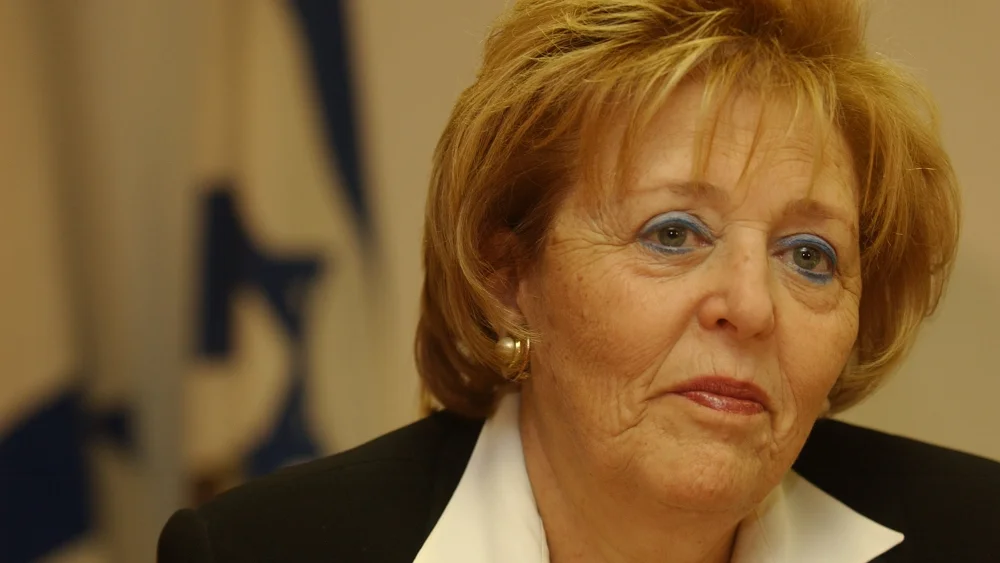
Former Israeli Supreme Court Justice and State Attorney Edna Arbel, one of Israel’s most prominent legal figures, died on Wednesday at the age of 82.
Arbel served as Israel’s state attorney from 1996 to 2004 before being appointed to the Supreme Court, where she served for a decade until her retirement in 2014. Over a public career spanning more than 40 years, she played key roles in some of Israel’s most significant legal and judicial proceedings.
Born in Jerusalem in 1944, Arbel studied law at the Hebrew University of Jerusalem and began her legal career as a criminal defense attorney in Tel Aviv before joining the State Attorney’s Office in the early 1970s.
She was appointed Central District prosecutor in 1984 and became a judge on the Tel Aviv District Court four years later. In 1996, she succeeded Dorit Beinisch as state attorney, overseeing a substantial expansion of the prosecution service before joining the Supreme Court in May 2004.
During her career, Arbel also served as the prosecution’s representative on the commission that investigated the 1982 Sabra and Shatila massacre in Lebanon, acted as the public prosecutor in disciplinary proceedings involving Mossad and Shin Bet personnel, and represented the attorney general on the committee examining the Bus 300 affair.
As state attorney and later as a Supreme Court justice, Arbel became one of Israel’s most influential—and controversial—legal figures.
Admired by supporters for her commitment to the rule of law and human rights, she was criticized by conservatives and many on the political right for embracing the activist judicial philosophy associated with then-Supreme Court President Aharon Barak and for backing criminal investigations of elected officials, including recommendations to indict prime ministers Benjamin Netanyahu and Ariel Sharon that were not accepted by the attorney general at the time.
In her farewell address to the Supreme Court, where she served for a decade until retiring on June 22, 2014, upon reaching the mandatory retirement age, Arbel said that every case before her centered on the dignity of the individual.
“Human dignity was a sacred value for me, whether the matter concerned the high and mighty or the poorest among us,” she said. “Victim, complainant, defendant, witness, litigant or petitioner, I always tried to see the person standing before me.
“I end my judicial path with the belief that I acted according to my professional conviction and moral outlook, while remaining faithful to the state and its laws, and that I fulfilled my oath.”
In one of her final rulings, Arbel wrote that foreign workers in Israel could not be treated as “hewers of wood and drawers of water” while their basic needs were neglected. She instructed the government to formulate regulations improving healthcare arrangements for long-term foreign caregivers.
President Isaac Herzog paid tribute to Arbel, saying she had served the country with “a profound sense of mission, responsibility and commitment to the State of Israel and the rule of law.”
“Throughout her path, Justice Arbel left a significant mark on the legal system, believing that behind every case and every decision stands first and foremost a person, and acting out of deep commitment to justice, human dignity and the values of public service,” Herzog said in a statement issued with his wife, Michal Herzog.
“Michal and I send a strong embrace to her daughters, her family members, her friends and all those who admired her. May her memory be blessed.”
Arbel is survived by her husband, Uri, and their three daughters.