


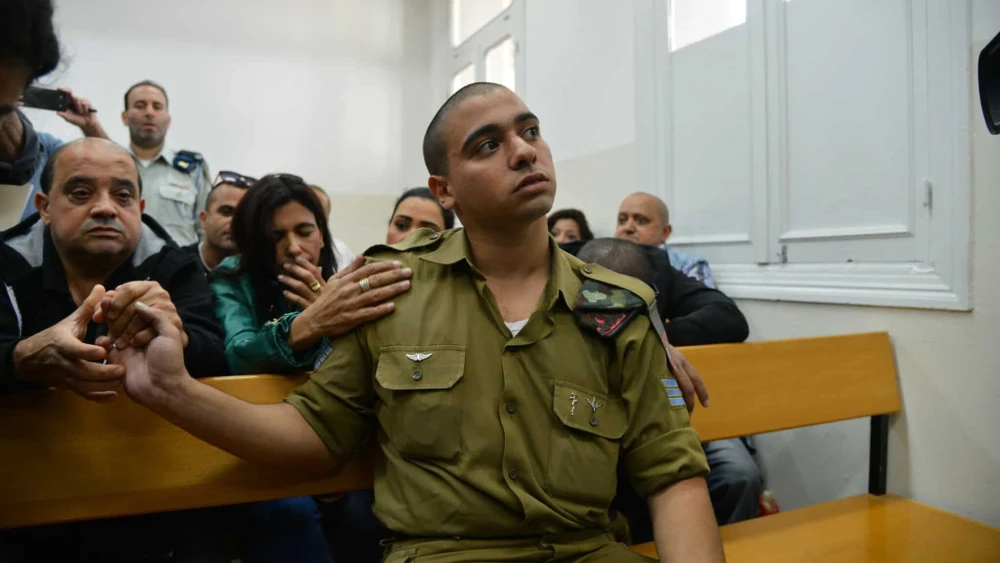
Israeli President Isaac Herzog on Saturday night pardoned former Israel Defense Forces soldier Elor Azaria, nearly a decade after he was convicted of manslaughter for fatally shooting a wounded Palestinian assailant in Hebron.
The pardon effectively expunges Azaria’s criminal record, which otherwise was set to be cleared in 2032.
The case dates to March 24, 2016, when Abdel Fattah al-Sharif and Ramzi Aziz al-Tamimi al-Qasrawi stabbed an Israeli soldier in Hebron. Al-Qasrawi was killed during the attack, while al-Sharif was wounded. Azaria, then a Kfir Brigade combat medic who arrived with reinforcements, shot al-Sharif in the head at close range after he appeared to have been subdued.
Herzog acted on the recommendation of Defense Minister Israel Katz, who welcomed the decision as “right, humane and appropriate” ahead of Yom Kippur. Katz said Azaria had served his sentence and “paid a heavy personal and family price,” adding that it was time to allow him “to leave the past behind, rehabilitate his life and build his future.
“The granting of clemency sends an important message to IDF soldiers and their families: We do not abandon our fighters and do not leave them behind,” Katz said.
Israeli National Security Minister Itamar Ben-Gvir also praised the move, saying that as someone who demonstrated in support of Azaria a decade ago, the decision was “very moving and joyful” for him. He called on the IDF chief of staff to allow Azaria to return to military service if he wishes.
“The record should not have existed in the first place,” Ben-Gvir said. “Elor, the people of Israel love you and stand by you.”
The President’s Residence in Jerusalem said Herzog based his decision on the time that had passed since the case, Azaria’s completion of his sentence, changes in his personal and family circumstances, and his desire to remove employment barriers and “open a new page in his life.”
Herzog’s office said Azaria had expressed regret over the consequences of the affair and, in an earlier pardon request to then-President Reuven Rivlin, described the shooting in hindsight as an “operational mistake” that he would not repeat.
A military court convicted Azaria of manslaughter in 2017 and sentenced him to 18 months in prison. Then-IDF Chief of Staff Lt. Gen. Gadi Eisenkot reduced the sentence to 14 months, and a military parole board later cut it further. Azaria was released in May 2018 after serving nine months in prison.
Herzog said that his decision did not reopen or undermine the military court proceedings, saying the clemency process was “not an appeals court” and did not amount to a reassessment of the conviction.
The case remained a national flash point in Israel for years, with the investigation, trial, sentencing and subsequent clemency efforts drawing intense public and political scrutiny. It became one of the country’s most divisive military cases, reflecting a broader debate, often along right-left lines, over military ethics, rules of engagement and how Israeli soldiers should respond to Palestinian attacks.



