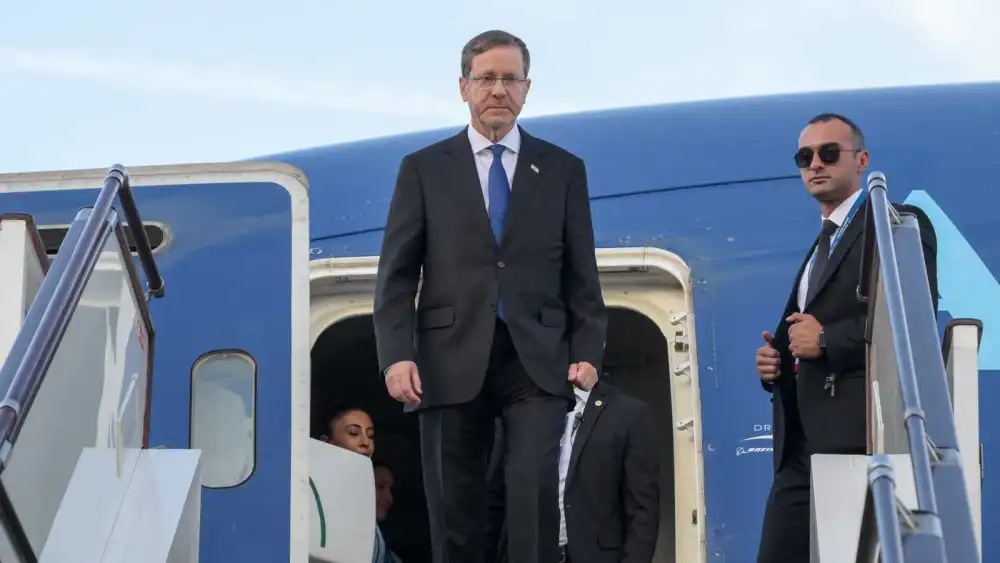
Israeli President Isaac Herzog on Thursday attended a pan-Asian conference in Azerbaijan, where he underlined the Jewish state’s openness to cooperation with allies amid terrorism and boycott attempts.
“I say to all neighboring countries, to all nations in this region and in Asia, that Israel desires and strives to enhance collaboration and to broaden the circle of peace. But peace cannot exist with terror, and cooperation cannot thrive with boycotts,” said Herzog at the 7th Summit of the Conference on Interaction and Confidence Building Measures in Asia (CICA) in Baku.
Several delegations walked out as Herzog began speaking, Turkish media reported. Turkish Foreign Minister Hakan Fidan was among those who left, as were the delegations from Iran, Kuwait and Pakistan, according to Daily Sabah.
“It is most fitting that we come together in Azerbaijan, a nation that is truly synonymous with impressive regional partnership, tolerance, and confidence-building measures,” Herzog said. Under Azerbaijani President Ilham Aliyev’s “wise leadership, Azerbaijan has become a paragon of stability, enjoying incredible economic growth and forging ties with nations across the region,” he continued.
The Abraham Accords, he added, “demonstrate how converging interests can transform political realities.”
Bahraini Foreign Minister Abdullatif bin Rashid Al Zayan, whose country is a signatory of the Abraham Accords, was also at the conference, and met with Herzog to discuss strengthening the agreements and expanding regional peace and cooperation, according to Herzog’s office.
According to his office, Herzog emphasized the importance Israel attaches to its relations with Bahrain and praised the leadership of King Hamad bin Isa Al Khalifa and the Bahraini government. He also conveyed his best wishes to the king and the Bahraini people.
Herzog also spoke on the conference’s sidelines with Chinese Foreign Minister Wang Yi, according to his office. “The meeting focused on the bilateral relations between the two countries and the situation in the Middle East. President Herzog expressed his appreciation for the importance of the bilateral relations between the countries, with an emphasis on economic, trade, and cultural ties, among other areas,” read the statement.
Another conference sideline meeting was with the president of Kazakhstan, Kassym-Jomart Tokayev, who had hosted Herzog on a state visit in April. That meeting was “to discuss the prospects for strengthening bilateral cooperation with a focus on trade, investment and economic ties,” said Tokayev’s office.
Azerbaijan, a predominantly Muslim country bordering Iran, maintains close military and energy ties with Israel, supplying the Jewish state with a significant share of its crude oil imports.
Rabbi Zamir Isayev, the chief Sephardic rabbi of Azerbaijan, described that country as “a middle power with its own national interests and an independent, multi-vector foreign policy.” He added that Azerbaijan “maintains strong relations with different sides and serves as a platform for dialogue between those who cannot communicate directly. Even before the Abraham Accords, Israeli and Arab diplomats met in Baku. President Herzog’s visit reflects Azerbaijan’s growing diplomatic importance and its significance to both Israel and the Arab world,” Isayev told JNS.