
For three and a half years after he died, the Israeli public was not permitted to know his name. He was simply “Lt. Col. M.,” an officer whose service to the state was so secret that, even in death, his identity remained classified. Only in May 2022 was his name finally made public: Lt. Col. Mahmoud Kheir El-Din, a Druze officer killed during an undercover operation in Gaza, whose courage helped protect the men serving alongside him.
Recently, at a Jerusalem hotel, our IDF Widows and Orphans USA delegation, which was deliberately scheduled to coincide with the week of the Oct. 7 anniversary, met with two people who had always known the man behind that name: his wife Nahed and their younger son. They had driven three hours from their village in the north to be with us. They spoke less about how El-Din died than about how he lived and what life had been like for the family he left behind.
They were among several widows and bereaved children we met during our visit.
Since Oct. 7, 2023, more than 400 widows and 1,000 children have joined our community, alongside thousands of families whose losses reach back through earlier wars. No delegation could encompass those experiences. But the families we met reflected something of Israel itself: religious and secular, from different communities and different walks of life, united by a loss none had chosen.
All of their stories should be known. All of their loved ones should be remembered.
For American Jews, that responsibility includes making room in our understanding of Israel for families whose faith is different from our own, but whose sacrifice is inseparable from the country we love.
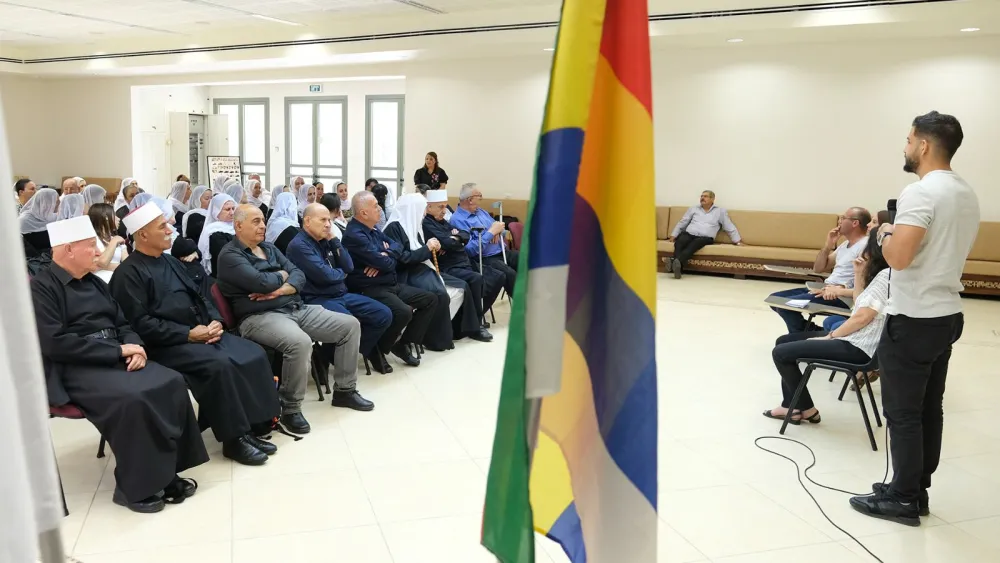
A September report put the number of Druze who have fallen in Israel’s wars at 451. A higher percentage of Druze men living in Israel, outside the Golan Heights, serve in the Israel Defense Forces than Jewish men do. In the Golan, the number of Druze serving is also beginning to catch up with the rest of the Druze community. Behind those numbers are generations of families who have answered the demands of service and carried its consequences.
We owe the Druze community a gratitude that is informed, personal and enduring. We should know the names of the fallen and something about the lives they led. We should know the families who continue living with their absence. An expression of appreciation at a memorial ceremony matters. So does remembering a child years later, when the ceremony is over, and another milestone arrives without a father.
Doing that well requires listening. Shared loss does not mean identical experiences of mourning. Druze belief in reincarnation has traditionally shaped burial customs and attitudes towards death, including the role of individual graveside visits. Military commemoration has also influenced how many Druze families remember their fallen soldiers. We should approach those differences with curiosity and respect, never with assumptions about the depth of another family’s grief.
We owe the Druze community a gratitude that is informed, personal and enduring.
Nahed’s experience also reveals the complexity of rebuilding a life within a close-knit community. Speaking publicly about her decision to remarry, she described many voices of encouragement, alongside some who reacted with anger. She spoke with pride about being Druze and about the values of her community, even as she sought room within it for her own needs and hopes. Remaining part of that community mattered deeply to her.
There is something in that experience that reaches beyond any one tradition. We ask bereaved spouses to preserve a memory while somehow finding the strength to build a future. We should give them the freedom and support to do both. A woman can love the husband she lost and seek happiness again. A child can welcome new people into his life while continuing to miss his father.
Perhaps the most revealing moment of our meeting came from Nahed’s son.
He explained that he had been asked to draw his circles of trust: The people upon whom he knew he could rely. In the first circle were his mother and brother. In the second were the other IDF orphans with whom he attends camp and had traveled to the United States that summer on a B’nei Mitzvah trip. In the third were extended family and community.
I remembered him from that trip, dancing with children wearing kippahs at a UJA-Federation gathering in New York City. At the time, I had seen children enjoying themselves together. Sitting across from him in Jerusalem, I understood more fully what those friendships meant.
Among those children, he did not need to explain what it was like to grow up without his father. There was room to talk about memories becoming harder to hold on to, or the complicated feelings surrounding a mother’s decision to remarry. There was also room to laugh, to dance and to be a child.
They belonged to a group none would ever have chosen to join. Yet within it, they had found people they could trust with parts of themselves that others might struggle to understand.
It is easy to measure support in camps, trips and gatherings. But this boy’s circles of trust showed what that support can mean: The children he met had become people he could depend on.
His father had served alongside Jewish soldiers, sharing responsibility for their safety. Years after his death, his son had found belonging alongside their children and the children of others who had fallen. That connection deserves our care.
For years, Israel could honor Mahmoud Kheir El-Din only by an initial. Now we can say his name. Our gratitude to him, in addition to the Druze community whose sacrifice he represents, must also be expressed in the lives of those who remain.
His son has drawn his circles of trust. The responsibility before us is to be worthy of a place in them.