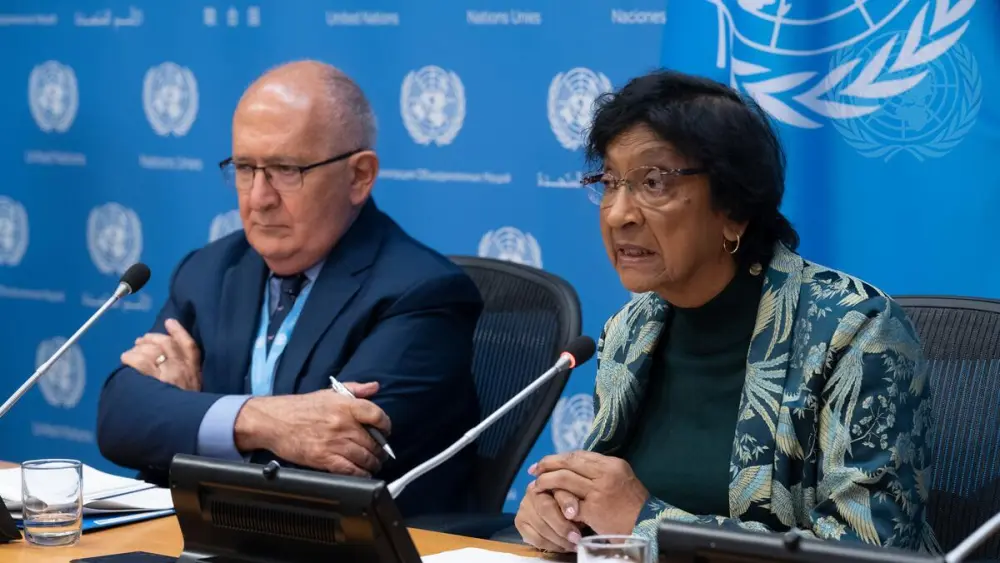
Chris Sidoti, a member of the United Nations Commission of Inquiry on Israel and the Palestinians, admitted last week that the U.N. panel reported that Israel intended to commit “genocide” in Gaza even though the commission never collected direct evidence to that effect.
The Australian jurist made the statement during a public debate with American military law expert Brian Cox at Caulfield Hebrew Congregation, an Orthodox synagogue in Melbourne.
Proving genocidal intent is “a very, very high test,” which is “higher than the criminal standard of beyond reasonable doubt,” Sidoti said at the event.
The U.N. panel member told attendees that “if we accept that the goal of the Israeli authorities in Gaza has been the destruction of Hamas, that does not preclude the possibility of genocide being the strategy by which their goal is going to be attained.”
Even if Israel aimed to destroy Hamas, it could still be using “genocide” as a strategy to that end, he claimed.
The U.N. panel’s conclusion that Israel was guilty of “genocide”—a charge which the Jewish state has repeatedly denied—was based on evidence on “reasonable grounds,” which is “not a high standard,” Sidoti said.
“We are not a court,” he told attendees. “We are not even prosecutors. We are an investigative body.”
The Genocide Convention requires specific intent, or dolus specialis in Latin, to destroy a group at least in part for a finding of genocide.
Navi Pillay, an anti-Israel activist and former chair of the commission who won a Nobel Prize last week, told a German newspaper that the panel “essentially worked like a court” with “all the instruments of the separation of powers.”
“Every fact was verified by us,” she told the paper.
The U.N. panel has said the International Court of Justice, the principal judicial arm of the global body which is based in The Hague, “put all States on notice of the plausibility of the State of Israel committing genocide.”
Cox played an audio clip of a former president of the court, Joan Donoghue, who said in a television interview that the court, which she led at the time, never ruled that the claim of “genocide” against Israel was plausible.
“Our paragraph is entirely consistent with then-President Donoghue’s comments,” Sidoti told attendees.
Sidoti said at the event that the panel does “not come to conclusions unless we ourselves have conducted an investigation.”
An audience member suggested otherwise.
The attendee noted that the U.N. panel claimed that 83% of Gazans killed in the war were civilians, which the commission took as evidence that Israel targets Palestinian civilians “deliberately.”
The 83% statistic has been debunked widely. The audience member asked Sidoti whether the commission independently verified it.
“No. We didn’t, because we don’t have that information,” Sidoti said. “We literally don’t know, nor does the IDF know.”