


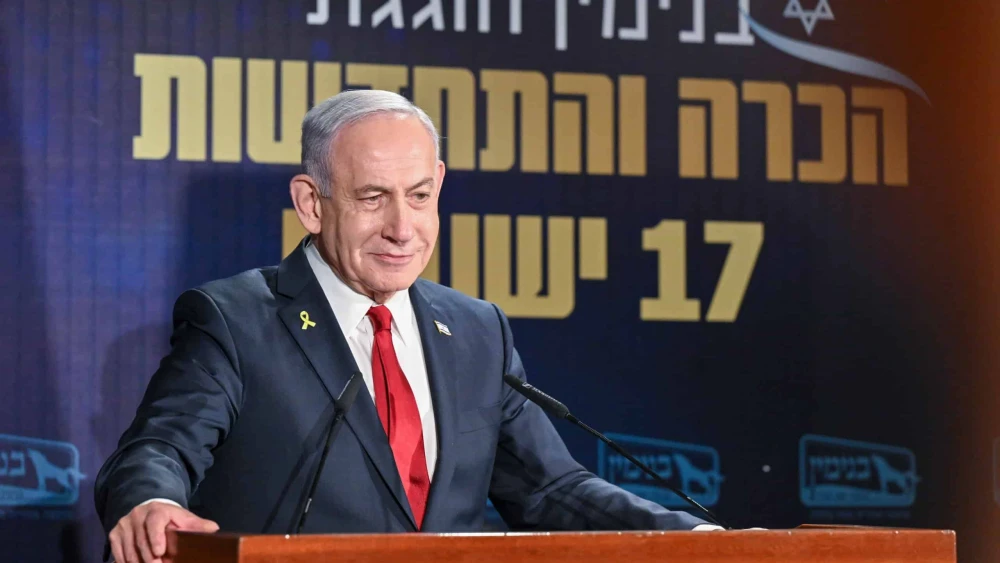
Israeli Prime Minister Benjamin Netanyahu said on Saturday that there is “no room for two states” between the Mediterranean Sea and the Jordan River, arguing the war created broad public consensus against creating a Palestinian state.
“Before the war, the public was divided: although in my opinion most of the public was against it, a significant portion was in favor. I think that has changed,” Netanyahu told reporters, answering a question at a press conference in Jerusalem on Saturday night.
“That is a basis for agreement,” added the premier. “In my opinion, there is much more unity among the public than you see in the Knesset.”
Netanyahu was responding to a question from Israel Hayom about the principles on which he would seek to form his next government if he wins another term in the general election this fall.
Before the Oct. 7, 2023, massacre that sparked the current multi-front war, 69% of Israelis opposed the establishment of another Palestinian state beyond the one in Gaza. This opposition surged to 79% in the aftermath of the attacks, according to polling data published by the Jerusalem Center for Security and Foreign Affairs in May.
On Feb. 21, 2024, the Knesset voted 99-11 to reject unilateral recognition of Palestinian statehood. All coalition members and most lawmakers from Zionist opposition parties voted against “international diktats regarding a permanent settlement with the Palestinians.”
In July 2025, a majority of 71 out of 120 Knesset members from the coalition and opposition passed a non-binding resolution in favor of applying Jerusalem’s sovereignty to Judea, Samaria and the Jordan Valley.



