


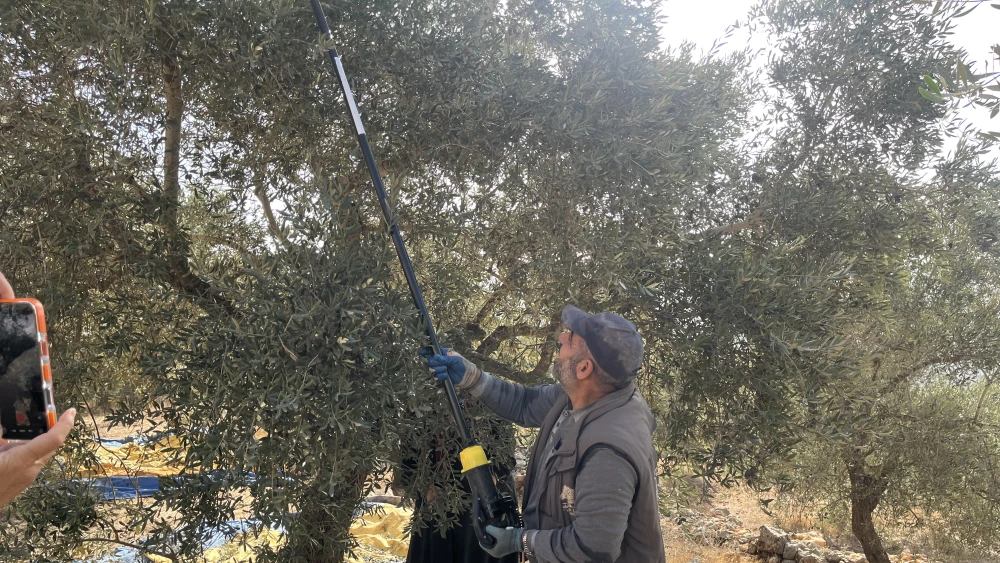
Despite perceptions that this year’s Palestinian olive harvest in Judea and Samaria has been marred by widespread violence, a senior Israel Defense Forces official overseeing the operation said approximately 98% of the harvest areas have been peaceful.
According to the official, only 2% of the areas where Palestinians are harvesting olives are considered potential friction zones, with an even smaller percentage experiencing actual confrontations between Jewish and Arab residents during the current six-week autumn harvest season.
The IDF Spokesperson’s Unit organized a tour and briefing for foreign journalists on Tuesday to provide a firsthand look at the situation on the ground and highlight the military’s efforts to prevent clashes and ensure the harvest proceeds safely.
The goal, the official explained, is to “protect the harvest,” particularly in the 2% of areas where tensions are more likely, from anyone—whether Jewish, Arab or anarchists from abroad posing as humanitarians—who might seek to disrupt it.
Protecting the harvest
The first stop on the tour, considered a potential conflict zone, was a series of olive groves within the boundaries of the Gush Etzion city of Beitar Illit, home to more than 70,000 Israelis, mostly from the ultra-Orthodox community.
The IDF official explained the challenges involved in allowing Palestinian farmers to enter the city’s boundaries to harvest olives, particularly in the post-Oct. 7 reality.
The official said residents have legitimate security concerns about individuals entering the area carrying heavy agricultural tools that could potentially be used as weapons. The challenge, he said, is to address those concerns while allowing Palestinian farmers to harvest their olives peacefully.
He stressed that the operation required close coordination among the IDF, Israel Police, Border Police and the city’s local security chief, with the shared goal of ensuring residents’ safety and preventing, in his words, any type of “clash between populations.”
Although the official start of the olive harvest was Oct. 8, the IDF began preparing for the operation as early as August, he said. According to the official, significant reinforcements were deployed to Central Command, including the headquarters of the 98th Division, a task-force headquarters from the Paratroopers Brigade, a regular battalion and Border Police companies.
The preparations also involved an extensive process of verifying land ownership in areas where Palestinian farmers were scheduled to harvest, as well as checking whether designated groves had a sufficient crop of olives to warrant harvesting.
He said the harvesting in the groves visited by journalists went smoothly thanks to the IDF’s efforts.
‘Five seconds of footage’
The official also criticized what he described as anarchists and local activists who use the olive harvest as an opportunity to arrive at potential friction points and manufacture media events, portraying isolated incidents as evidence of widespread violence even when the surrounding situation is peaceful.
“These people take five seconds of footage, frame it in a particular way and share it, taking what happened completely out of context,” he said.
The result, he argued, is that brief, isolated moments are circulated on social media in a way that creates a distorted picture of what is actually happening on the ground.

Cooperation outside Beitar Illit
The next stop on the tour was an olive grove just outside Beitar Illit’s security fence, where the family of Muhammad Sabateen, mayor of Husan, a town under Palestinian Authority control located directly across the road from Beitar Illit, was harvesting olives alongside members of his extended family.
Sabateen acknowledged to JNS that this year’s olive harvest had been largely free of conflict.
“Without the cooperation of the IDF, nothing would have been able to be accomplished effectively,” he said.
Asked about the Oct. 7 Hamas invasion and massacre in southern Israel, Sabateen did not condemn the attacks, instead saying that the events had “caused great upheaval in our lives.”
He also called on the IDF to ease restrictions in the area and urged Israel to transfer tax revenues collected on behalf of the Palestinian Authority to help address its economic difficulties.
Israel has withheld portions of the P.A.’s tax revenues for years over its payments to Palestinian terrorists and their families.
‘Life will win’
Capt. Adi Stoler, head of the IDF International Press Desk, who participated in the tour, told JNS that the olive harvest in the Beitar Illit area was an example of how the process can proceed peacefully when left undisturbed.
“Once you have Palestinians who are just interested in harvesting their trees, and once you have Israelis who want nothing but to live their own normal day and take their children to school, nothing will happen,” she said.
Addressing the presence of foreign activists who arrive at harvest sites, Stoler said some deliberately seek to provoke confrontations to generate footage for social media and advance a particular narrative.
“They will just do anything in their possible way to trigger it for the picture, for the narrative, to tell a story once they go back to where they came from,” she said.
Stoler emphasized the considerable effort and resources the IDF devotes each year to ensuring that the olive harvest proceeds peacefully. Having served in the area for a year and a half, she said she understands the sensitivities and potential for violence but believes ordinary life should take precedence.
“Life will win. Not the conflict, not the ideology,” she said.
Asked about Palestinian violence against Jewish residents of Judea and Samaria during the harvest season, Stoler said some individuals exploit the agricultural activity to carry out attacks.
“I will call them terrorists because that’s what they are,” she said. “Once you use the olive harvesting as a disguise to attack, you’re not only harming the Israelis, you’re also harming the Palestinians.”
Stoler warned that when the harvest is used as cover for attacks, the IDF has little choice but to intervene, potentially disrupting the very agricultural activity it is trying to protect.
“Security comes before everything,” she said. “We won’t take any risks.”


