


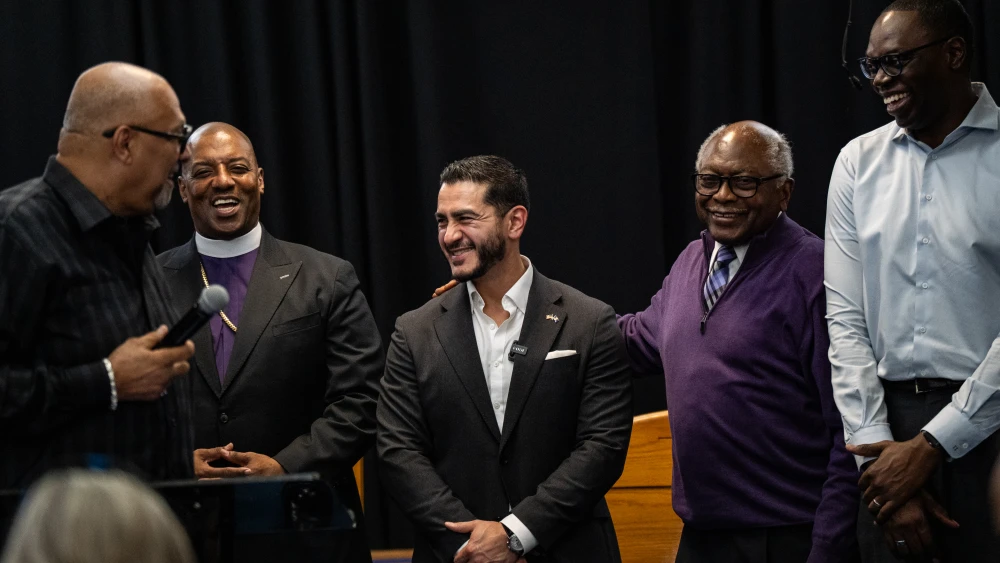

The Black church has stood at the forefront of America’s struggle for justice, equality and human dignity. Its moral authority was built through generations of courage, sacrifice and resistance to hatred. That is precisely why the recent decision to welcome Michigan Senate candidate Abdul El-Sayed to one of America’s most prominent Black churches deserves serious scrutiny.
On Nov. 1, El-Sayed appeared at Greater Emmanuel Institutional Church of God in Christ alongside Rep. Jim Clyburn (D-S.C.). The gathering took place under the leadership of Presiding Bishop J. Drew Sheard, one of the most influential figures in the Church of God in Christ (COGIC), the largest predominantly Black Pentecostal denomination in the United States.
This was more than a campaign appearance. It was an opportunity for a political candidate to address a congregation whose members look to their spiritual leaders for moral guidance. When such a platform is extended to someone whose statements about Israel have deeply alarmed the Jewish community, the leadership has a responsibility to address those concerns.
El-Sayed has described Israel’s military campaign in Gaza as genocide, compared the Israeli government to Hamas in terms of evil and questioned the future of Israel as a Jewish state. He has also repeatedly linked American support for Israel to domestic problems such as the cost of healthcare, education and childcare.
On Nov. 2, during an interview on CBS’s “60 Minutes,” El-Sayed was asked directly whether Israel has a right to exist. He answered yes but then qualified his position, saying Israel’s future should be determined through an agreement between Israelis and Palestinians, whether in a two-state or one-state arrangement.
There is nothing wrong with debating Israeli government policy or discussing possible political solutions to the Israeli-Palestinian conflict. Such debate is legitimate. But the question of whether the Jewish people have the right to national self-determination in their historic homeland is not merely another policy disagreement. It goes to the heart of Jewish identity, security and historical experience.
The danger becomes even clearer when we examine the campaign advertisement released by Rebellion PAC in support of El-Sayed. It depicts a husband and wife shopping for groceries. The wife tells her husband they must put the eggs back because they have set aside seven dollars for killing Palestinians.
The message is unmistakable: American families are struggling because their country supports Israel.
This is a deeply troubling political message. Blaming Israel for the economic difficulties of ordinary Americans echoes an ancient and dangerous pattern: holding Jews collectively responsible for society’s problems. When the Jewish state becomes the explanation for everything from grocery prices to healthcare costs, we must recognize the familiar logic of scapegoating.
Imagine a political figure associated with the Ku Klux Klan being welcomed onto the platform of one of America’s most historic Black churches after making statements blaming Black Americans for the country’s problems. Would church leaders simply offer that person a microphone without addressing the underlying rhetoric?
Of course not. The outrage would be immediate and justified.
The same moral standard must apply when rhetoric targeting the Jewish people is given legitimacy through a church platform.
I know the destructive power of hatred firsthand. I grew up in a home where antisemitism and racism were part of everyday life. My father hated both Jews and Black people. He would say, “The Blacks are ruining the country, and the Jews are running it.”
When I was 11 years old, I tried to defend my Jewish mother from my father’s abuse. He responded by strangling me. I have never forgotten that moment.
I learned early that hatred is not an abstraction. It destroys families, communities and lives. It begins with words, grows through normalization and becomes even more dangerous when those with moral authority choose not to challenge it.
The Black and Jewish communities understand this history. For generations, they have stood together in the struggle for civil rights, religious freedom and human dignity. Jewish Americans supported the civil-rights movement, while Black pastors and Christian leaders have stood with the Jewish people and Israel through difficult moments in history.
That relationship is not simply political. For millions of Christians, it is rooted in their biblical faith and in the shared heritage of the Scriptures.
This month, approximately 500 African-American pastors and leaders, including representatives from the Church of God in Christ, are in Israel, walking the land, experiencing its history, meeting its people and strengthening relationships that transcend politics. Their presence is a powerful reminder of the deep relationship that exists between Black Christian leaders and the Jewish people.
One pastor’s decision does not represent an entire denomination. Nor should a single political appearance erase decades of friendship and solidarity. But precisely because this relationship is so important, the leadership of COGIC cannot afford to remain silent.
Bishop J. Drew Sheard carries an extraordinary responsibility. When a candidate is welcomed into his church and given access to its congregation, that invitation carries institutional weight. The Nov. 1 appearance deserves an explanation. Why was El-Sayed given this platform without a clear public acknowledgment of the concerns surrounding his rhetoric about Israel and the Jewish people?
Bishop Sheard and the leadership of COGIC should publicly affirm that antisemitism has no place in their church. They should make clear that criticism of Israeli government policy must never become an excuse to demonize Jews, deny their right to self-determination or blame Israel for America’s domestic problems.
This is not a partisan demand. Even within the Democratic Party, Rep. Haley Stevens (D-Mich.) has challenged El-Sayed over his campaign’s messaging and his rhetoric about Israel. Her intervention demonstrates that concern about antisemitism transcends party lines.
Clyburn’s participation in the Nov. 1 gathering also deserves consideration. Political leaders must understand that the platforms they share communicate values and confer legitimacy. Their responsibility does not end with the immediate electoral objective of an appearance.
The Church of God in Christ has a remarkable legacy of standing against injustice. Its moral authority should be used to confront hatred wherever it appears, including when that hatred is directed at the Jewish people.
I am not asking COGIC to endorse Israel’s government or any political candidate. I am asking its leaders to uphold a fundamental moral principle: The Jewish people deserve the same dignity, security and right to self-determination that every other people claims for itself.
Denounce antisemitism. Reject the demonization of Israel. Protect the historic bond between Black and Jewish communities.
The prophet Amos declared, “Let justice roll down like waters, and righteousness like a mighty stream.”
Justice cannot be selective. We cannot condemn hatred when it targets one community and excuse it when it targets another.
The Black church has too much history, too much spiritual authority and too much moral influence to look away.
Silence is not neutrality when hatred is given a platform.


