


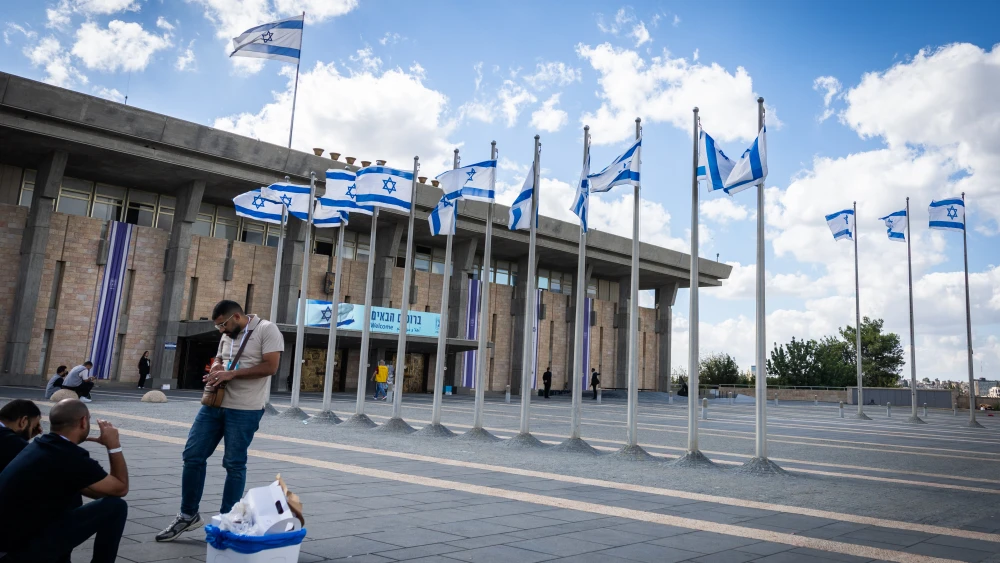

On Oct. 27, Israelis went to the polls in an election held under the long shadow of war, and they did so in numbers not seen in a generation. Now that the ballots have been counted, the real contest begins: not on the campaign trail, but behind closed doors, where coalitions are built, promises are traded and red lines are tested.
The headline number belongs to Likud. Benjamin Netanyahu’s party once again emerged as the largest in the Knesset, winning 27 seats on the strength of 1,167,458 votes, or 20.4% of the ballots cast.
That is a commanding plurality, but in Israel’s parliamentary system a plurality is only a starting point. No government can be formed without the support of 61 of the Knesset’s 120 members. Together with its traditional partners—Otzma Yehudit (7), United Torah Judaism (7), Shas (6) and Religious Zionism (6)—the Netanyahu bloc holds 53 seats, eight short of a majority. Every one of those missing seats will now have to be negotiated for.
Close behind is Yashar (Hebrew for “straight” or “upright”), the new party led by former IDF Chief of Staff Gadi Eisenkot. Yashar won 21 seats with 913,502 votes, or 16% of the ballots, a remarkable showing for a party contesting its first national election.
Eisenkot, who commanded the Israel Defense Forces from 2015 to 2019, is a Mizrahi Jew, born in Tiberias to parents who immigrated from Morocco. His story carries a weight few politicians can match. In this war, he lost his son, Gal Meir Eisenkot, who fell in Gaza in December 2023, as well as two nephews: Maor Cohen Eisenkot, killed just two days later, and Capt. Yogev Pazy, killed in northern Gaza in November 2024. Few Israelis doubt that he understands the price of the decisions a prime minister must make.
Eisenkot’s natural allies emerged from election night battered but still standing. B’Yachad (“Together”), headed by former Prime Minister Naftali Bennett and including Yair Lapid’s Yesh Atid, won 12 seats. Yair Golan’s The Democrats took eight, and Avigdor Liberman’s Yisrael Beiteinu won seven.
Together, the parties of the Zionist opposition hold 48 seats, five fewer than the Netanyahu camp and 13 short of a governing majority. Two lists, the Reservists-New Economic Party and People of Israel, failed to cross the 3.25% electoral threshold, and the more than 250,000 votes they attracted will not be represented in the new Knesset.
A remarkable turnout
Whatever else this election produced, it produced a remarkable expression of civic commitment. Turnout reached 77.9%, up from 70.6% in 2022 and the highest since 1999.
Israeli President Isaac Herzog called the high turnout “a badge of honor for Israeli society,” and he was right. After three years of war, a nation still mourning its dead, still carrying the trauma of Oct. 7 and still awaiting the healing of its wounded chose to show up.
Nowhere was that surge more dramatic than in Israel’s Arab communities. The two Arab-led parties, the Joint List and Ra’am, together won nearly 840,000 votes, an increase of roughly 64% over 2022, according to the Central Elections Committee’s final results. That translated into 19 seats—11 for the Joint List and eight for Ra’am—shattering the previous record of 15 seats.
In Sakhnin, turnout reached 87%, the highest of any locality in the country. As the exit polls appeared on election night, Ra’am leader Mansour Abbas told his supporters: “We are here, and we are not on the sidelines.”
That declaration marks a real change. In the past, many Arab citizens of Israel boycotted national elections, convinced that their votes would make little difference. This time, they voted because they do not want their communities overlooked, neglected or ignored, and because frustration over rising crime and fear for their future pushed many of them to the ballot box.
The two Arab parties, however, are by no means interchangeable.
Ra’am, an Islamist party that made history in 2021 as the first independent Arab party to join an Israeli governing coalition, has positioned itself as the more pragmatic of the two. It campaigned openly on the benefits of joining a coalition and avoided rhetoric that might alienate potential Jewish partners.
In a striking gesture, it placed Yoav Segalovitz, a Jewish former senior police official, former Yesh Atid Knesset member and former deputy public security minister, second on its list. Segalovitz, who made his name fighting organized crime, has called for a genuine Jewish-Arab partnership, saying that “there is a difficult history between Arabs and Jews in this country, but there is also a shared future.”
The Joint List, led by Yousef Jabareen, with veteran lawmaker Ahmad Tibi chairing its Knesset faction, is far more hostile toward the Israeli government, and in particular toward National Security Minister Itamar Ben-Gvir and Finance Minister Bezalel Smotrich.
“We will be ready to pave the way for removing the Netanyahu, Ben-Gvir and Smotrich government and sending them home,” Jabareen declared after the results came in.
Ben-Gvir, for his part, appealed to his own voters on Election Day in stark terms: “If you want this country to remain Jewish and Zionist … then get out and vote!”
Such rhetoric may well have had the opposite of its intended effect, energizing the very Arab electorate it sought to counter. Whatever the cause, the Arab parties now control 19 seats, a bloc that some opposition leaders may find very tempting indeed.
Election challenges
The results have not gone unchallenged. Likud alleged widespread irregularities in Arab polling stations, including vote-buying, intimidation of polling staff and forged identities, and called for the allegations to be investigated.
Separately, the Shin Bet is investigating suspicions of foreign interference in the election after Central Elections Committee Chairman and Supreme Court Justice Noam Sohlberg asked Shin Bet Director David Zini to examine the matter.
On Wednesday, however, the Central Elections Committee announced that an extensive review of the election results found no evidence that the integrity of the vote had been compromised or that the results had been altered.
The review covered protocols from 9,069 polling stations, with more extensive examinations of ballots, voter registries and other voting materials conducted where necessary. The committee said all complaints submitted by political parties and members of the public had been examined.
The foreign-interference investigation remains separate and ongoing.
These questions must be answered transparently and promptly. Public confidence in the integrity of the vote is the foundation on which any new government will have to stand.
The arithmetic of 61
Arithmetic, meanwhile, is driving the politics.
Eisenkot could receive as many as 60 recommendations without Yisrael Beiteinu, from Yashar, B’Yachad (Together), The Democrats, the Joint List and Ra’am. If Liberman’s seven-member Yisrael Beiteinu also recommends him, that number would rise to 67.
Netanyahu, meanwhile, is expected to receive 46 recommendations from Likud, Otzma Yehudit, Shas and Religious Zionism. United Torah Judaism’s seven seats remain uncertain.
But recommendations are not a government.
Liberman has vowed that he will neither sit in a government led by Netanyahu nor support a minority government that relies on the Arab parties. He has indicated that he would prefer a broad national unity government.
The haredi parties, meanwhile, have their own demands, foremost among them legislation governing military conscription for haredi men.
In other words, every road to 61 runs through someone else’s red line. Netanyahu needs eight seats beyond his current 53-seat bloc. Eisenkot faces an even more complicated equation: The parties of the Zionist opposition have only 48 seats, meaning that reaching a governing majority would require support from outside that bloc or a deal with parties that have so far resisted joining him. Each option comes with a political price that could fracture his own coalition.
The temptation to bargain will be enormous, and so will the stakes.
The formal process
The formal process has begun. The Central Elections Committee presented the official results to President Isaac Herzog on Wednesday, after which he began consultations with representatives of the parties elected to the Knesset to hear whom they recommend to form the next government.
Under Israeli law, Herzog then has seven days to entrust a Knesset member with the task of forming a government. Traditionally, the mandate has often gone to the leader of the largest party, but the president may choose whichever lawmaker he judges to have the best chance of succeeding.
The designated lawmaker will have 28 days to negotiate coalition agreements, and the president may grant an extension of up to 14 additional days.
If no government has been formed by then, Herzog can transfer the mandate to a second candidate, who would have 28 days without an extension, or inform the Knesset that he sees no prospect of a government.
In that case, 61 lawmakers would have 21 days to rally behind a candidate of their own, who would then have 14 days to form a coalition. If every path fails, the Knesset is dissolved and Israelis will be sent back to the polls.
That is precisely the outcome Herzog is pleading with the parties to avoid. Israel endured five elections in less than four years before the last government was formed, and the country can ill afford another round of paralysis after years of war.
“The election results are a fact. They are reality,” Herzog said, urging party leaders to arrive with an open mind. “Stop climbing the trees and face that reality.”
The voters have spoken, and they have spoken loudly. They have not handed any single leader a clear mandate. Instead, they have handed Israel’s politicians a test of whether they can put the country’s security and unity ahead of their own ambitions.
In the coming weeks, we will learn whether they are up to it.
Let the horse-trading begin.


