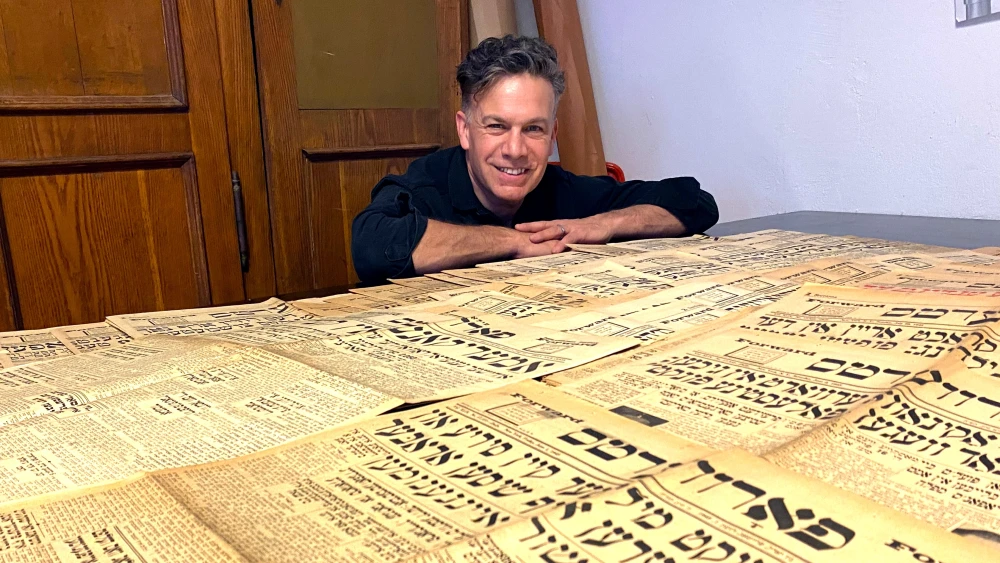
Three Ashkenazi prayer books, reportedly the first known machzors printed in the United States, are up for sale for nearly $25,000.
Dan Wyman, a Jewish rare book dealer in Brooklyn, is selling a two-volume Polish-rite set for $17,000 and a German-rite Rosh Hashanah volume for $7,500. The trio, which the Jewish publisher Henry Frank printed in New York in 1854, were made for newly arrived German and Polish immigrants seeking Jewish prayer books aligned with their traditions.
“When a book represents a ‘first’ in American Jewish book history, that makes it a big deal,” Wyman told JNS. “These machzorim represent the first attempt to produce a machzor in America for Ashkenazi Jews.”
A Bavarian immigrant, Henry Frank, who printed the mahzors, also operated one of the earliest Jewish bookstores in the United States, according to Wyman.
Speaking from Berlin, Wyman told JNS about a recent acquisition of his—a 1947 photo album produced in a Jewish displaced-persons camp after the Holocaust.
The handmade volume, which used photographic paper rather than a printing press and has Yiddish captions, is thought to be one of just a handful made. It documents life in the camp, according to Wyman, whose research suggested that residents of that camp were evacuated during the Berlin Airlift in 1948-49, as Cold War tensions mounted.
“There’s this sort of unexpected twist in the story,” Wyman told JNS, of the album. “That’s part of the fun when you start in these things, and you kind of think it’s going to go a certain direction and probably does, and then there’s a, ‘Wait, I wasn’t expecting that.’”
The dealer didn’t want to speculate about how much the photo album might fetch.
One of his larger sales, he said, was $79,000 for a set of journals by David Einhorn, a mid-19th-century rabbi and leader in the Reform Judaism movement.
“He was run out of Baltimore, because he opposed slavery and ended up in Philadelphia, and he founded a journal called ‘Sinai,’ which ran seven volumes,” Wyman told JNS. “Sometimes you see one volume here or there. I had a complete set of it, and I had it nicely rebound.”
The dealer’s list of buyers includes “lots of librarians, but also collectors, scholars, amateur genealogists and Jewish book lovers of all kinds,” he said.
Though he doesn’t get to keep the volumes, getting to handle them along the way is “part of the fun,” he said.