A coalition crisis over proposed legislation that would allow the Knesset to override Supreme Court rulings that strike down Knesset legislation appears to have been averted, following a meeting on Sunday between Israeli Prime Minister Benjamin Netanyahu, Attorney General Avichai Mandelblit and coalition party leaders.
Before the meeting, some political officials thought that Netanyahu would try to leverage the crisis to hold early Knesset elections, currently scheduled for 2019.
However, sources close to the prime minister said the meeting was “to the point,” and that in the coming days, Netanyahu will spearhead a framework to put the High Court’s power over the Knesset into check.
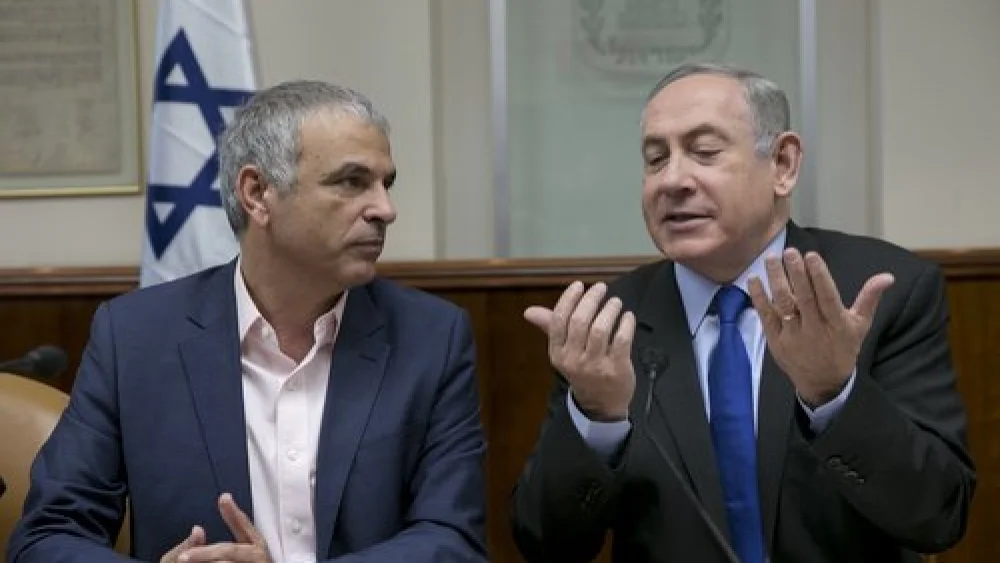
Before Netanyahu entered the meeting, Kulanu Party chairman Moshe Kahlon told the leaders his party was essential to the coalition, saying, “Without Kulanu, Netanyahu isn’t the prime minister.”
Kahlon, who opposes allowing the Knesset to override High Court rulings, said: “If the prime minister wants an [early] election, there’s no problem with him calling an election. Likud won’t get even 25 seats if he does.”
Kahlon told the Likud ministers at the meeting that if they wanted to “break everything and push the election up,” his Kulanu faction was willing to see that happen.
Later in the meeting, Mandelblit laid out several “softened” versions of the High Court override measure, saying he would back a bill that allows the High Court to strike down a Knesset law only if at least six out of nine justices on a panel vote in favor of doing so, and allows the Knesset to restore a stricken-down law only if a minimum of 70 MKs vote in favor of the law.
Israeli media reported Sunday that Netanyahu recently met with former Chief Justice (ret.) Aharon Barak to discuss the issue of the override measure.
In the meeting, Netanyahu said “we want to arrive at appropriate, balanced solutions.”
Netanyahu and Tourism Minister Yariv Levin are promoting a law that would allow the Knesset to override the High Court, along the lines of the British model, preventing the court from interfering with legislation passed by the Knesset. However, political sources say Kahlon’s opposition is keeping the coalition from achieving the requisite majority to pass the bill.
Kahlon has said he would be willing to pass a measure that allows the Knesset to override the court specifically on the issue of illegal African migrants in Israel—an issue that has divided the nation recently, as many, including the court, oppose the government’s deportation policy.
After the meeting, Netanyahu met privately with Kahlon, and the two agreed that they would reach an agreement on any bill designed to check the High Court’s powers and would work together to pass it.
Chief Justice Esther Hayut responded on Sunday to the attempts to clip the court’s wings, saying that “judicial discretion is vital to preserving the system of independent courts, which protects the fundamental constitutional principles of the democratic system.”