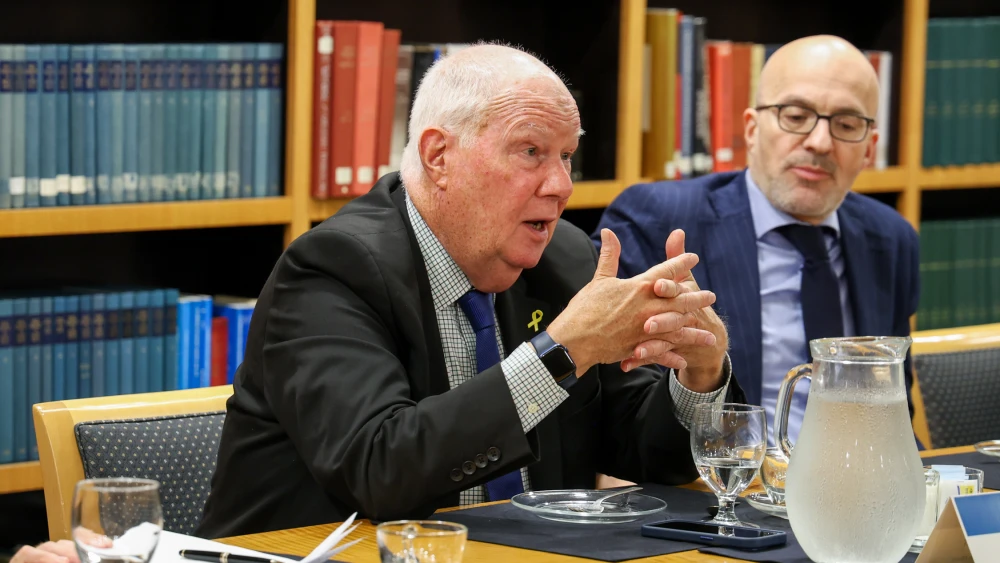
Nearly 50 years ago, Andrew Baker was out of a job. His synagogue in Chicago eliminated his position as a congregational rabbi, and the then 29-year-old had to decide what to do next.
Baker landed a role at the American Jewish Committee in Chicago in 1979, thinking he’d do it for a year or two before returning to a pulpit. Though he is retiring from the AJC, he told JNS that he plans to remain active.
“There’s obviously a lot of feelings about this being my institutional home for almost all of my life, so even if the issues and some of the work continues outside, it’s certainly a fond goodbye,” the outgoing AJC director of international Jewish affairs, who has been decorated by the German, Lithuanian, Latvian and Romanian presidents, told JNS.
Baker intends to continue to handle some matters that he calls “AJC-adjacent.”
Since 2009, he has served each year as the personal representative of the Organization for Security and Co-operation in Europe’s chairperson-in-office on combating antisemitism. That role will last until the end of the year, and he has been reappointed each year for the past 17 years, Baker told JNS.
He also intends to continue as co-chair of the Lithuanian Good Will Foundation and as a long-time officer of the Claims Conference.
On his last day at the AJC, set for July 1, Baker plans to attend a conference on Jew-hatred in Vienna, at the invitation of the European Union and the Austrian government.

All of those side roles are “still going to be on my agenda, even if it isn’t while I’m wearing my AJC hat,” Baker told JNS.
He was the AJC’s European director in the 1990s.
“We saw the revival of Jewish life in the Central and Eastern Europe communities that had been decimated by the Holocaust, and then under half a century of communist domination,” Baker said.
“I think many people would have said there was no future for Jewish life there, and when the wall came down, the few Jews left could emigrate or make aliyah,” he told JNS. “But in fact, there was a real revival.”
That revival has required a focus on pushing countries to confront their Holocaust-era past and address questions of restitution, according to Baker.
“I think we had a lot of success over those years,” he told JNS.
Baker conceded that “we probably did not imagine that antisemitism would return to Western Europe in any significant way.”
“We were clearly taken by surprise with a resurgence of incidents in the early 2000s, which led us to mobilize a focus on government, and the need to understand antisemitism in its new form,” he said.
That led the European Monitoring Centre on Racism and Xenophobia to draft a working definition of antisemitism. Baker was heavily involved in that project, he told JNS.
The draft was later adopted in more or less the same way that the International Holocaust Remembrance Alliance’s working definition has been, becoming the most standard definition of Jew-hatred used globally.
But defining antisemitism did not necessarily help prevent it, according Baker.

Populist, right-wing parties in countries in Central and Eastern Europe in particular are using Holocaust distortion as a political tool, Baker said.
“On the one hand, we made a lot of progress in getting governments’ attention and in devising tools when it comes to security and other needs of the communities,” he told JNS.
“But it’s hard to feel very sanguine or satisfied when the problem has not diminished by anyone’s account, by any measure, really,” he said. “The polling of what Jews experience, or counting of incidents, it’s far more severe.”
“It’s hard not to feel somewhat ambivalent,” he added.
In his time at AJC, Baker has been involved heavily in pressuring the German government to open the door to pensions for Holocaust survivors and victims of communism.
He also played a significant part in efforts to expand the North Atlantic Treaty Organization, employing pressure on applicant governments to address Jew-hatred at home before Washington would give approval for membership.
“It was clear that countries had to demonstrate that they were ready for NATO, not just a military alliance but a community of values,” Baker told JNS.
“So we were able to position concerns about confronting the renewal of antisemitism in open societies, addressing that Holocaust history, providing support for the revival of Jewish life, all the elements that were viewed as ultimately a key condition for NATO membership,” he said.
He recalled that the State Department contacted him in 1998 to alert him in advance about a phone call from Estonian President Lennart Meri, who invited Baker to accompany him to a Baltic summit in Riga. There, he would be able to speak privately with three Baltic leaders about the need and the value of creating historical commissions to confront their Holocaust-era history.
By the end of the summit, the presidents announced that they were creating a commission, leading to clear historical documentation, new programs, curricula and education, and notably, the beginnings of negotiating on Jewish communal property restitution.
Baker served as the main negotiator with the Lithuanian government on behalf of international groups and the country’s Jewish community.
“It was much longer than we had anticipated, ultimately a 10-year negotiation, but it resulted in significant payments,” Baker told JNS.

He also challenged the Romanian government’s refusal to acknowledge elements of the Holocaust in the country through internal deportations and anti-Jewish measures resulting in hundreds of thousands of deaths.
That led to the government to form the Wiesel Commission, chaired by Nobel Peace Prize laureate Elie Wiesel, and task it with researching the history of the Holocaust in Romania. The country established a research institute and developed a memorial in the center of the capital for Holocaust victims.
“We had some very practical successes for creating the basis for sustaining Jewish life in these countries,” Baker told JNS.
His influence also stretches into Poland, where he followed up on the work of Miles Lerman, then chair of the U.S. Holocaust Memorial Museum’s council, to establish a memorial in Belzic, the site of the Nazi death camp in southeastern Poland where half a million Jews were murdered and buried in less than a year in 1942.
It also stretches into Egypt, where he engaged over the years with the country’s leaders to restore long-dormant synagogues and Jewish institutions, including the Rambam Yeshiva in the Jewish Quarter of historic Cairo—even as the Egyptian government refused to allow reporters to cover the rededication.
A full restoration and repair of the Eliyahu Hanavi Synagogue in Alexandria followed, which drew attendance from more than 100 Jews originally from Egypt and disbursed worldwide.
In Baker’s first years working for the AJC, the entity was almost entirely focused on domestic issues. Its foreign affairs department was, in practice, a handful of people working out of the New York office.
David Harris, longtime CEO of the committee, increased the group’s global focus, establishing offices in Europe and elsewhere around the world.
“That was a dramatic and important shift, because we certainly saw that the real challenges and dangers that Jews were facing within the international arena,” Baker said. “Our interest in America was to be able to help provide support and understanding for the state of Israel and what it faced.”
Developments in the past decade have required an inward focus again, according to Baker.
Until recently, American Jews “tended to think” that troubles for Jews were “problems there and not here—that we were blessed in America, that we didn’t have the need for the kind of community security that was commonplace in front of European synagogues that we had been able to rely on support for Israel being a strong bipartisan position across the spectrum,” Baker said.
With bipartisan support falling and domestic security challenges growing, Baker told JNS that he is concerned that the current U.S. government can’t be relied upon to support AJC’s diplomatic work given its often adversarial relationship with democratic allies, especially in Europe.
“Now we have these challenges of confronting the problems in America, as well as in Europe, in trying to maintain a nonpartisan approach politically, but doing so in what today in America is a very highly charged, very partisan environment,” he said.
That also occurs amid “special challenges of being supportive of Israel when that support is difficult, when frankly there are more and more internal activities in Israel and policies and ministers that give many of us in major Jewish organizations, as well as in the Jewish, public cause for concern,” Baker told JNS.
Baker said that the AJC has “really talented staff and leadership that are positioned to do this.”
He told JNS that it is wrong to think that money should be directed to Jewish education as a long-term factor in Jewish safety and continuity rather than fighting antisemitism, which is seen as a lost cause.
“Obviously we need to do both, and I think I can look back with a long view, as the AJC has managed to adapt and even recreate itself to meet new challenges that are no longer so new,” Baker told JNS. “I’m persuaded that it will have the ability to keep doing this going on into the future.”