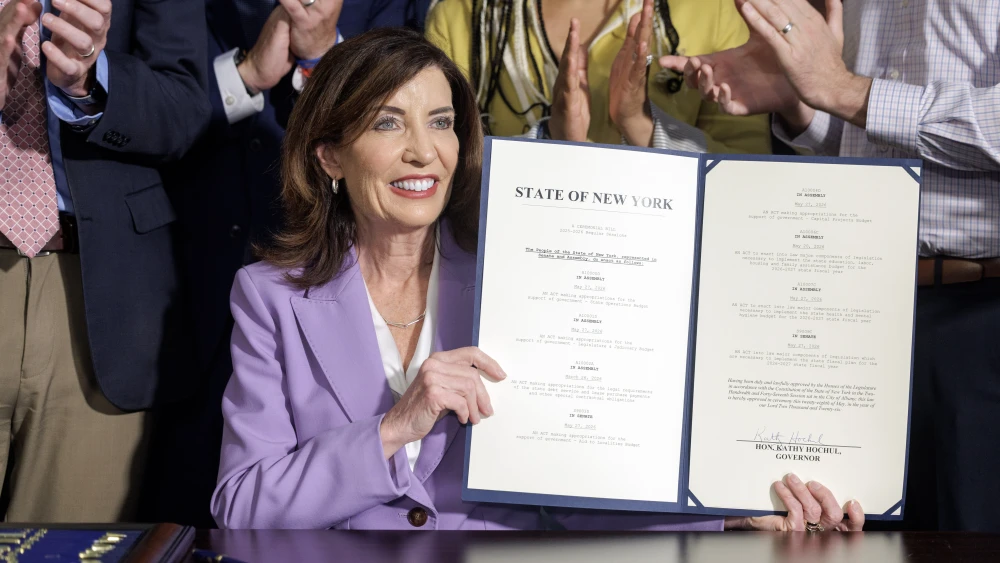
New York Gov. Kathy Hochul said she did not discuss the state’s new “buffer zone” law for houses of worship, religious schools and community centers with New York City Mayor Zohran Mamdani, who vetoed similar legislation affecting schools in April.
The governor said the proposal had been under discussion for months before it was included in the passage of the state budget.
“This is not a new issue,” Hochul said in an interview with Spectrum News NY1. “I’ve talked to the mayor about a lot of issues, mostly you know we talk about childcare, we talk about public safety, we talk about how the state can help, how we can do what we do with the pied-à-terre tax, as you mentioned—the tax on second luxury homes for people who are not New York City residents—so we have a lot of conversations, but just not on this one topic.”
Hochul signed the state’s $268.1 billion budget package into law on Thursday. Included in the measure is legislation creating the crime of “criminal interference with access to a place of religious worship,” making it illegal to intentionally block or intimidate people entering or leaving houses of worship and certain religious schools. The law also authorizes police to establish security perimeters of up to 50 feet around such sites.
“It’s important that people who are exercising their free right of religion can be able to go into their place of worship without people harassing them and intimidating them, and it is deterring them from wanting to do what they have a God-given and a constitutional right to do, or a school, a yeshiva, or a Catholic school,” the governor said.
She added that the legislation “does not negate your right to protest at all. It’s just saying, as the Supreme Court has allowed, within certain restrictions.”
The governor’s office stated that the law is intended to ensure “safe access to worship” by protecting people entering or exiting houses of worship from harassment or intimidation.
The legislation follows months of debate over protests outside synagogues and other religious institutions in New York City. In April, Mamdani vetoed a City Council bill that would have created protest buffer zones around educational facilities, citing concerns about free speech and the measure’s broad definition of schools and educational institutions. A separate bill concerning houses of worship became law after passing the City Council with a veto-proof majority.