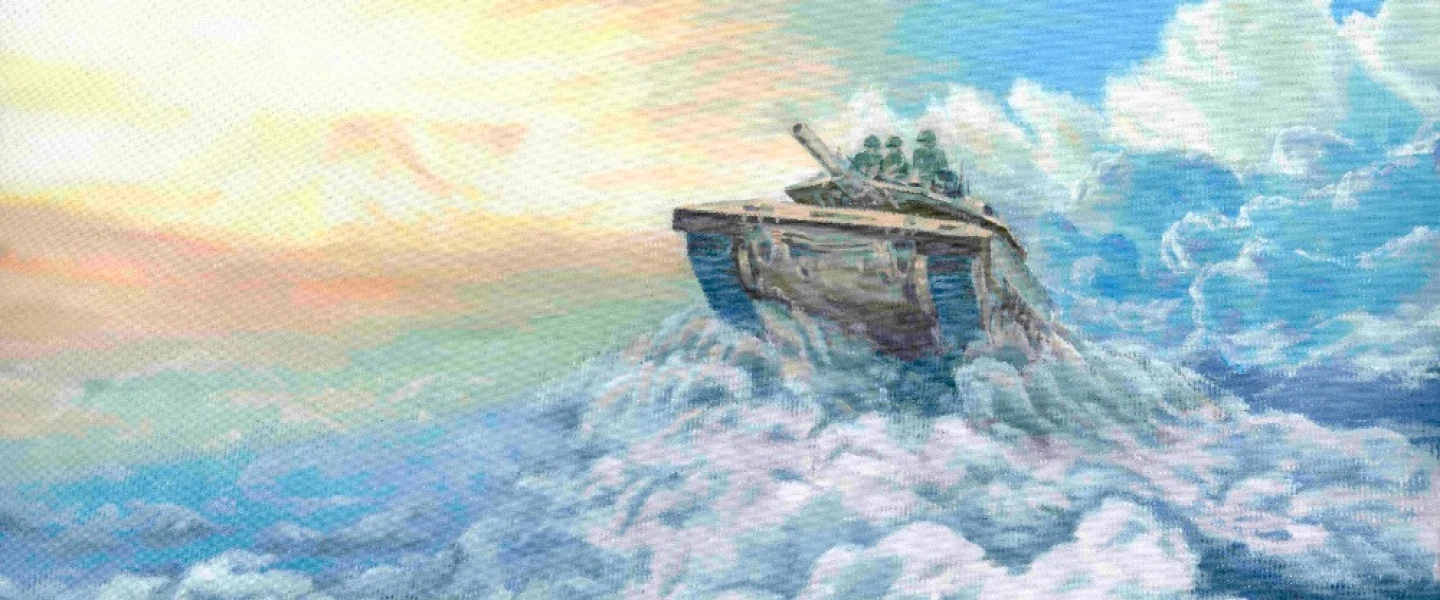
A tank carrying three soldiers emerges from a swirl of clouds, suspended between earth and sky like a lifeboat riding storm-tossed waves. In another painting, a man stands divided between two worlds—half soldier, half civilian—with flames and war on one side and a tranquil pastoral landscape on the other.
These are just two of the more than 130 works currently featured on Hazut, a new online platform dedicated to highlighting Israeli artists living in Judea and Samaria and connecting them with a wider audience. Calling itself “The Home of Judea and Samaria Artists,” the website invites audiences in Israel and beyond to “discover the original art, landscapes, and inspiration of an ancient, multi-layered region rich in the history of the Jewish people.”
The first painting, Borne to the Heavens in a Tempest, was created by Peduel artist David Fisch, whose son, Capt. Eitan Fisch was killed in Gaza in December 2023. The second, Between the Holy and Mundane, is the work of Shiloh artist Marc Provisor, whose decades in Israel’s security establishment have profoundly influenced his artistic vision.
The platform is the creation of curator Ophra Shoshtari, who moved from Netanya to the Samaria community of Einav and found herself surrounded by talented artists who often struggled to gain exposure.
“Frequently because of their addresses, these artists are not welcome in gallery spaces in the center of the country,” Shoshtari told JNS in a recent interview. “Just living in Judea or Samaria makes them ‘not relevant’ to the conversation. And it’s not fair. That attitude skews the art world.”
Armed with degrees in museology from the United States and art history and curation from the University of Haifa, Shoshtari spent years working in prominent Israeli galleries and museums before turning her attention to creating a platform of her own.
“For many years I wanted to create the website—an artists’ registry—but I didn’t have the skills or the money to pay someone else to do it,” she said. “With AI, I was able to do most of it by myself. Sometimes my husband, who works as a programmer, helps. It’s been liberating. I started asking artists to join.”
Unlike commercial marketplaces such as Etsy, Hazut is not designed primarily as a sales platform. Instead, it serves as a registry, networking hub and showcase for artists, while also providing a point of contact for collectors, curators, interior designers and anyone interested in commissioning work.
Art shaped by conflict
Many of the artists featured on Hazut draw directly from their experiences living through conflict and loss.
Provisor, who studied at New York’s School of Visual Arts, began painting while serving as a young soldier in 1982. Later, as head of security for Shiloh during years of Palestinian terrorism and the Second Intifada, he increasingly incorporated those experiences into his art.
“Painting used to help me assess security situations,” he said. “I’ve painted on the northern border and the southern border, exploring the different light and shade. At first, it was my way of dealing with stuff.”
During the recent war with Iran, he found himself working on a different kind of canvas.
“During the last Iran war, I began painting calm landscapes on shrapnel from the missiles,” he said.
One of Provisor’s most striking works, She Walked Here, depicts a flower-lined dirt path beneath a canopy of trees. A splash of blood appears in the foreground, trickling across the trail.
The painting commemorates Esther Horgan, a mother of six who was murdered by a terrorist while jogging near Tel Menashe in northern Samaria in December 2020. Provisor was among those involved in investigating the attack.

Other artists draw inspiration from Jewish history, spirituality and the landscape of the biblical heartland.
Talmon artist Chani Cohen Zada incorporates Torah and Kabbalah themes into her paintings. One work offers an interior view of the Cave of the Patriarchs in Hebron, where a ghostly figure appears among visitors.
“This particular Ohel Yitzhak v’Rivka, part of the Machpela, is only opened to Jews at certain times of the year,” Cohen Zada explained. The figure, she said, represents Sarah, the biblical matriarch, welcoming visitors to the resting place of her son Isaac.
Her more recent work explores the emergence of new farming communities throughout Judea and Samaria, which she sees as symbols of renewal and rebuilding.

Difficult conversations through art
For Shoshtari, art is more than aesthetics. It is a vehicle for dialogue.
Before launching Hazut, she organized a project that brought together artists from the Binyamin region and Israel’s Eshkol region near the Gaza border. Participants arrived with sharply different political perspectives, but the experience convinced her of art’s ability to bridge divides.
After meeting several times, the artists created works reflecting both their disagreements and their shared experiences.
“The kind of dialogue and conversation that emerged from this art alliance needs to happen all the time,” Shoshtari said. “Sometimes it’s uncomfortable, but regardless of internal politics, it’s so important to develop relationships and respect for each other.”
“What many don’t understand is that art is an international language,” she continued. “These days instead of allowing opinions they don’t agree with to be part of the conversation, people say, ‘I refuse to listen,’ and cut out whatever they find objectionable.
“This is not how discourse should go. You have to talk in order to have a conversation. Otherwise, you won’t hear the other person’s pain or experience. It’s not healthy. If you cut out someone because of where he lives, or what he stands for, everyone loses. All our experience is part of the Israeli experience—it’s painful and beautiful at the same time.”
Shoshtari describes public diplomacy as one of Hazut’s central goals, believing that art can communicate aspects of Israeli life that politics often obscures.
That commitment to open discussion has occasionally generated controversy.
At an exhibition Shoshtari curated at the Jerusalem Theatre in November 2025, one visitor objected to a Cohen Zada painting depicting Israeli soldiers entering Gaza while smoke rose from buildings below and the Third Temple appeared among the clouds above.
According to Shoshtari, the complaint argued that Arab visitors to the mixed city of Jerusalem would find the image offensive.
“It’s important to have uncomfortable conversations,” she said. “One person’s vision reflects a large portion of the population’s vision and hope. It’s OK to represent it instead of telling her to hide her opinions. It still exists even if you disagree with it.”
The Jerusalem exhibition was one of several projects she has curated in recent years. She also organized three exhibitions in Ariel and another in Shiloh dedicated to the memory of Nachman Mordoff, a young shepherd murdered in a terrorist shooting attack at a gas station in Eli in June 2023.
Mordoff had documented life on the hillsides through photography. His mother dreamed of transforming those photographs into paintings but found the task emotionally overwhelming.
An artist named Libi Yaar Horowitz brought the photographs to a consortium of artists and invited Shoshtari to curate them, creating an exhibition that drew an enthusiastic local response.
Building a community

Beyond promoting artists and encouraging dialogue, Hazut seeks to solve a practical problem: geography.
Travel across Judea and Samaria can take hours, making it difficult for artists to meet regularly, collaborate or build professional networks.
The site gives each artist a dedicated profile and dashboard while linking to personal websites and portfolios. Shoshtari also acts as an intermediary for inquiries, helping protect artists from online harassment and antisemitic doxxing.
While formal training is not required, many participants studied art extensively.
“What’s important is that the art expresses something meaningful and tells the story well,” she said. “I include photography and video art because they are powerful media. The message is what I am looking for.”
New artists continue to join the platform almost daily. Shoshtari is also searching for permanent exhibition spaces throughout Judea and Samaria where rotating shows can be displayed year-round.
“I love talking to people about their art,” she said. “When people can’t sleep because they have to produce a painting—this is a real artist. They are driven. They need to do this.”
Ultimately, she hopes Hazut will become both a cultural resource and a source of regional pride.
“I want to create exhibitions that have purpose and connect people on a deeper level,” she said. “People here live far from the museums. I want people in our region to connect to each other through art.
“Like any language, an art piece conveys tone, but you can’t fully understand it unless you learn art history and technique—unless you dive a bit deeper. I want to create opportunities for people to understand art better and be proud of the artists in our region. It should be known as a source of pride and inspiration.”