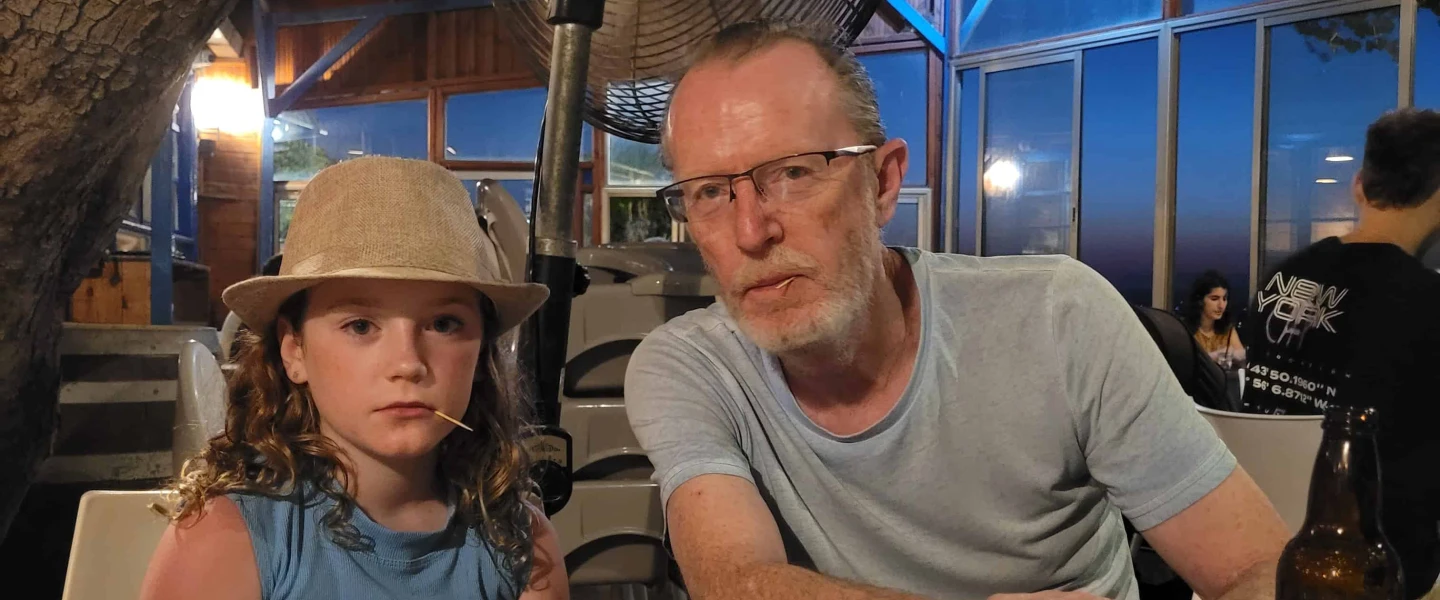
“Obviously, the first thing you want to do is try to understand what she went through. I still don’t know half of it. When she’s older, I might be able to ask her.”
For Tom Hand, father of former Hamas hostage Emily Hand, the questions surrounding his daughter’s 50 days in captivity remain largely unanswered. Yet nearly three years after the Oct. 7, 2023, Hamas massacre, he says the 11-year-old has shown remarkable resilience as she rebuilds her life and prepares to return home.
On the morning of Oct. 7, Emily, then eight, was sleeping at the home of her friend Hila Rotem Shoshani in Kibbutz Be’eri, less than five miles from the Gaza Strip, when Hamas terrorists stormed southern Israel, murdering some 1,200 people and kidnapping 251 others. Among the hostages taken to Gaza were Emily and Hila.
The ordeal initially took a devastating turn when kibbutz authorities informed Hand that his daughter had likely been killed. His reaction made headlines around the world after he admitted that learning she was dead seemed preferable to the alternative of captivity in Gaza.
Weeks later, however, investigators discovered that Emily’s body was not among the victims recovered from Be’eri. No blood traces were found in the home where she had been staying, and cellphones belonging to members of the host family were tracked to Gaza.
On Nov. 17, 2023, Emily marked her birthday in captivity. Nine days later, she and Hila were released during a weeklong ceasefire agreement between Israel and Hamas that secured the freedom of 105 hostages, primarily women and children.
Hand, an Irish-born resident of Kibbutz Be’eri, moved to Israel in 1992 as a volunteer and built his life in the Gaza border community, where he married and raised a family.
Waiting on Kibbutz Hatzerim
Today, Hand and his daughter are living with other evacuated Be’eri residents in Kibbutz Hatzerim while waiting for their community to complete reconstruction efforts and return home.
In the meantime, Emily has gradually built a new routine.
“One by one, all the parents decided that since we should be returning to Be’eri soon, they wouldn’t send their kids to the local secondary school, but rather to the one in the Eshkol region, which is an hour’s coach ride from here,” Hand told JNS in a recent interview.
“In the end, Emily was the only one who wanted to stay here. Last night, she finally decided she will also go to school in Eshkol. She is amazingly social. She’s made a lot of friends in Hatzerim and she did not want to lose that,” he said.
For Hand, the decision carried emotional weight. The school in Hatzerim is just minutes from their temporary home, while the Eshkol school requires traveling roads near Gaza, some of the same routes used by Hamas terrorists during the Oct. 7 assault.
Despite those concerns, he says Emily has adapted extraordinarily well.
“It’s very hard not knowing,” Hand said of her captivity. “I wish I had a video of everything that happened to her from the morning of Oct. 7 until she came back, to know what the hell she went through. Imagination is usually worse than reality.
“She is simply incredible, to have gone through that and come out the other side,” he continued. “On one hand, it is terrible that she was so young, but on the other hand, it might have been a blessing. I know older kids from Be’eri who haven’t done well at all. They have become completely introverted and still don’t want to leave the house. Whatever happened with her and us turned out okay, thank God.”
Hand attributes part of her resilience to the hardships she faced even before Oct. 7.
Emily’s grandfather, uncle and mother all died of cancer within three years. Her stepmother, Narkis, who helped raise her, was murdered by Hamas terrorists during the attack on Be’eri.
“I always taught my kids to be independent, to be strong, hopefully confident and, obviously, before Oct. 7, she had already gone through some major personal crises,” Hand told JNS. “She has had to learn how to deal with trauma. If you go through adversity in your life, you’re able to cope with it more easily.”
Although father and daughter rarely discuss her captivity directly, Hand said Emily occasionally raises memories on her own terms.
“Every now and then she’ll bring something up from the past that she wants to talk about,” he said. “Once she’s finished talking about it, it’s gone.”
Most days, he added, Emily appears no different from any other child her age.
“I’ve got every confidence that she will adapt. She is an amazingly strong girl,” he said. “After coming back from captivity, it was hard for a few months, but she is just like a normal kid now. If you sat in a room with her, you wouldn’t think, ‘Oh, this poor girl went through a lot.’ She is just like any other kid her age.”
Still, reminders linger.
“I wake up in the morning and she’s in my bed,” Hand said. “She has nightmares and comes in for security. If I need to go to the store in the evening, she is not too happy about me leaving at night.
“It is slowly fading. I can see over time that she’s becoming less and less stressed about little things like that. She’s still only 11. I have no worries about her.”
As the community prepares to return to Be’eri, Hand says both residents and local security teams are determined not to repeat the mistakes that left the kibbutz vulnerable on Oct. 7.
“What happened on Oct. 7 was absolutely shocking,” he said. “We were left alone for so long. I was there from 6:30 a.m. until 11:30 p.m. before the first soldier came to me. Some people were only freed from their homes the next morning.”
‘It will be great to go back’
Before the massacre, Be’eri’s security squad was designed to confront a limited infiltration and hold attackers off until military forces arrived. Instead, hundreds of Hamas terrorists overran the community, exposing weaknesses in both preparedness and response times.
Hand said he continues to carry a firearm and intends to take additional precautions when he returns.
“I always had a gun. It was a great comfort on the day and it gives her a sense of security,” he said. “When I lived in Be’eri, I always planned to build a secret room, to close off a room and make it look like a wall with a bookcase in front of it, because I believed the people of Gaza would erupt one day.
“Unfortunately, I was lazy and never got around to doing it. When I go back, I am making contingency plans in that direction.”
He also believes the community must strengthen oversight of workers entering the kibbutz and become more self-sufficient in matters of security.
The physical scars of Oct. 7 remain visible throughout Be’eri. Many homes that were attacked have been demolished, including the house where Emily’s stepmother was killed.
“The image I have in my head is Narkis’s house, which has now been destroyed,” Hand said. “I don’t think many people want a reminder of that day—it’s too traumatic.”
Yet amid the loss, rebuilding is underway. A new neighborhood is being constructed on the side of the kibbutz farthest from Gaza, replacing homes destroyed during the attack.
“Hopefully, by the time we go back, the place will be cleared,” Hand told JNS. “There will be a lot of houses missing and a lot of empty spaces where homes once stood, but it will be better.”
Despite everything, he remains optimistic about returning.
“It will be great to go back,” he said. “It will give everyone a very good feeling. My house had a few bullet holes, but the kibbutz has repainted the entire neighborhood. It will basically be a clean sweep.”