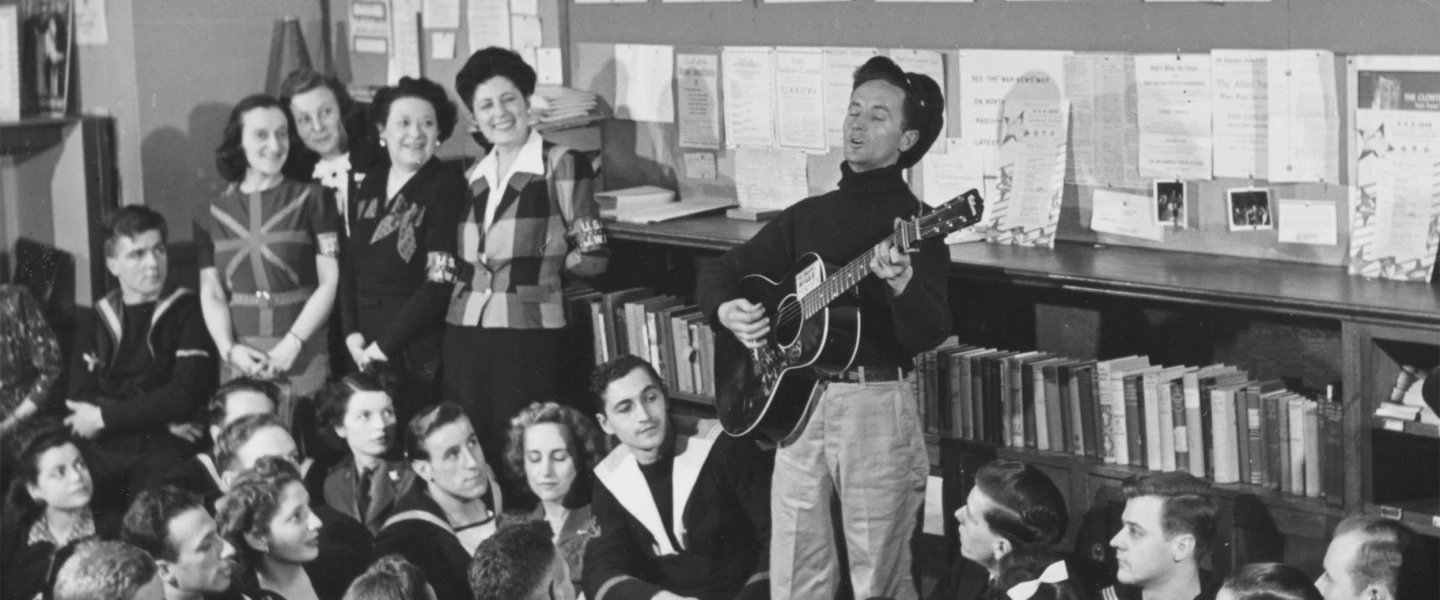
The same folk singer who wrote “this land was made for you and me” also wrote, “Chanukah candlelight, see my flame, shining on my window’s pane.”
Woody Guthrie’s songs were recorded by the Kingston Trio, the Weavers and the Klezmatics, and his mother-in-law was an accomplished poet who wrote in Yiddish.
The Jewish story about Guthrie, who died in 1967, is the subject of the new documentary “Dust Bowls and Jewish Souls: Another Side of Woody Guthrie,’’ which is scheduled to make its world premiere on June 4 at the Toronto Jewish Film Festival.
Steven Pressman, of San Francisco, a former journalist who produced the film, told JNS that he first came across Guthrie’s Yiddishkeit four years ago at an exhibit at the Morgan Library and Museum in New York City.
There, nestled alongside one of Guthrie’s guitars and other artifacts, was a sheet of lyrics to a song about Chanukah.

“Like most of us, I knew ‘This Land is Your Land’ and the Dust Bowl stuff and not much more,” Pressman told JNS. “I looked at these lyrics to a Chanukah song, and I thought, ‘What on earth does Woody Guthrie got to do with Chanukah?’”
Plenty, it turned out.
Guthrie’s second wife, Marjorie, was Jewish, and his mother-in-law, Aliza Greenblatt, was a famed Yiddish poet. The singer asked questions about the Jewish holidays.
His record label, Folkways, was run by a Jewish American, Moe Asch, who first introduced Guthrie to the Jewish world in New York City.
Asch was the son of Yiddish author Sholem Asch.
The family had a menorah in the window for Chanukah and attended Passover seders, and there is a home movie of Guthrie’s daughter Nora holding the afikoman. Guthrie’s son, Arlo, a folk singer in his own right, had a bar mitzvah of sorts.
Arlo’s tutor was Meir Kahane, who at the time was the rabbi of the Howard Beach Jewish Center in Queens. Kahane later founded the militant Jewish Defense League before moving to Israel and creating the far-right political party Kach.
One of Guthrie’s Jewish songs, “The Many and the Few,” contains 20 stanzas, most of them about Chanukah. It begins with Cyrus the Great, the Persian king who allowed the Jews to return to the Holy Land and rebuild the Temple.

“Suddenly, I came to realize that this iconic American cultural figure, Woody Guthrie, who we all think of as this Dust Bowl character, this guy from Oklahoma—he’s immersed in this Jewish world,” Pressman told JNS. “I thought there’s a film there, and it turns out there was a film there.”
“We were off and running,” he said.
The Guthries cooperated in the making of the film, providing pictures, home movies and other materials. Two of the singer’s three surviving children, Arlo and Nora, were interviewed on camera.
“That cooperation was critical to making the film, and they were really generous with their time, with their material,” Lisa Stark, a former television reporter from Bethesda, Md., and associate producer of the documentary, told JNS.
“They were showing us these home videos, and we were like, ‘Oh my gosh. That’s incredible,’” she said.

“We walked out of there saying, ‘Oh my gosh. They have to give us some videos,’ and they hadn’t really given them out before,” Stark told JNS. “We felt very grateful that they did that, because it showed you the Jewish life that they were living.”
“The Friday night dinners, the services,” she said. “It just showed you that this was a Shabbat dinner with Bubby.”
Pressman’s previous documentaries all had Jewish themes, but he said that he didn’t expect his next subject to be Guthrie, who grew up in a small Oklahoma town where he probably never met a Jew.
“I never imagined making a Jewish film about Woody Guthrie,” Pressman told JNS. “That was never part of the thinking. So when we started finding out all these threads, it just opened my eyes completely, and here we are, having made a Jewish film about a very non-Jewish guy from this tiny little town in Oklahoma.”
Pressman and Stark acknowledge that no one would call the Guthrie family practicing Jews. But the three children born to Marjorie were Jewish under Jewish law because their mother was Jewish, and they embraced grandmother Aliza Greenblatt, their Bubby.
“I think it would be a stretch to say that these are practicing, observant Jews. They aren’t,” Pressman told JNS. “What I will say, however, is that Nora, in particular, probably more so than Arlo—Nora really has embraced at least this kind of Jewish cultural side that she never knew about for the longest time.”
“I don’t know that Nora, or any of them these days, would sort of identify as Jewish, the way we would ourselves growing up, but she has certainly come to appreciate this side of her father’s life that she never really knew about when she was growing up,” he said.

The film also explores the life of Greenblatt, the grandmother.
Pressman credited Aaron Lansky, founder of the Yiddish Book Center in Amherst, Mass., for helping him connect Guthrie to his mother-in-law.
“He did a great job of kind of helping us to connect the threads, because he had his own connection to Woody’s widow, Marjorie Guthrie,” Pressman told JNS.
After the center was founded in 1980, Lansky received a letter from Majorie Guthrie.
“She introduces him to this collection of Aliza’s books that she had, and that’s when Aaron makes the connection between Marjorie and Woody,” Pressman told JNS. “He did such a great job in helping us connect these two otherwise completely separate worlds, and I think he wound up telling us stories that are in the film that I’m not even sure the Guthries knew about.”
Marjorie Guthrie later became involved with the Yiddish Book Center, serving on its board and helping raise money, including by bringing actor Theodore Bikel to an event, Pressman said.
Guthrie’s Jewish connection wasn’t exactly a secret, but it wasn’t well known and was not part of earlier documentaries and films about the folk singer, according to Pressman.

“We can’t take credit for discovering the story. What we can take credit for in making this film is telling it in a broader way that puts it all together,” he told JNS. “I would venture to say that most people seeing this film are going to be learning about this Jewish side of Woody for the first time.”
At a time of rising Jew-hatred, Pressman and Stark said that learning that there was a Jewish side to Guthrie isn’t going to stem that tide.
The film quoted Guthrie as saying, “Millions of years from now, we’re all going to be one color, and maybe we’ll get rid of the fascists by then.”
“You can substitute ‘antisemitism,’ because he was aware of antisemitism,” Pressman told JNS. “He was aware of it, as he was aware of racism, and he wrote about that stuff back in the 40s and 50s.”
“Woody, whatever he might think of the world at large these days, would be certainly upset to see that we’re still dealing with antisemitism,” Pressman said.
“Whether this film changes anybody’s mind, doubtful, but it’s always nice to say, ‘Here’s a guy who has his own Jewish story,’” he told JNS. “As you say, it’s a reminder that in a sense, he’s one of us.”