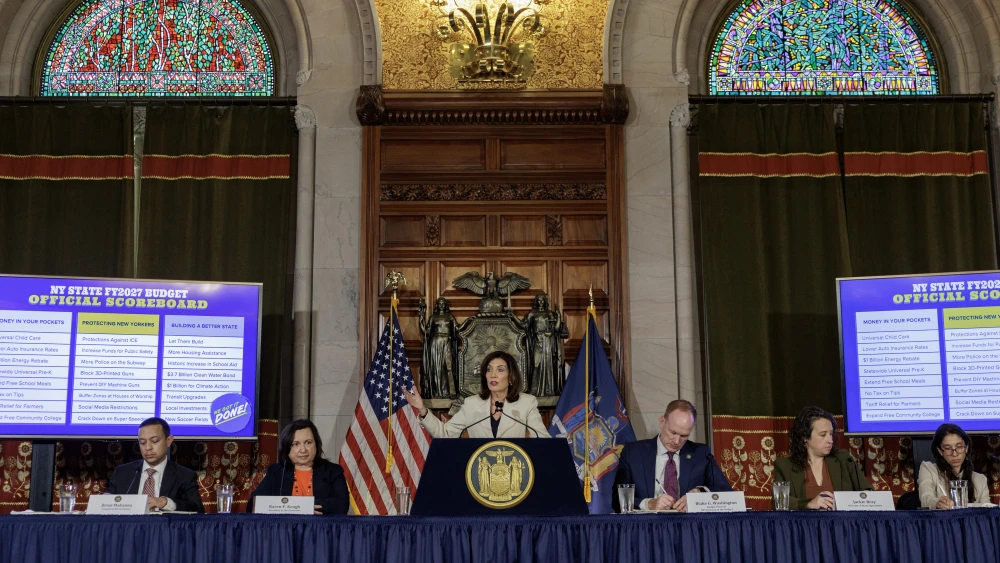
New York lawmakers rolled a proposal for a 50-foot “buffer zone” around Jewish day schools and community centers into the state budget on Tuesday.
Sam Sutton, a Democratic state senator who is Jewish, stated that “after the horrific incident outside Park East Synagogue, I became the first legislator to introduce this proposal.”
“Today, buffer zone protections were included in the final state budget,” he said.
Noam Abrahams, Sutton’s communications director, told JNS that the proposal was included in the budget bill that’s being discussed in session.
“Although that means it hasn’t technically passed both houses yet, I’ve never seen a budget bill not pass once it was on the floor,” Abrahams told JNS.
Mark Treyger, CEO of the Jewish Community Relations Council of New York, said that Jewish organizations and partners had turned “pain into purpose and ultimately policy to ensure safety reaches all faiths and communities across New York.”
Members of the state Assembly said that the buffer zone is particularly important after Zohran Mamdani, mayor of New York City, vetoed a buffer zone around educational institutions which passed the New York City Council without a veto-proof majority. The council passed a bill, which calls on the New York City Police Department to come up with a plan to protect houses of worship, with a veto-proof majority.
“Over the last three years, Jewish communities across New York have faced a deeply troubling rise in antisemitism, harassment and violence,” state legislators said in a press release. “From attacks outside synagogues and community institutions to the intimidation of students on college campuses, too many New Yorkers no longer feel secure in the very places that should offer refuge and belonging.”
When an initial proposal for a 25-foot buffer zone “restricting protest at houses of worship” was introduced several months ago, “many of us in the Assembly immediately felt it did not go far enough,” the representatives wrote. “We in the Assembly recognized that a narrow 25-foot boundary simply could not match the magnitude of this crisis.”
They added that the “state intervention became undeniably urgent following the New York City mayor’s veto of the City Council’s school safety perimeter transparency and reporting bill,” they stated. “That municipal failure left many Jewish New Yorkers deeply disappointed and exposed. If the city of New York cannot find it within themselves to take the necessary steps to protect our children, the state of New York must and will step in and act. We refuse to let local executive vetoes dictate the safety of our children, and we came together to fight for a state-level bill with real teeth.”
The Assembly members said that the “final legislation successfully secured in the New York state budget represents a massive legislative achievement.”
In addition to creating 50-foot perimeters, the new law also “creates a misdemeanor for individuals who demonstrate and harass within the 50-foot zone,” the lawmakers said.