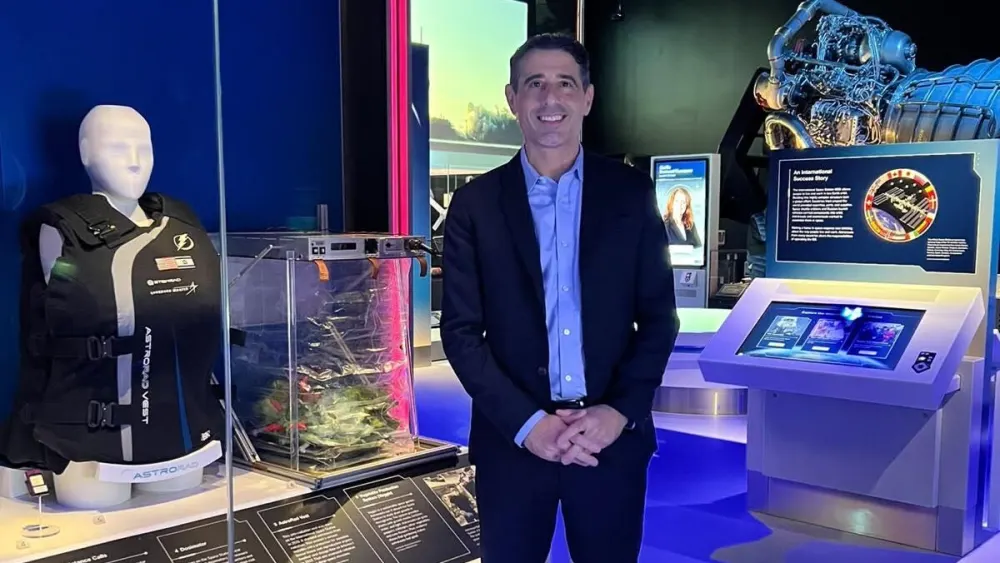
A radiation protection vest, developed by an Israeli-American company and worn by astronauts aboard the International Space Station, went on display Friday morning at the Smithsonian’s National Air and Space Museum in Washington, D.C.
The AstroRad vest, developed by StemRad, was worn by four female U.S. astronauts and an Israeli private astronaut during routine daily activities aboard the space station.
“Having AstroRad displayed at the Smithsonian is a tremendous honor and a proud milestone for our team,” stated Oren Milstein, CEO and co-founder of StemRad.
StemRad was founded in 2011. In 2023, the company secured a $4.5 million agreement with the U.S. Department of Defense for its 360-degree gamma-shielding gear for use by the U.S. National Guard.
“Knowing that a technology we developed to help protect astronauts is now being recognized as part of the history of space exploration is incredibly rewarding,” Milstein stated.
“With AstroRad also on display at Kennedy Space Center following the groundbreaking Artemis I mission, we hope these exhibits will inspire future generations to tackle the challenges of human space exploration,” he said.
AstroRad was developed in collaboration with Lockheed Martin to address ionizing radiation in space.
Research findings published in Science Advances suggested that “AstroRad’s ability to dramatically reduce radiation exposure during potentially cancer-inducing solar radiation storms.”
The figures were taken from NASA’s Artemis I mission, which went around the moon.
The vest from that voyage is on display at NASA’s Kennedy Space Center Visitor Complex in Florida.
“The AstroRad vest helps tell two stories in the new ‘At Home in Space’ exhibit,” stated Jennifer Levasseur, a curator at the National Air and Space Museum.
“Importantly, the vest represents efforts to protect astronauts from the significant concern of increased radiation exposure on long-duration spaceflights,” she said. “It’s also an example of how technology demonstrations on the ISS will inform future human deep space exploration.”