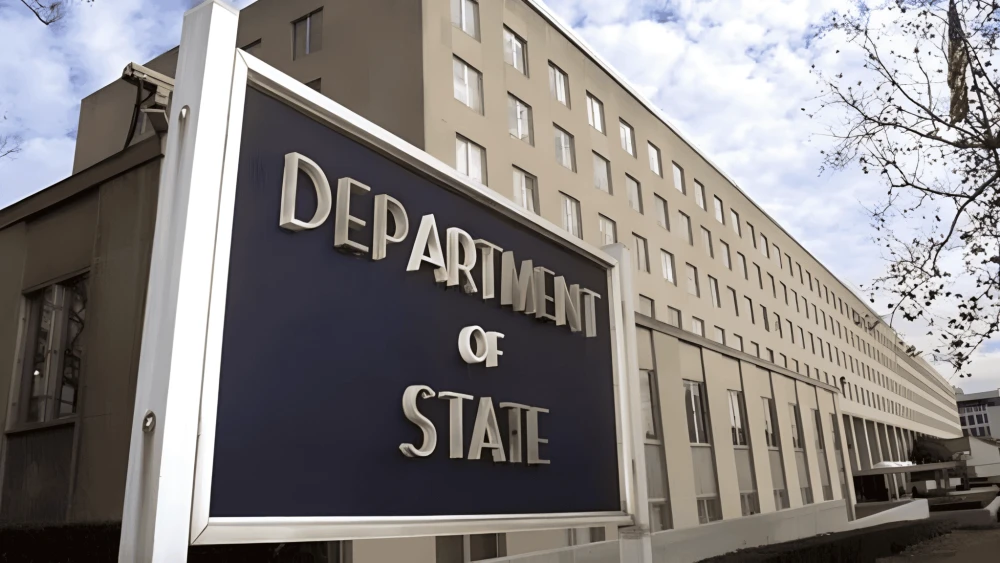
Members of the Congressional Jewish Caucus asked U.S. Secretary of State Marco Rubio to keep the Office of the Special Envoy for Holocaust Issues and not place it under the U.S. special envoy to monitor and combat antisemitism.
The office, established in 1999, advocates for Holocaust survivors. In a letter to Rubio on Wednesday, the lawmakers said that the special envoy “has worked with foreign governments, international institutions and Jewish organizations to pursue restitution and compensation for survivors and their families, recover Nazi-looted property, preserve Holocaust memory and address unresolved Holocaust-era obligations.”
“As the number of living Holocaust survivors continues to decline, this work is only becoming more urgent,” they wrote.
In the letter, the lawmakers also asked Rubio to quickly name a senior career State Department official to fill the vacancy as special envoy for Holocaust issues.
“That official should have the seniority, diplomatic experience and specialized expertise necessary to negotiate complex restitution and compensation matters and to maintain the relationships that” the Holocaust office “has built over decades,” they wrote.
“There are fewer Holocaust survivors with each passing year,” they wrote. “Every delay risks losing opportunities for restitution, accountability and historical preservation that may never return.”
The members took exception to proposals to merge the Holocaust office with the office on antisemitism, which they said have distinct and separate missions.
“Both are full-time responsibilities that require full-time principals with unique areas of focus and full-time staff with unique expertise,” they wrote. “Combining them would not streamline efficiency or eliminate any meaningful duplication. It would risk diminishing the focus, experience and institutional capacity necessary for each.”
The State Department declined comment. “As a matter of policy, we do not comment on congressional correspondence,” a department spokesman told JNS.
Those signing the letter include caucus co-chairs, Reps. Brad Schneider (D-Ill.) and Jerrold Nadler (D-N.Y.), and Reps. Jake Auchincloss (D-Mass.), Becca Balint (D-Vt.), Suzanne Bonamici (D-Ore.), Steve Cohen (D-Tenn.), Lois Frankel (D-Fla.), Laura Friedman (D-Calif.), Dan Goldman (D-N.Y), Josh Gottheimer (D-N.J.), Sara Jacobs (D-Calif.), Greg Landsman (D-Ohio), Mike Levin (D-Calif.), Jared Moskowitz (D-Fla.), Jamie Raskin (D-Md.), Jan Schakowsky (D-Ill.), Kim Schrier (D-Wash.), Eugene Vindman (D-Va.) and Debbie Wasserman Schultz (D-Fla).