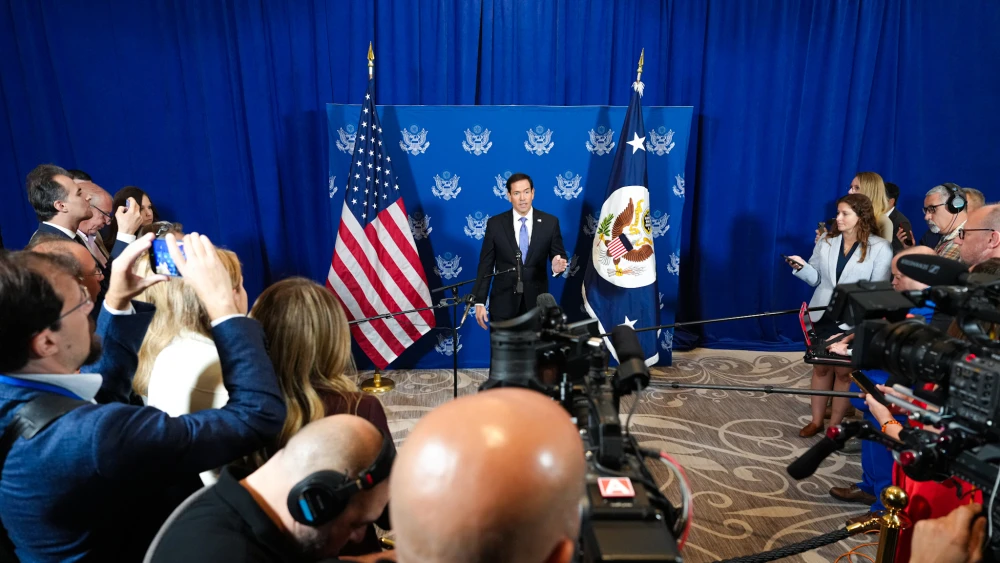
U.S. Secretary of State Marco Rubio told reporters on Wednesday that the United States doesn’t “want to see additional flashpoints” in Judea and Samaria, “given everything that’s going on in the region now.”
“The difficulties in implementing the agreements made with regard to Gaza, the tenuous situation in Lebanon, obviously now the Houthis and Saudi Arabia, the ongoing friction and conflict in Iran—obviously, the last thing this region needs is an additional flashpoint,” Rubio told reporters on the sidelines of the United Nations General Assembly high-level debate in New York City.
“The last thing we think Israel needs is an additional flashpoint,” he said. “The president really doesn’t think the world right now needs a West Bank crisis, and that’s our position.”
“I think we’ve been clear on that,” he said.
The secretary made the remarks amid growing tension between Jewish and Arab communities in the region, and some reports that the Trump administration has privately expressed frustration about the Israeli government’s control over the region.
Rubio wouldn’t say if U.S. President Donald Trump is considering taking action against Israelis, who may be contributing to the violence. Israeli officials have said the reports of such violence is either overblown or is leading to misdirected blame.
Washington and Tehran took part in surprise, indirect talks in New York on Tuesday.
Rubio said that the perception, which Trump has said often, that the Islamic Republic is playing for time until the U.S. midterms, shows that “the Iranians are fundamentally misreading our political system.”

“I think the president made it very clear yesterday. For him, the Iranian issue is not a political issue. It is the fact that for generations now, for almost 50 years, every American president and, frankly, every country in the world for the most part, agrees that Iran can never have a nuclear weapon,” Rubio said.
“But ultimately, no one ever does anything about it, and he’s going to do something about it,” he told reporters. “He’s doing something about it, and it comes at a price and at a cost, there’s no doubt about it. But the cost of not doing something about it is substantially higher, especially for future generations.”
JNS asked Rubio if Trump’s meeting with Gulf and other Middle East allies on Tuesday led to an agreement about how to collectively move forward in dealing with Iran.
“I think there’s consensus that the straits need to be open and free without attack,” he told JNS. “I think there’s consensus that what’s happening with the Houthis and in Yemen is deeply problematic. I think there’s a consensus that Iran can never have a nuclear weapon.”
“I think writ large, you’ve seen a lot of support from many of those countries for the sanctions and the economic costs that the United States is imposing,” the secretary added.
Rubio added that there is a “strong consensus that Iran is a malign force in the region.”
“At the end of the day, the one thing you will find in the region is that virtually every country in the region is facing the threat of some Iranian proxy that has for years—not for the last few months, for years—threatened the safety and security of these countries,” he told JNS. “On that, there’s very strong consensus that Iran is a malign force in the region.”

In the end, Iran must decide, “Do they want to be a country or do they want to be a revolution?”
Rubio blamed the Islamic Revolutionary Guard Corps for torpedoing a memorandum of understanding, which the two sides agreed to this summer and which quickly collapsed.
“The ultimate decision making in Iran lies in the hands of people that are strong believers in Iran the revolution, and that makes interactions problematic, because you can deal with the people that represent Iran the state, and you could reach agreement on some points, and you can even discuss the potential for agreement on other points,” Rubio said.