Republican and Democratic senators expressed support for increased funding for the Nonprofit Security Grant Program on Tuesday during the Orthodox Union Advocacy Center’s annual visit to Washington.
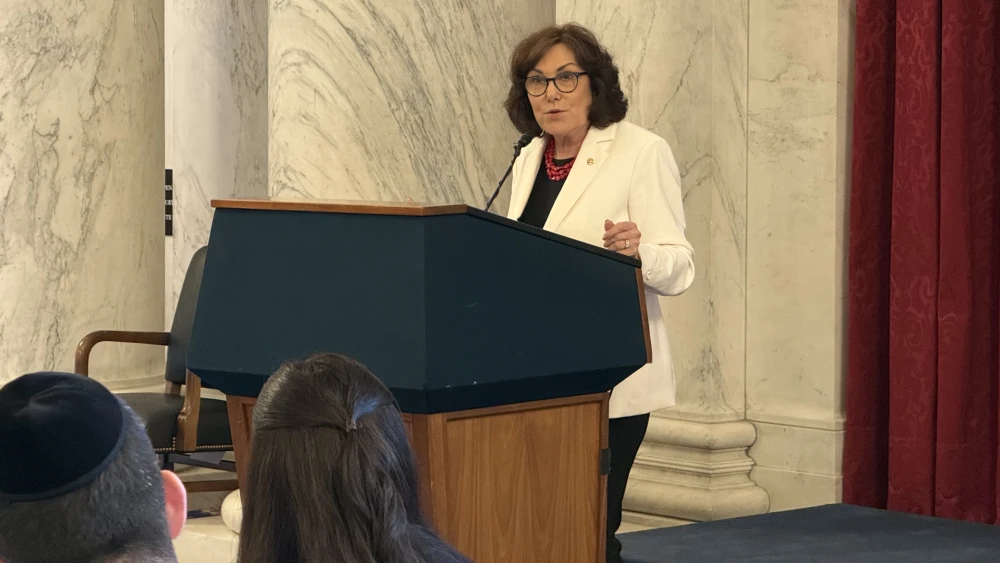
Speaking to some 120 center members in the Russell Senate Office Building, Sens. Elissa Slotkin (D-Mich.), Susan Collins (R-Maine), Andy Kim (D-N.J.) and Jacky Rosen (D-Nev.) argued that the rise of Jew-hatred in the United States requires greater federal spending to protect Jewish institutions.
“That was brought home to me when my own synagogue, Temple Israel, was attacked in March,” said Slotkin, who is Jewish. “We need to be surging to the threat.”
Jewish organizations and interfaith groups, including the Orthodox Union, have called for funds to the security grant program to be increased to $1 billion annually, up from the $300 million that was appropriated in the U.S. Department of Homeland Security’s funding bill for the 2026 fiscal year.
Senators of both parties frequently express support for the program, which is designed to improve security features at houses of worship and other vulnerable non-profit sites.
But except for a one-year surge to $450 million in 2024 after the Oct. 7 attacks, funding levels have hovered between $250 million to $300 million since 2022.
Earlier in June, the Republican-led House Appropriations Committee proposed a modest increase in the program for 2027 to $315 million.
Rabbi Josh Joseph, the Orthodox Union’s executive vice president and chief operating officer, told JNS that the history of the program, which started with $25 million in 2005, shows that progress is still being made.
“We’re not at a billion yet, but we’re closer,” Joseph said. “If we keep pushing and we keep working, you heard from all the senators—they’re on board.”
“We’ll get to the $1 billion that we need,” he said.
Though the OU advocates for the Orthodox community in the United States, Joseph said this issue unites Jews of all denominations.
“We’re all speaking with one voice right now that we need safe and secure access to places of worship,” he said.
“We need safe and secure institutions, nonprofits, synagogues, shuls, temples, schools, places of gathering. We’re all agreed on that,” he added. “We are in lockstep.”