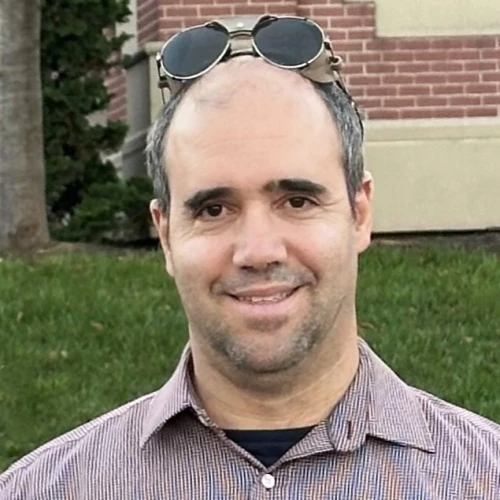
GIVATAYIM, Israel—Nearing 102 years old, curiosity has not left Dan Hadani.
The centenarian’s life story, which begins in prewar Poland and continues in the nascent State of Israel, weaves an extraordinary narrative of renewal and resilience that, in many ways, mirrors the history of modern Israel.
He survived a selection at Auschwitz conducted by the sadistic torturer Dr. Josef Mengele, also known as “the Angel of Death.”
With no family left after the Holocaust, he immigrated to Israel alone in 1948 to begin a new life. Hadani was immediately drafted into the Israel Defense Forces and served for 15 years in the Israeli Navy, beginning while the War of Independence was underway.
Despite having no formal training in photography, he embarked on a decades-long career in photojournalism. What began as a hobby and a source of income with the Kodak camera he had brought from Germany gained momentum during his final year of military service in the IDF Spokesperson’s Unit, following his naval service.
After his discharge, he followed his passion by founding a photography agency, where he rubbed shoulders with Israeli and world leaders while documenting Israeli history for three-and-a-half decades.
“From my childhood I was curious and remained curious,” Hadani told JNS in an interview last week at his apartment in suburban Tel Aviv, where he scrolls through decades-old photographs on his cellphone with the ease of someone a fraction of his age.
“Until today, I didn’t only want to know what, but how?” he said.

Historic contribution to Israeli archives
Hadani’s hobby became his profession after he was discharged from the military in the mid-1960s.
He founded the Tel Aviv-based Israel Press Photo Agency (IPPA), which operated from 1964 to 2000. The private news photography agency employed professional photographers who documented many of the defining moments in Israel’s history.
In an era before email, Hadani recalls mailing four to eight photographs—complete with captions he wrote himself—twice a week to 25 newspapers around the world that retained his services.
“They always say a picture is worth a thousand words, but it isn’t worth anything if there are no words attached to it,” he quipped.
His work took him to Washington, where he photographed Israeli Prime Minister Menachem Begin and Egyptian President Anwar Sadat, images the ever-active centenarian proudly displays on his computer alongside photographs of Israel’s founding father and first prime minister, David Ben-Gurion, visiting his naval base, and the first truck delivering ice in Tel Aviv.
After closing the agency in 2000, when most people his age would have been thinking about retirement, Hadani embarked on a 15-year effort to digitize hundreds of thousands of negatives.
Last decade, already in his 90s, Hadani donated his life’s work—400,000 digitized negatives, another 1 million negatives and tens of thousands of slides—to the National Library of Israel.
“At first, I was going to destroy them because I didn’t want to see them end up littered in the street,” Hadani said matter-of-factly.
He had even planned to buy two paper shredders after failing to sell the collection when, by chance, a National Library official contacted him that very day and suggested donating it instead.
Hadani still remembers the seven-ton truck that arrived at his home in 2016 to transport the meticulously stored boxes of negatives.
“There were days I almost cried,” he recalled. “It pained me that I was going against the principles of an independent photographer who started with nothing, but this was the history of the State of Israel.”
In August, the National Library will hold a special ceremony unveiling the Dan Hadani Collection.

Tragic beginning
It was only later in life that Hadani, who Hebraized his name after immigrating to Israel, publicly shared the story of his childhood during the Holocaust.
He was born Dunek Zloczewski in Lodz, Poland, in 1924 to a staunchly Zionist family that planned to immigrate to what was then British Mandatory Palestine before World War II.
The family even reached Italy before a friend of his father’s who had just returned from the Holy Land persuaded them not to continue because of the Arab riots against Jews in the 1930s.
“That was our fate, and all the tragedy of Auschwitz,” he said.
Eight decades later, Hadani vividly remembers the brutality of the Germans as they entered Polish towns, murdering Jews trying to flee Lodz and pushing them into city sewers. “The spirit of mankind cannot comprehend what I saw,” he stated.
After his father, who had fallen ill, died in the Lodz Ghetto, Hadani, his mother and sister were deported to Auschwitz on one of the last transports in 1944. He lost sight of them within seconds of arriving at the Nazi death camp and never saw them again. He later learned that they had both been murdered.
Hadani still remembers looking into the open train cars and seeing the bodies of those who had not survived the journey lying alongside buckets of human waste.

“It was a nightmare,” he said.
Soon afterward, he came face to face with German SS officer and physician Josef Mengele during one of the camp’s infamous selections.
Mengele pointed in Hadani’s direction, prompting him to respond in German: “Did you mean me?” The Nazi guards looked on in astonishment, accustomed to complete silence during the selections.
“Stand still, dog,” Mengele shouted, pointing instead to the man behind Hadani.
After the war, Hadani returned to Lodz to find he had no family left. He made his way to Italy before immigrating to Israel.
‘There is no tired for me’
Eighty years later, the Hamas-led terrorist attacks in southern Israel on Oct. 7, 2023, brought back painful childhood memories, leaving him feeling that another kind of Holocaust had struck the Jewish state.
“You are living on a volcano,” he said. “Did you prepare yourself for that?”
Turning 102 next month, Hadani—who drove himself until last year and now receives only minimal assistance from a caregiver—is already focused on his next project: a book.
“There is no ‘I am tired’ for me,” he said. “This is something that I take with me from the Holocaust.”
He rises at 6 a.m. each day and still goes out for coffee with friends in Tel Aviv.
“I have to move about,” he said.
Looking back on his remarkable life, which began in tragedy, Hadani said he accomplished things that defied all logic.
“It’s not how old you are; age is just a number,” he said.