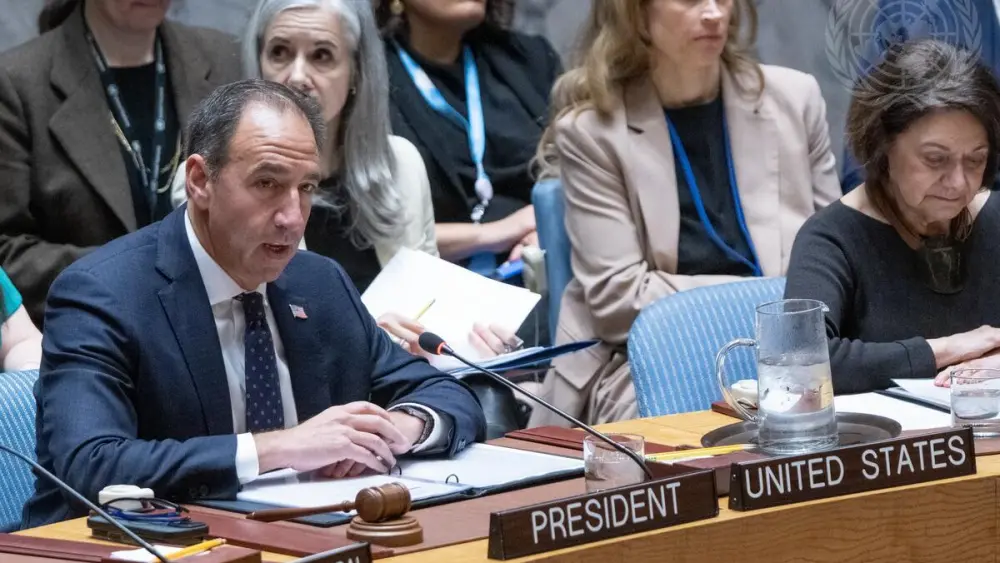
Jeff Bartos, U.S. representative for U.N. management and reform, criticized the U.N. Relief and Works Agency for Palestine Refugees in the Near East during the agency’s annual donor conference on Tuesday, urging member states to stop funding what he described as a terror-compromised organization.
“Another annual pledging conference for UNRWA. Same speeches,” Bartos said. “Same condemnation of Israel. Same failures to condemn Hamas.”
The conference sought contributions for the global body’s Palestinian aid and social services organization, which says it faces a $100 million deficit for the current fiscal year, despite significant cuts in services.
Since the Hamas-led terrorist attacks in southern Israel on Oct. 7, 2023, UNRWA has come under intense scrutiny after evidence emerged that some employees participated in the attack and following longstanding allegations of ties between agency staff and Gaza-based terrorist organizations. Several donor nations suspended funding before many later resumed contributions.
Echoing the Trump administration’s position, Bartos urged governments to end their support.
“Year after year, you choose to fund UNRWA in Gaza, hoping for—and perhaps even expecting—a different result. It is time—it is well past time—to break this cycle,” he said.
“This year, you have the choice to stop funding UNRWA schools in Gaza that indoctrinate the hatred of Jews and glorify terrorism,” Bartos added. “To stop underwriting an organization that has become a subsidiary of Hamas, whose employees took part in one of the most barbaric terrorist attacks in human history.”
He urged member states to take advantage of the opportunity to help Gazans “find durable solutions and prosper, instead of subjecting them to endless cycles of dependency and forever refugeehood” and fund the U.S.-led Board of Peace instead.
Christian Saunders, UNRWA’s acting commissioner-general, called the level of donor commitments announced on Tuesday “a little disappointing,” though a final total was not immediately available.
Saunders said he agreed that “we need to do things differently,” but argued that “we need to stop making UNRWA the talking point here.”
“We do an awful lot to ensure the neutrality and the appropriateness of the education and the learning that takes place in UNRWA schools,” he said, insisting that every page of every textbook is reviewed, with inappropriate material replaced.
Responding to Bartos’s criticism that the agency has failed to identify extremists within its ranks, Saunders acknowledged that UNRWA depends heavily on information from member states, particularly Israel, to investigate allegations of misconduct.
“If people are committing criminal acts,” he said. “Then we take action.”
However, after a U.S. foreign-aid watchdog presented evidence that about 100 UNRWA employees had ties to terrorist groups, UNRWA disputed the findings, even as it fired 70 employees in June. A U.N. spokesman told JNS at the time that “sometimes the commissioner-general has to take decisions that are not easy to take, but that are in the best interest of the organization.”
Saunders also agreed that long-term reliance on UNRWA is unsustainable, saying Palestinians need greater economic opportunity and self-sufficiency.
“We have to look to promoting livelihoods, to promoting economic opportunities so that Palestinians are given agency, and they can live full and meaningful lives while waiting for a political solution,” he said.