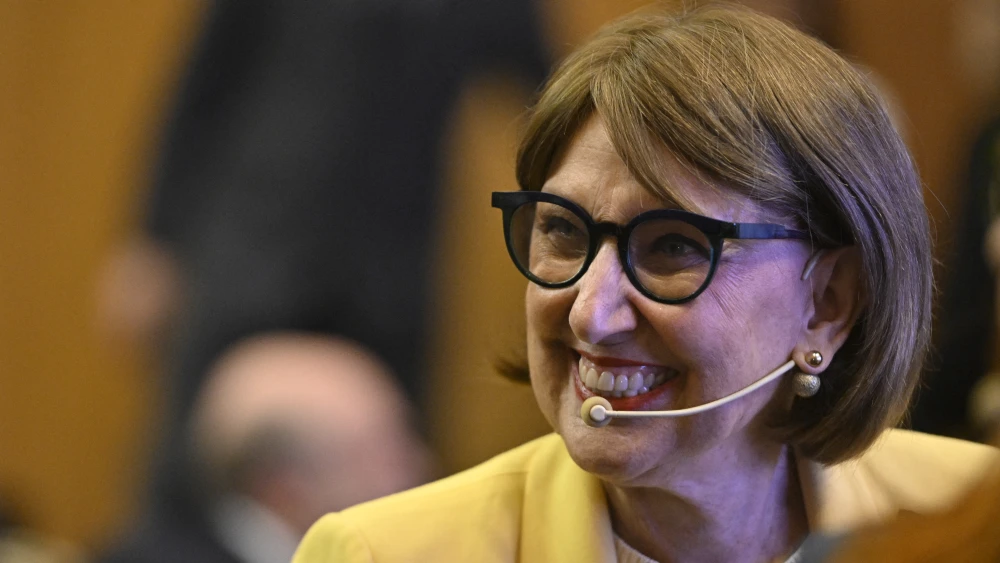

Rebeca Grynspan, a Costa Rican Jew, emerged on July 30 as the early frontrunner in the first informal U.N. Security Council poll to select the world body’s next secretary-general.
A former vice president of Costa Rica, Grynspan received 10 “encourage” votes from the council’s 15 members, one more than her nearest rival. The poll was nonbinding and more rounds are expected, but if Grynspan ultimately prevails, she would become both the first woman and the first Jew to lead the United Nations.
Her candidacy casts an intriguing light on the history of the Central American nation’s tiny Jewish community.
Grynspan’s parents were Polish Jews who fled Poland before World War II. After surviving the war, they attempted to reach the Land of Israel but were detained by the British in Cyprus. They met there and married, later settling in Costa Rica. The family initially ran a small store in the countryside before moving to the capital of San José, where Grynspan’s parents established a textile factory.
Nearly a century ago, the Polish Jews who laid the foundations of the modern Costa Rican Jewish community were far removed from national office or international diplomacy.
They arrived in the late 1920s and 1930s with little money, almost no Spanish and few useful connections. Most came from a handful of Polish towns, especially Żelechów and Ostrowiec. Some had planned to continue to Argentina or Brazil but remained after landing at the Caribbean port of Limón. Others followed relatives or townspeople who had written home saying that it was possible to make a living in the region.
One of the earliest arrivals was Max Teitelbaum. He fled Poland in 1928 to escape military conscription. His ship was forced to stop in Limón, and while waiting in San José, he decided to stay and began selling door to door.
Many Jewish newcomers followed the same path. They bought clothing, fabric and household goods on credit in San José and carried them into smaller towns and rural areas. Some walked; others traveled by horse or mule. They knocked on doors, displayed their wares and allowed customers to pay in installments. Costa Ricans came to call them polacos.
In Spanish, the word simply means “Poles.” But Polish Jewish immigrants became so closely identified with door-to-door installment sales that their national label was gradually transferred to the occupation itself. A polaco came to mean not only someone from Poland but also an itinerant peddler, whether or not he was Polish.
The usage became so deeply embedded that the Royal Spanish Academy still defines polaco in Costa Rica as an itinerant seller, particularly one selling clothing in rural areas. It also records the verb polaquear, meaning to sell from house to house, generally on credit.
The work was hard, but it gave the newcomers a foothold. It also allowed rural families to purchase goods they could not otherwise afford. In time, many of the peddlers opened stores, import businesses and small factories, particularly in clothing and textiles.
They were not, however, the first Jews to reach Costa Rica.
Some historians believe that conversos—Jews forced to convert to Catholicism in Spain and Portugal—arrived during the centuries of Spanish rule, starting in the 16th century and ending with independence in 1821. Many settled around Cartago, Costa Rica’s first capital. Over time, their descendants assimilated into the local population.
Hungary had wanted her dead. Costa Rica gave her work, freedom and a future for her three sons.
In the 19th century, Sephardic merchants arrived from Curaçao, Jamaica, Panama and other Caribbean ports. They participated in trade but established few lasting Jewish institutions.
It was Polish immigrants who built the institutions on which today’s community rests. But as they prospered, resentment grew. During the 1930s, Costa Rica tightened Jewish immigration, while politicians and newspapers accused Jewish merchants of unfair competition and sought to restrict peddling and other commercial activity by foreigners.
Antisemitism intensified amid the political upheaval of the 1948 Costa Rican civil war. In 1952, nationalist activists promoted measures that would have restricted commerce to native Costa Ricans, and Jewish homes and institutions in San José were targeted. The following year, however, President José Figueres Ferrer publicly affirmed that Jews were entitled to the same constitutional rights as other citizens.
By then, Jewish communal life had become firmly established.
The country’s first Jewish cemetery opened in 1931. The Centro Israelita Sionista de Costa Rica became the central organization for religious life, education, charity and youth programs. Its principal synagogue, Shaarei Zion, followed Orthodox practice even though levels of personal observance varied widely.
Education became central as well. The Dr. Chaim Weizmann School, officially the Instituto Dr. Jaim Weizman, opened in 1960. Students followed the national curriculum while also studying Hebrew, Jewish history and tradition.
After the Holocaust, survivors arrived to join relatives already living in the Central American country. One of them was Magda de Davidovich, a Hungarian Jew who survived Nazi persecution, fled Communist Hungary in 1956 and reached Costa Rica the following year.
She later spoke with deep affection about the country that had taken her in. Hungary, she said, had wanted her dead. Costa Rica gave her work, freedom and a future for her three sons.
“We didn’t just survive,” she said. “We multiplied.”
Others followed relatives or townspeople who had written home saying that it was possible to make a living in the region.
Over the decades, Costa Rican Jews moved from peddling into academia, government and diplomacy. They served in the legislature and cabinet, and attained some of the country’s highest offices. The organized Jewish community has also maintained strong Zionist ties and a close identification with Israel.
Remarkably, four Costa Rican Jews have been elected vice president. Grynspan served from 1994 to 1998, followed by Astrid Fischel from 1998 to 2002. Luis Fishman was elected second vice president in 2002, while banker and economist Luis Liberman served as second vice president from 2010 to 2014.
For a Jewish community generally estimated at only a few thousand people, that is an extraordinary record.
Costa Rica’s ties with the Jewish state have been significant. It recognized Israel in 1948 and later maintained its embassy in Jerusalem for decades, one of only a handful of countries to do so. The embassy was moved to Tel Aviv in 2006. But in May 2026, shortly after taking office, President Laura Fernández Delgado expressed her willingness to upgrade Costa Rica’s diplomatic representation in Jerusalem to a full embassy.
At the same time, Jewish life has spread beyond San José. Israelis and other Jews have settled in Pacific beach towns such as Jacó, Uvita, Manuel Antonio and Santa Teresa, where Hebrew signs and Israeli restaurants have become increasingly common. Chabad now maintains a permanent presence in Santa Teresa, where Friday-night meals can attract more than 100 people during the high season.
Jewish life in Costa Rica today bears little resemblance to the world those first Polish immigrants encountered. The community has established schools, synagogues and institutions; entered public life at the highest levels; and expanded beyond San José to new centers along the Pacific coast.
Still, one of the most unusual reminders of its beginnings remains hidden in plain sight.
The word polaco began as a description of Jewish immigrants from Poland who made their living as itinerant salesmen. Over time, Costa Ricans came to use it for the trade itself. Nearly a century later, that usage remains a small but revealing testament to how deeply those Jewish newcomers became woven into national life.