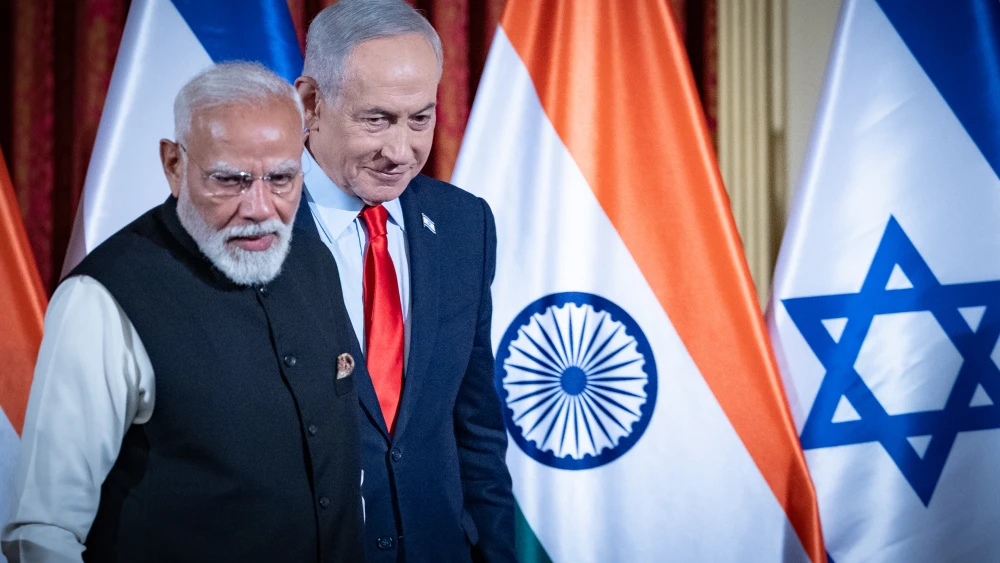
Amnesty International, an NGO whose critics say it disproportionately singles out Israel, released a report on July 30 stating that India’s arms shipments to the Jewish state put it at risk of being complicit in “genocide.”
The NGO said it analyzed 2,596 weapons-related shipments sent from India to Israel between Oct. 7, 2023 and Nov. 30, 2025, and documented some 390,516 parts for military-grade small arms, 564,970 parts for explosive weaponry and 298 military vehicle components. Amnesty identified companies that India owns and controls as among the suppliers.
The NGO excluded shipments that may have been meant for civilian use or for anti-missile defense technology.
Agnès Callamard, secretary-general of Amnesty, stated that “India manufactures and supplies arms transferred to Israel through its ownership and control over key supplier companies” and has “deepened its defense partnership with Israel.”
“By knowingly allowing the transfer of arms to Israel, India stands in clear violation of its duty to prevent genocide under the Genocide Convention and its obligation to ensure respect for the Geneva Conventions,” she said.
Hillel Neuer, executive director of UN Watch, told JNS that “Amnesty’s accusation is an obscene inversion of truth.”
“The only attempted genocide was Hamas’s Oct. 7 massacre. Had they not been stopped, Hamas terrorists would have continued slaughtering Israelis,” he said, referring to the Palestinian Arab invasion of southern Israel, and the ensuing atrocities and hostage-taking that launched the war in 2023.
Neuer stated that “India is not enabling ‘genocide.’ It is helping a fellow democracy defend its citizens against genocidal Islamist terrorists. That is both legitimate and honorable.”
Max Abrahms, associate professor of political science at Northeastern University, told JNS that “there was no genocide. Not even a little bit.”
“This is all just an antisemitic op,” he said, adding that “India is currently a critical ally for Israel.”
“That bilateral relationship will only grow in importance due to the emerging Pakistan-Turkey-Saudi alliance coupled with reduced confidence in U.S. military assistance into the future,” he said.