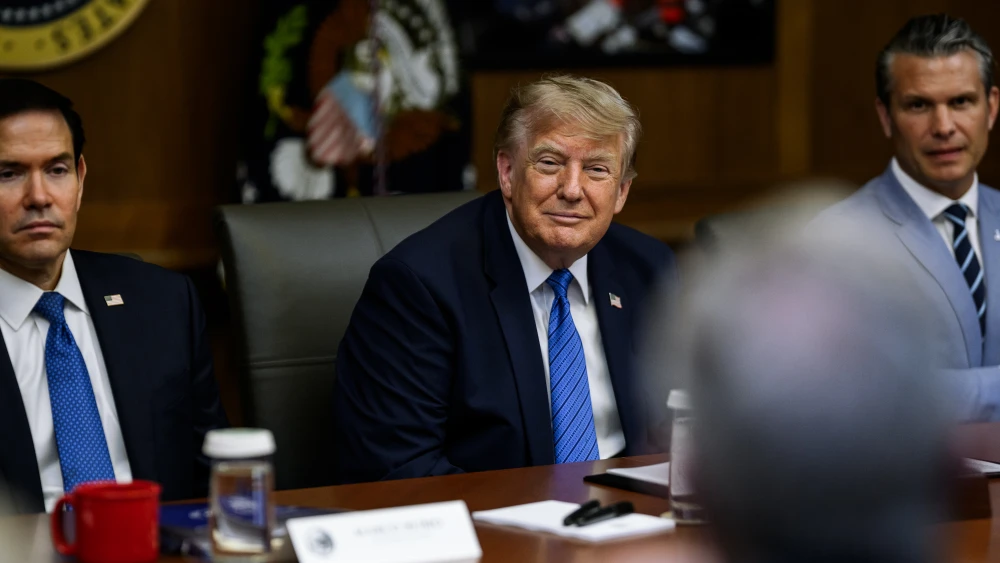
U.S. President Donald Trump signaled on Sunday that he is prepared to let economic pressure on Iran build rather than order a renewed military offensive.
“We are low-keying it,” Trump said during a brief phone call with Axios reporter Barak Ravid, adding that Washington was “only semi-negotiating” while watching the Islamic Republic’s soaring inflation.
The regime “is in very bad shape” economically and cannot pay its troops due to the U.S. naval blockade on Iranian ports, the president said.
Axios noted that Trump made no new military threats and voiced no frustration over Iran’s delay of an announcement on reopening the Strait of Hormuz. He likened the standoff to a game of chess, saying, “It always works out.”
U.S. officials told Axios that Trump had been leaning toward resuming major combat operations a week ago but was persuaded to de-escalate.
When the regime is not at war, an official added, it is forced to confront a grim economic reality with no real solutions at hand.
U.S. Central Command said on Sunday that it has redirected 55 commercial vessels, disabled two and boarded two since the blockade of Iranian ports resumed on July 14.
CENTCOM published the figures on X alongside an image of U.S. sailors standing watch on the bridge of the Aegis guided missile destroyer USS Ross, one of more than 20 warships deployed to the Middle East for missions “including strict enforcement of the U.S. blockade against Iran.”
Since Saturday, the military redirected two more commercial vessels, according to CENTCOM.
In a Saturday post, the command said it had also permitted more than 30 ships to pass through the blockade for humanitarian aid.
U.S. Sailors stand watch on the bridge of USS Ross (DDG 71). Ross is one of over 20 U.S. warships deployed to the Middle East supporting military missions, including strict enforcement of the U.S. blockade against Iran. As of Aug. 9, CENTCOM has redirected 55 commercial vessels,… pic.twitter.com/B5NCpX7Nxw
— U.S. Central Command (@CENTCOM) August 9, 2026
Tehran reshapes leadership positions
Meanwhile in Iran, President Masoud Pezeshkian has appointed former Islamic Revolutionary Guard Corps commander Mohsen Rezaei as secretary of Iran’s Supreme National Security Council, replacing Mohammad Bagher Zolghadr, the president’s office confirmed on Sunday.
Supreme Leader Ayatollah Mojtaba Khamenei separately appointed Rezaei as his representative on the council, citing his “valuable experience” and his role as “one of the first commanders” during the 1980-88 Iran-Iraq War.
Khamenei also named Zolghadr as his political adviser. Rezaei commanded the IRGC during most of the Iran-Iraq War and has since held senior political and security positions.
In the Name of God, the Compassionate, the Merciful
— Ayatollah Mojtaba Khamenei (@MKhamenei_ir) August 9, 2026
Dr. Mohsen Rezaee
Considering your valuable experience, I am hereby appointing you, who were one of the first commanders in the triumphant 8-Year Sacred Defense, to be my representative in the Supreme National Security Council.
On Saturday, Tehran issued a list of conditions for the reopening of the Strait of Hormuz, including that the United States “completely compensate” Iran for war damages, the Associated Press reported.
The United States must never threaten Iran again; must permanently end hostilities in the region; must lift the naval blockade of Iranian ports and withdraw its military from the area; and must lift sanctions and “unconditionally” release frozen assets, the report cited Tehran’s Supreme National Security Council as saying.
Iranian Foreign Ministry spokesman Esmail Baghaei confirmed on Monday that Iran will not agree to reopen the Strait of Hormuz until the United States lifts its naval blockade and compensates Tehran for damages caused by U.S. and Israeli attacks.
“The opening of the Strait of Hormuz is contingent on the fulfillment of conditions that have been imposed on the Islamic Republic of Iran,” Baghaei said, adding that Washington must halt what Tehran considers violations of the June 17 Memorandum of Understanding and “make amends.”
The demands come on the backdrop of renewed negotiations between Tehran and Muscat over the opening of a new transit route in the Strait of Hormuz.
Iranian Foreign Minister Abbas Araghchi said on Saturday that the sides are “very close” to finalizing an agreement. Pezeshkian held a press conference in Tehran the same day, saying that now was the best time for an agreement to end hostilities, the report continued.
“There is cohesion, strength and unity in the country, and as far as I know, Iran is considered victorious and powerful in this war,” Iranian news agencies quoted him as saying.
On Sunday, however, Araghchi said that Tehran and the United States are not currently holding talks, adding that messages are being passed through intermediaries but that “this process is not called negotiation.”