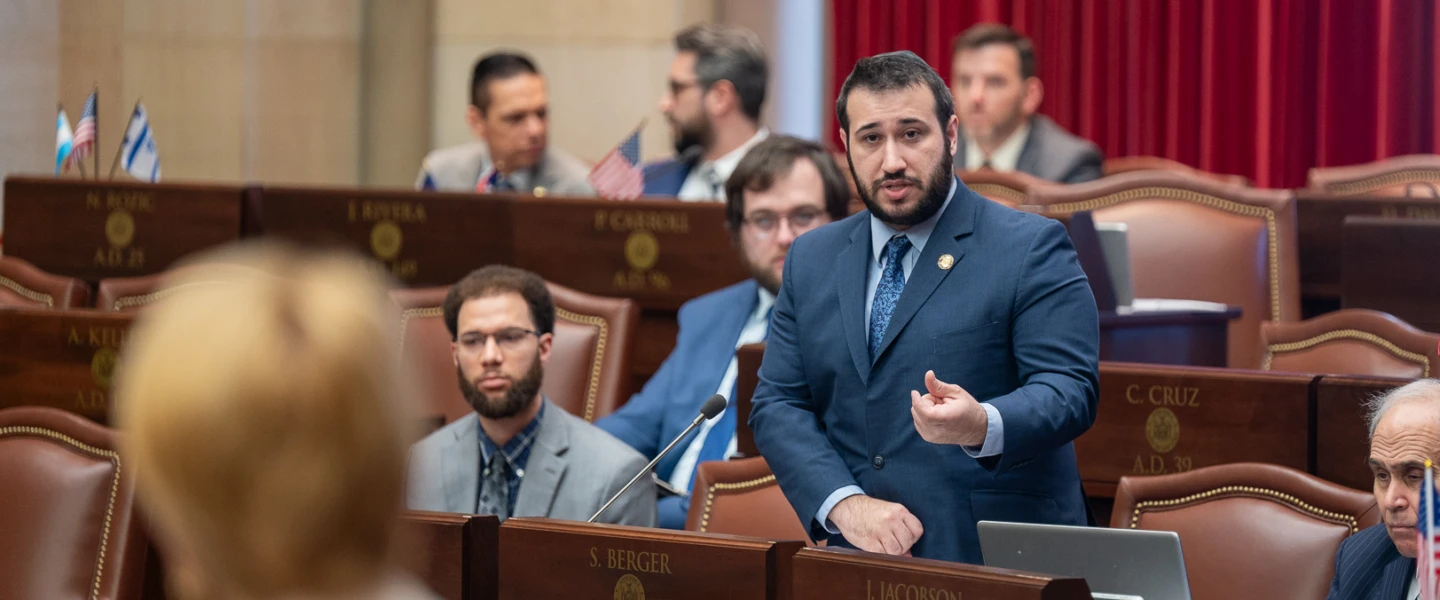
Simcha Eichenstein, a Chassidic member of the New York state Assembly, wasn’t convinced that fellow Orthodox Jewish state legislator Sam Berger was going to be able to get what came to be called Gittel’s Law passed in 2024.
“I didn’t believe he’d get it. Nobody did,” Eichenstein told JNS. “Everyone told him, ‘You’re making a mistake.’”
The law, which Berger sponsored and which he told JNS was his first major legislative achievement, expanded the definition of mental healthcare provider under state sex-offense statutes to include licensed mental health counselors and licensed marriage and family therapists.
It addressed a gap in the law that left patients vulnerable to sexual exploitation by professionals, whose credentials were not covered by the existing definition.
Eichenstein told JNS that Berger returned often from meetings with staff and legislative leaders frustrated but unwilling to abandon the effort to get the law passed. “I’m not giving up,” he told Eichenstein.
At 28, Berger, known to family and friends as Shmuie, is the youngest member of the New York state Assembly. An Orthodox Jew, attorney, husband and father of three, he told JNS that getting the law passed convinced him that the government can work when legislators put in the effort.
“It was about protecting people who are in the most vulnerable state,” he said.
Berger worked intensively to build support, securing 80 Democratic co-sponsors before the measure passed the Assembly. New York Gov. Kathy Hochul signed it into law on Dec. 21, 2024.
He told JNs that he got a standing ovation when the bill passed, and then he got a second standing ovation. A senior colleague told him that he had never seen that happen to a legislator for a single bill, he told JNS.

Berger entered politics almost by accident when he was preparing to take the bar exam after graduating from St. John’s University School of Law, he told JNS.
“I went to law school to help people,” he said.
His father, an attorney, helped shape that outlook. Berger watched both his parents work behind the scenes to support the Queens community and saw how his father used his legal connections to help others. His father also served as president of Bnos Malka Academy, an Orthodox school for girls in Queens.
Before pursuing law, Berger discussed his future career path with his rabbi and rosh yeshiva in Jerusalem, where he spent three-and-a-half-years studying. He also completed internships in criminal court and surrogate’s court, which helped him understand the ways that he could serve others.
“As long as I can be in a place where I’m productive and I’m able to make a meaningful difference to help people, that’s where I want to be,” he told JNS.
He found going from law to representing New Yorkers in Albany seamless.
“When you’re practicing law, it’s learning how to apply the law,” he said. “Being a legislator at its core is learning how to draft a law.”
As a then 25-year-old without political experience, Berger was preparing for the bar.
Daniel Rosenthal, vice president for government relations at the UJA-Federation of New York, who was then a state Assembly member, talked to Berger about entering public service.
Berger’s and Rosenthal’s families were close due to their involvement in the Queens Jewish community, and the conversation prompted Berger to consider a political career that he hadn’t imagined before.
“I said, ‘OK, if this is the best place I can be,’” he told JNS. “This is where I can help people. This is where I can do chesed,” Hebrew for “kindness.”

“This is where I can make a difference, and this is what I want to do,” he said.
He split his time between preparing for the bar exam and politics. He passed the bar, won the election and took office in September 2023.
Berger represents the Assembly’s 27th district, which includes Kew Gardens Hills, Pomonok, Electchester, College Point and Whitestone. The neighborhoods are familiar to the Kew Gardens Hills native, who attended school in the area and returned after his years of Torah study in Israel.
That familiarity, he said, makes the job both meaningful and humbling.
His political philosophy is rooted in local concerns rather than party maneuvering. “It’s always about local politics,” Berger told JNS. “It’s trying to make sure your ear is always to the ground and you’re listening to people, being available to people and not getting lost in the political news cycle.”
Grilled-cheese, microwave meals
Berger told JNS that his Jewish identity informs not only the legislation he pursues but also the way he conducts himself in public office.
“When I go out and do things, it’s never, ‘Oh, look at what Sam did.’ It’s always like, ‘What Sam-the-Jew did,’” he said.
He feels a responsibility to represent the Orthodox community well and to take substantive action against Jew-hatred rather than limiting himself to public statements of condemnation.
He also wishes more New Yorkers understood how central education is to Orthodox Jewish life. His father and mother have both been involved in education, and his wife is a speech therapist and teaches at a Jewish high school.
“We want to make sure our kids are getting the best quality education possible,” he said. “I really wish that the secular world could see that and understand that.”
His religious commitments present practical challenges in Albany, where he spends extended periods during the legislative session, away from his family and familiar Jewish community.
Kosher food options are limited, and finding places to pray can be difficult. For an Orthodox legislator, maintaining his routine requires planning and support.
The legislative session runs from January until mid-June, and because Albany is about a three-hour drive from Queens, Berger typically spends Sunday night to Wednesday or Thursday night there. His wife helps prepare dinners for him to bring, and he has a kosher microwave and a grilled-cheese maker in his office, he told JNS.

The time away makes spending Shabbat with his family particularly important, and when he is home during the week, he tries to give his three children especially focused attention, he told JNS.
Assembly speaker Carl Heastie recognized the implications for Berger’s family when the latter won his special election. At the victory party, Heastie approached Berger’s wife, knowing her husband would be spending considerable time in Albany.
“Don’t worry. I promise he will never be in Albany for Shabbos,” Heastie told her, Berger recalled. “It was a very kind reassurance, though Hashem had other plans.”
Sessions rarely extend into the weekend, except during budget negotiations, which can last two or three days and sometimes involve working through the night, and at the end of the legislative session, when major bills are being considered.
The Assembly does not require Sabbath-observant members to remain in Albany during those periods and recesses for the Purim and Pesach holidays.
Berger has only spent one Shabbat in Albany. During his first year in office, he and Eichenstein remained in the capital while legislation affecting every yeshiva in New York state was being negotiated that day.
After consulting his rabbi, Berger said he was told that he had an obligation to be present and represent the interests of Orthodox Jewish New Yorkers.
Arrangements proved difficult. Their food was delivered to the entrance of the Capitol on Friday afternoon, but it was stolen. The two lawmakers voted without using electronics or otherwise violating the Sabbath, Berger told JNS.
He was unable to leave the Capitol because of its entrances and exits that would require him to use electricity. “I stayed in my office, on my couch,” he told JNS.
On a typical morning, including when he is in Albany, Berger spends about 30 minutes studying the Talmud over Zoom with a friend from his former seminary in Israel, Yeshivas Bircas HaTorah.
The duo has been studying together consistently for more than seven years, and for the past two years, the two have been working their way through tractate Sanhedrin, which discusses the laws and structure of the Jewish court system.
The daily study helps Beger begin the day with Torah before turning to the demands of legislation and public service. “Our religion is not separate from our lifestyle,” he told JNS. “Our religion is our lifestyle.”

He also consults with a rabbi when confronting votes that may raise difficult religious or ethical questions to make decisions in accordance with Jewish law.
The arrangements are not always easy, but Berger views the effort as part of his responsibility rather than an obstacle to his work.
He has also developed close friendships with non-Jewish colleagues in Albany, something he initially was unsure how he would navigate socially.
He does not drink alcohol, and there is not much to do around the Capitol beyond a few bars. Over time, however, long nights at work helped build camaraderie with legislators from across the state, he said.
Berger’s secular legislative friends have gone out of their way to accommodate his Orthodox observance, even making sure kosher ice cream is available when colleagues pick up a treat, he told JNS.
His faith also shapes his understanding of Israel’s importance to American Jews. For Orthodox Jews, he said, the relationship is not solely political.
“When we’re talking about the safety and security of that country, we’re talking about the safety and security of so many families of New Yorkers,” he said. “We forget that there is a religious component as well.”
He cited the practice of praying three times daily while facing Jerusalem as an example of the connection.
‘Jadedness’ of government
Berger’s age can be an advantage in a legislature where change often moves slowly, he has found.
“It makes me more willing to try new ideas,” he told JNS. “I don’t have the kind of jadedness that you can get in government.”
Berger described the legislative process as a marathon, in which proposals sometimes struggle to move forward. He believes being young and relatively new to politics has given him the energy to keep pushing.
One of his achievements came in 2025, when the Ignazio Giacalone Act passed, and Hochul signed it into law on Sept. 10. The law provides more service-exam credits to children and siblings of New York City sanitation workers who died from the Sept. 11 attacks or subsequent rescue and recovery operations.
The legislation followed a constituent’s efforts to address a disparity in the benefits available to relatives of deceased sanitation workers compared with those of police officers and firefighters.
For Berger, the bill illustrates why listening to constituents is central to his work. He had not experienced the work of a sanitation worker, firefighter or mental health professional, and understanding their challenges required speaking with the people affected, he said.
“There’s so much out there that the state hasn’t impacted,” he told JNS. “There are so many things we just don’t think about that are impacted by our local government.”
He recalled a constituent, a marriage and family therapist, who approached him about wanting to supervise social-work students but being unable to do so under existing state licensing rules.
Berger looked into the issue and found that state legislation could address it. The experience reinforced, for him, how much lawmakers can learn from people who approach them with problems they encounter in their professional and personal lives.
The Orthodox lawmaker has also advocated for better funding for early-intervention services for children, including speech, occupational and physical therapy.
His wife, a speech therapist, helped him understand the importance of getting children the services they need during critical developmental periods. He said he has also seen the difference early intervention made for his own children.
Berger has also made fighting Jew-hatred a legislative priority.
His proposed Honoring Our Pledge to Eliminate Antisemitism (HOPE) Act would require state agencies and courts to consider the International Holocaust Remembrance Alliance’s working definition of Jew-hatred when reviewing potential discrimination.
The measure would help clarify the distinction between legitimate political disagreement and antisemitism, including cases in which anti-Zionist rhetoric is used to justify discrimination against Jews, he said.
“I’ve never had a problem calling out people in my own party for either being antisemitic or fomenting antisemitic ideologies,” he told JNS. “I will always vote with the values of my community.”
The bill remains in committee as of October 2026.

‘Don’t want to check any part of who I am’
Berger’s family history reinforces his sense of responsibility. His grandparents were Holocaust survivors who settled in Forest Hills and rebuilt their lives in Queens.
He previously told JNS about their experience at the recent designation of Spider-Man Way in Forest Hills, a project for which he advocated because of the neighborhood’s connection to the fictional superhero.
Berger said that he does not see his religious, family and professional identities as separate from one another.
“I’m Shmuie. I’m Sam Berger. I’m a husband and father of three, an Orthodox Jew, a lawyer, a pop culture nerd and a representative of the people of Assembly district 27,” he told JNS.
“I try to bring all of those things with me into the Capitol every day,” he said. “I don’t want to check any part of who I am at the door when I walk into work.”
He hopes to bring a greater understanding of Orthodox Jewish life to colleagues with whom he works.
Berger measures his work less by symbolic achievements than by whether he has made a tangible difference for the people whom he represents.
JNS asked what he hopes his legacy will be.
“That we sought to make a real difference rather than just make a real career,” he said.