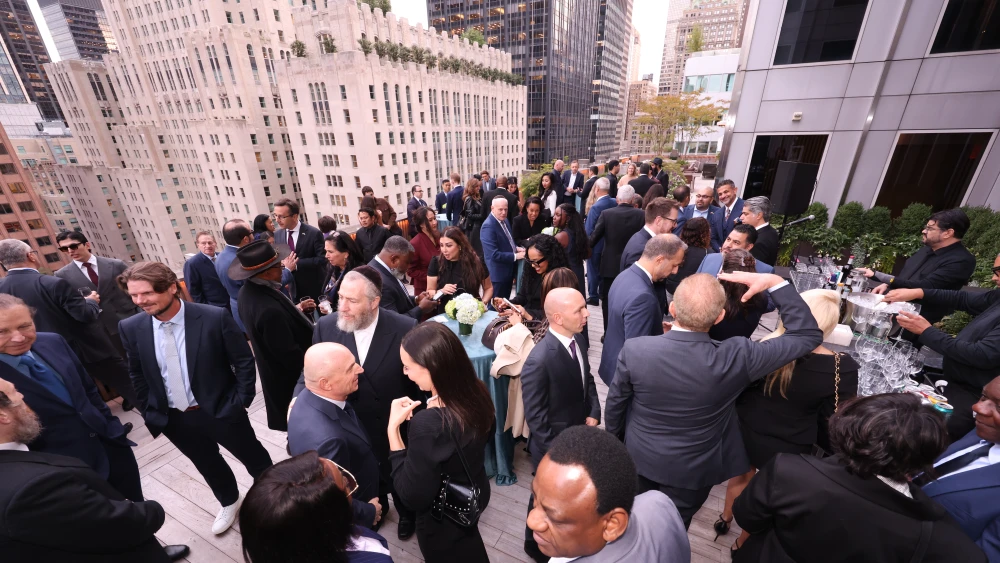
As world leaders and diplomats gathered in New York for the U.N. General Assembly, business leaders and international officials met for a Project Legacy gala focused on global cooperation, counterterrorism, antisemitism and economic development.
The Presidential Roundtable Gala and Dinner brought together officials and business leaders from the United States and abroad to discuss global challenges and opportunities for cooperation. Tunisian businessman Kamel Ghirbi chaired the gathering, while Ezra Friedlander and Joe Ouaknine co-hosted.
Held on the rooftop of the Mutual of America Building, the event also highlighted historical milestones involving the United Nations and Morocco’s relationship with the United States. Attendees included World Health Organization Director-General Tedros Adhanom Ghebreyesus; former Italian Foreign Minister Angelino Alfano; Balqasem Haftar, director-general of the Libya Development and Reconstruction Fund; and Prof. Dr. Khaled Abdel Ghaffar, Egypt’s minister of health and population.

“It’s an unprecedented opportunity to enter into dialogue with members of the international community,” Friedlander, Project Legacy’s founder and CEO, told JNS. “How often do they all get together? It’s only once a year in New York. So this was the obvious time, most suitable venue, and that’s why we did it now.”
Friedlander said Project Legacy aims to use historical milestones as opportunities for education and engagement. He discussed the organization’s plans to launch a commemorative coin initiative connected to Anne Frank, whose legacy he said could provide a teaching opportunity for future generations.
The organization also plans to engage with African leaders and focus on the 250th anniversary in 2027 of Morocco’s recognition of the United States.
“We’re going to focus on Morocco’s recognition, the 250th anniversary of Morocco’s recognition of the United States, which is being discussed tonight,” Friedlander said.
Friedlander emphasized the importance of dialogue throughout the night.
“We have to speak to one another, especially if we disagree,” he told JNS. “That is the number one criteria for solving problems, is when everyone sits together.”
Ouaknine similarly described the gathering as an opportunity to build relationships and exchange ideas. He said its success should be measured by whether attendees came together for a meaningful purpose rather than simply to socialize.
“We hope to speak about antisemitism. That’s our number one focus: We’re trying to spread the word,” Ouaknine told JNS.

Ouaknine also characterized the gathering as nonpartisan, saying the organizers did not seek to promote one political party over another.
Ghribi called for greater international investment in developing countries, particularly in education, health care, electricity and economic opportunities.
He argued that addressing poverty and a lack of basic services is essential to tackling conditions that can contribute to extremism. He also highlighted Africa’s natural resources and called for partnerships based on investment and mutual benefit rather than charity.
Drawing on his own international business experience, Ghribi said cooperation across nationalities and cultures could help build a better future.
“I don’t ask anyone from which color you are, which religion, because we are all human beings. Love each other,” Ghribi said.
Nancy Dahbouh, who spoke at the gathering, discussed the Trump administration’s counterterrorism priorities, including its approach to the Muslim Brotherhood, cartels and left-wing extremist groups.
Dahbouh also discussed the administration’s designations of Muslim Brotherhood chapters and its stated efforts to address extremist threats domestically and internationally.
Tim Henchel, a co-founder and CEO of travel-related businesses, told JNS that regional conflict and rising costs have affected the tourism industry.
Henchel, who is based in Boca Raton, Fla., said he attended the gala while in New York for a travel conference and other U.N.-related events. He discussed the effects of instability on tourism in the United Arab Emirates, including Dubai and Abu Dhabi, and said business was beginning to recover.
He expressed hope for peace in the Middle East and a return to more normal conditions for tourism.
“We’ve got a lot running on getting a peace deal soon,” Henchel said, referring to the challenges facing the travel industry.
The gala’s organizers said they hoped the gathering would encourage continued international engagement and cooperation beyond the evening’s discussions.