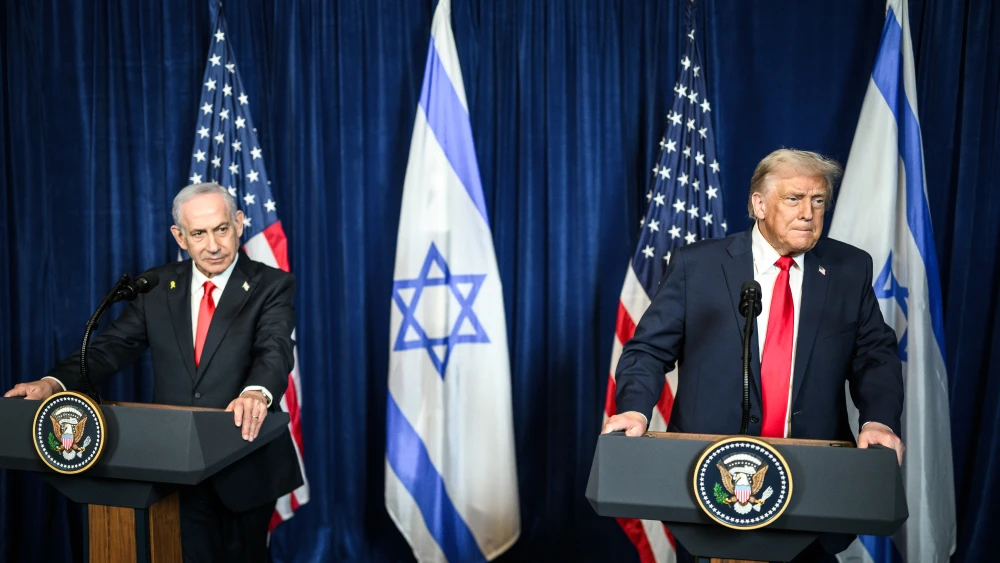

The recent conversation between U.S. President Donald Trump and Israeli Prime Minister Benjamin Netanyahu was surprisingly friendly. On the outside, they reported—and quite rightly so—a rift in relations, about throwing Israel under the bus, but between the driver and the one being run over, a calm and quiet conversation took place.
For listeners, it brought to mind the story of King David, who fasted and prayed for his sick son. Precisely when his son passed, he arose and shook off his mourning: “Why should I fast? Can I bring him back again?”
Although the dimensions of the American surrender are breathtaking in their scope, the surrender itself did not surprise Jerusalem. The assessment voiced by Netanyahu himself in discussions was that the Americans want an agreement at almost any cost. For many weeks, Israel has known that the agreement would not include stopping the funding of terrorism and shutting down the ballistic-missile array. But the inconceivable ease with which the self-proclaimed negotiation genius gave up on the equation—the nuclear program in exchange for lifting the stranglehold—testifies to the intensity of the collapse.
One can be insulted, but there is no need to be too impressed by the attacks on Israel and on Netanyahu that accompanied that action. This is just the rhetorical justification for the main move, which is wrapping up the affair while continuously bombing rhetorically anyone perceived as interfering.
In their conversations this week, Trump remembered to tell Netanyahu again in a call how Netanyahu congratulated Biden after the 2020 elections, which, in my personal opinion, is a much less severe injustice than attempting to obtain illegal atomic weapons and killing many Americans, but maybe I am missing something.
The child who did not die and is still being fought over is actually Lebanon. Eighty percent of the talks with Washington deal with the struggle over the war with Hezbollah, an Israeli official estimated the day before yesterday. Hezbollah is in a desperate situation, on the verge of breaking. Linking the two fronts will not only save the organization but make it easier for it to resume harassing the residents of the north, or to strengthen, or both. There is a national consensus in Israel on the matter, a consensus that should have been expressed by the heads of the opposition.
Trump’s betrayal of the principles he himself set was so sudden and powerful that many are convinced this is again a deception that will end with Tehran going up in flames. They are in for a rude awakening. But the story, nevertheless, did not end this week. The Iranians will not miss the opportunity to present Trump as an empty vessel, as a joke. At some point, perhaps, he will abandon them again in favor of Israel and the Gulf states. You can count on the ayatollahs to give him the opportunity.
Longing, Inc.
So, where could things have been done differently against Iran? Should the protesters in Iran in January have been told to forget about help? Maybe to say to Trump in February, “Thank you, Mr. President, but attack alone, we pass”? Maybe to avoid destroying the ballistic missile industry, from the opportunity to deduct $300 billion from Iranian assets?
Opponents of Netanyahu and Trump are aiming the time machine specifically at 2018, to the decision to exit the nuclear deal that Obama signed with Iran. The claim is that leaving the agreement is what prompted Iran to enrich enough uranium for ten bombs and to race forward with the program. Former President Barack Obama gloated over his successor this week and essentially said that any agreement with Iran would look the same.
This is a selective interpretation of the facts. First, according to the original agreement, the main restrictions on uranium enrichment were supposed to gradually expire within 10 to 15 years. Or in other words, right about now. Not illegally, but with the permission and authority of the Security Council and without sanctions. Even within the agreement, Iran would have reached the same amount of fissile material.
In their conversations this week, Trump remembered to tell Netanyahu again in a call how Netanyahu congratulated Biden after the 2020 elections.
The dramatic difference is that right now Iran is doing so as a blatant violation, under a regime of sanctions and diplomatic isolation, whereas if we had stayed in the agreement, it would have done so with the backing of the U.N. Security Council, with its coffers swelling from hundreds of billions of dollars of free trade.
But mainly, a half-truth is worse than a lie: Iran did not leap to 60% enrichment immediately after the American withdrawal in May 2018. For many months, and even beyond that, it feared the reaction of the Trump administration and stayed within the limits of the agreement. The dramatic rise in enrichment began only when the Iranians recognized that the American military threat was not credible.
Surprisingly, or not, this happened after Trump was replaced by Biden, and it was clear to everyone that there was no credible military threat and that the West was deterred from conflict. And this is exactly, but exactly, what might happen now, when the Iranians are wounded and bruised but hold the weapon of closing the Strait of Hormuz and the belief that Trump will never embark on another adventure. It might require another president and another daring operation to extract an archive to cancel this agreement as well.
Never forget
“The only electrical appliance that Yahya Sinwar hangs around,” Gadi Eisenkot said during the war, “is a 25-watt lightbulb, and even that is not certain.” The Hamas leader loathed cellular phones and conveyed his messages on notes or by fax (!), a recipe for longevity and avoiding assassinations.
It was somewhat surprising, then, to discover that the arch-terrorist was killed while wearing a running watch, the kind that transmits, or can transmit, data on routes, speed in kilometers per hour and other goldmines of intelligence. His belongings, like a change of underwear, a vest and a uniform, appear in a rare, difficult and essential exhibition to visit, called “Return to October” at the Intelligence Heritage Center, somewhere in central Israel. Meters away, they are now renovating the memorial center for the fallen of the intelligence community, including the fallen without a name, picture or circumstances of falling.
The dark rooms and tunnels where the exhibition is housed manage to recall the depth of the murderousness that burst like a tidal wave of evil across Israel’s borders. There are abduction videos there that have never been seen before. In the corner of one room stands a hoe, as if someone forgot it. And then the horrific clip is screened in which, with that same hoe, a Hamas murderer decapitates a Thai worker while he is still alive. There is unbearable documentation there of a lynching of IDF soldiers in one of the tanks that would become a symbol.
The time that has passed has a tendency to blur and repress the fact that what happened here was an attempted genocide that was simply halted in its tracks after a few hours, thanks to the heroism of individuals and the delayed recovery of the Israel Defense Forces. The terrorists were given abduction kits (zip ties, sedatives, equipment for live broadcasting); instructions for preparing toxic gases “for synagogues, schools and homes”; and standard-issue jihad manuals (fatwas and books explaining why there is an obligation to slaughter Jews). The center’s staff did not locate material on ordering rape; this was apparently a spontaneous local initiative, for both men and women.
Gaza is today the quietest front. There are Israelis who probably tend again to underestimate the dimensions of their neighbors’ lust for murder and blood. The visit to the exhibition testifies to a satanic Nazi plan to kill Jews. The evidence regarding the Gazans themselves, who knew and enthusiastically encouraged Hamas, reminds us that they are the “helpers.”
It is worth remembering that the only ones in the Middle East besides the Israelis who democratically elected their leadership are the Gazans, who continue to support that leadership to this day.
Originally published by Israel Hayom.