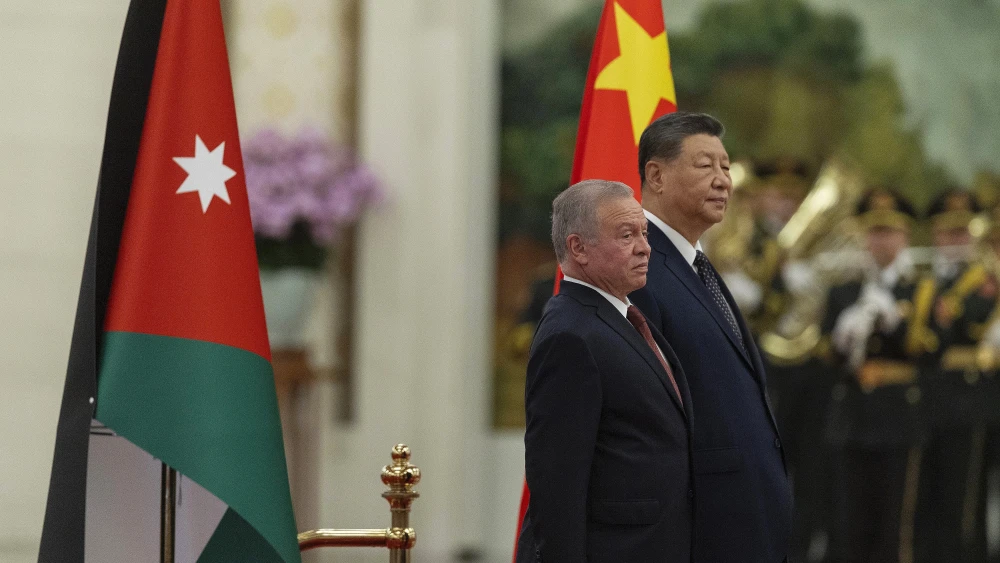

It has been 11 years since Jordan’s King Abdullah II visited China. Why go now?
Perhaps the timing is connected to the unusual frustration about the region expressed by China’s leading Middle East experts when I was in Beijing leading a SIGNAL Group delegation in July. The policy advisers spoke openly about the difficulty of navigating the war between two of China’s comprehensive strategic partners, Iran and Saudi Arabia; the instability in the Red Sea; and the continuing closure of the Strait of Hormuz.
What had long been treated in Beijing as a distant regional problem was becoming something much more immediate: an energy-security challenge for China.
Against that backdrop, President Xi Jinping invited King Abdullah to China for his first visit in more than a decade.
Jordan is an unusually useful place for Beijing to look for perspective. It is one of Washington’s closest Arab partners, politically stable, deeply connected across the Arab world and in regular contact with Israel, while maintaining a strongly pro-Palestinian position that aligns comfortably with Beijing’s rhetoric on the conflict.
At the same time, Jordan is clearly not aligned with Iran. Iranian-backed forces have attacked U.S. troops stationed in Jordan, and Jordan has participated in regional air-defense cooperation with the United States and Israel.
Greater involvement in Asia can bring infrastructure and industrial growth for Amman, but it can also raise concerns about transparency, debt exposure and political influence.
For Beijing, Abdullah therefore offers something relatively rare: access to a leader who is close to Washington, deeply embedded in the Arab political system, knowledgeable about Israel and not tied to Tehran. That makes Xi’s invitation look less like routine diplomacy and more like an effort to hear from a regional actor who might help China make sense of a region it is struggling to read.
Abdullah, however, appears to have recognized an opportunity of his own. Rather than treating the trip as a summit visit to Beijing, he turned it into a week-long tour that began in Shanghai and Shenzhen, two of China’s most important economic and technology centers.
One meeting was especially revealing. Abdullah visited China’s State-owned Assets Supervision and Administration Commission, or SASAC, the powerful body responsible for overseeing China’s centrally owned state enterprises. According to Jordan’s Royal Court, the king was briefed on how Beijing manages state-owned companies and expressed interest in learning from the Chinese experience.
That meeting deserves more attention than it has received. In March, Jordan adopted a new State Ownership and Governance Policy aimed at clarifying the role of state ownership, strengthening corporate governance, and improving oversight of the performance and fiscal risks of state-owned enterprises.
The SASAC meeting suggests that Amman is now looking at whether parts of China’s state-capitalist model might offer useful lessons. Jordan is not simply asking China for investment. It appears to be exploring how the state can manage strategic assets more effectively, improve the performance of public companies and attract capital without relinquishing control over critical sectors.
It’s an ambitious balancing act. Jordan needs investment, employment, technology, manufacturing capacity and greater export potential. Chinese capital and industrial capabilities could help. But Amman also has to protect its relationships with Washington, the Gulf states and international financial institutions.
Greater Chinese involvement can bring infrastructure and industrial growth, but it can also raise concerns about transparency, debt exposure and political influence.
The trip therefore appears to have served two different purposes. For China, King Abdullah may have been a source of political and strategic insight at a moment when Beijing is struggling to formulate a workable approach to Middle Eastern instability.
For Jordan, China offered an opportunity to pursue investment, technology, manufacturing and perhaps even lessons in state-owned enterprise governance as Amman seeks to move higher up the economic value chain.
The political exchange was comparatively easy. China reaffirmed support for Jordan’s sovereignty, stability, and its position on Palestinian rights and a two-state solution. Jordan, in turn, backed Beijing’s core positions on the one-China principle, Taiwan, sovereignty and territorial integrity. There was little friction because each side could endorse the other’s positions at relatively low political cost.
For Israel, this is worth watching closely. A more economically capable and politically stable Jordan is clearly in Israel’s interest. Jordan is a critical buffer on Israel’s longest border, a security partner, and an important component of the regional architecture that has emerged against common threats. If Chinese investment helps strengthen Jordan’s economy and industrial base without altering its strategic orientation, Israel may benefit indirectly.
But there is another side to the equation. A deeper Chinese economic presence in Jordan would place Beijing immediately on Israel’s eastern frontier and inside one of Washington’s closest regional partners, potentially creating national-security questions and a source of friction with the United States. Jordan will also have to navigate not only how much China invests, but where, in what technologies, under what ownership structures, and with what access to data, infrastructure, and strategic assets.
That makes Jordan an interesting test case for Jerusalem as well.
Israel has an interest in Jordan attracting investment and becoming more economically resilient, but it also has an interest in the architecture around it remaining compatible with U.S.-led security arrangements. Jerusalem should therefore be paying attention not to Jordan’s diplomatic embrace of Beijing, which is relatively unsurprising, but to whether the economic relationship begins moving into strategically sensitive sectors.
The more important question is what comes next. If the visit produces a deeper economic relationship, Jordan will have to manage it carefully. Amman’s challenge will be to extract value from Chinese capital, technology, and industrial capacity without allowing those ties to undermine its strategic relationships elsewhere.
For Beijing, the test will be different. Will Jordan become more than a diplomatic partner and instead serve as a useful regional touchpoint as China tries to understand and protect its interests in a Middle East that is becoming harder for it to navigate?
Depending on whether and how the China-Jordan relationship evolves, this may mark the beginning of a more consequential exchange: China looking to Jordan for regional insight, Jordan looking to China for economic models, capital and leverage—and Israel watching closely to see where it leads.