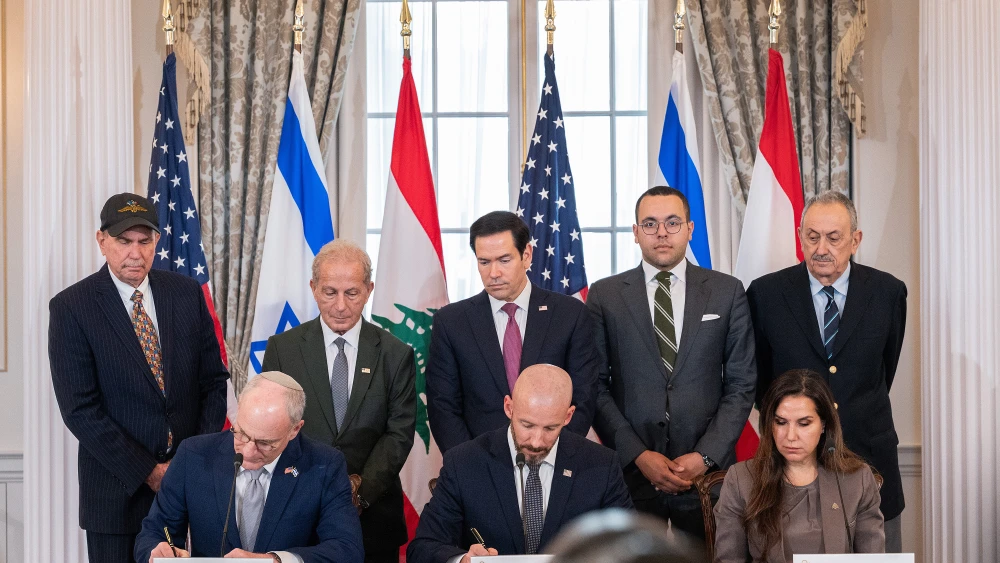

Israel and Lebanon have signed agreements, armistices, ceasefires and security understandings before—in 1949, 1983, 1996, 2024—and now in 2026.
It is, therefore, understandable that skeptics of the current trilateral agreement argue that it will simply pave the way for yet another Lebanese civil war while tensions in the Gulf continue to rise, potentially leading to a confrontation between Iran and the United States.
Yet there is another way to view this moment—through the broader history of relations between East and West and the role of the United States. That perspective offers reason for hope.
At a critical moment, when Iran appeared to be gaining the upper hand across the region, it instead suffered a strategic defeat.
For years, Tehran treated sovereign Lebanon as one of its strategic assets, seeking to impose a permanent confrontation with Israel while allowing Hezbollah to dominate the country, remain heavily armed along Israel’s border and prepare its own version of another Oct. 7 massacre.
That vision has now been challenged.
The new U.S.-brokered agreement was negotiated by the two countries with the greatest stake in its success—Lebanon and Israel, neighboring states that have both suffered from Hezbollah’s aggression.
On Lebanon’s MTV television network, political talk show host Walid Abboud addressed Hezbollah directly: “You have to leave. Stop ruining our lives.”
His words reflect a growing sentiment. Lebanon still dreams of making Beirut the Paris of the Middle East—not a satellite of Tehran. Hezbollah demonstrations this week were met with a firm response from Lebanon’s own security forces.
In Israel, meanwhile, there is once again cautious hope for peace with its northern neighbor and for the end of Iran’s regional dominance.
The road ahead will be difficult, but it symbolizes something larger: The possibility that even in difficult times, the divide between Judeo-Christian civilization and the Muslim world can be overcome by confronting the common enemy—terrorism.
For a time, Iran appeared to hold the fate of the Middle East in its hands, insisting during its understandings with Washington that Israel immediately withdraw from Southern Lebanon.
Despite pressure from U.S. Vice President JD Vance, Israel maintained that it would not leave while Hezbollah remained entrenched on the border with its missiles, drones and underground tunnel network.
Now Lebanon appears to recognize what much of the international community has failed to understand—that Israel has no territorial ambitions in Lebanon and that cooperation with the Jewish state could become the path toward freeing the country from Hezbollah’s grip.
A similar process may be unfolding in Gaza, where growing public protests suggest that some Palestinians are beginning to recognize that Israel’s presence may ultimately help free them from their greatest enemy: Hamas’s dictatorship.
Under the agreement, Israel has committed to withdraw once Hezbollah is fully disarmed. Both Israel and Lebanon affirm “the right of each state to live in peace” and express their shared desire “to live in security as sovereign states.”
Two designated areas will serve as the first test of Lebanon’s effort to restore what the agreement describes as “the state’s monopoly on the use of force” through the Lebanese Armed Forces.
When Israel withdrew from Lebanon in 2000, Hezbollah had lost any legitimate reason to exist. Instead, it tightened its grip on the country. Former Lebanese Prime Minister Rafik Hariri was assassinated in 2005 in a bombing widely attributed to Hezbollah, which then amassed an arsenal of some 150,000 missiles and ultimately dragged Lebanon into another devastating war in 2026.
Watching Lebanese Ambassador Nada Hamadeh Mouawad sign the agreement on Friday was deeply moving.
The elimination of Hassan Nasrallah, Hezbollah Secretary-General Naim Qassem’s increasingly desperate calls to reject the agreement, and the weakening of Iran’s regime created the conditions that enabled U.S. Secretary of State Marco Rubio to broker this unexpected diplomatic breakthrough.
The result is more than a ceasefire. It represents a renewed moral campaign against terrorism and in favor of genuine peace.
Israel and Lebanon now deserve the full support of the free world.