
When you’re 23, there’s not a whole lot that you would find interesting about your 74-year-old aunt. So, I went for a tried-and-true hook: “Did you know I was at Woodstock?”
Daniel looked up from his phone with something resembling curiosity. “Yeh?”
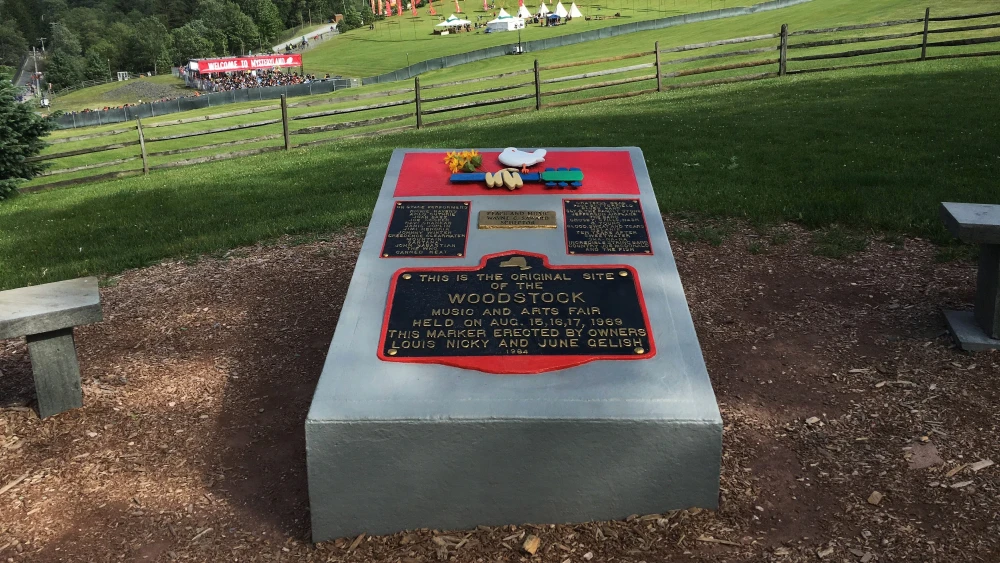
Wasting no time (now that I had his attention), I launched into a story that bears repeating this week, the 57th anniversary of the Woodstock Music and Art Fair from Aug. 15-18, 1969.
The six of us (four friends, my sister Tobi and myself, at the ripe old age of 17) packed into a friend’s aged Peugeot—sadly destined to be among the hundreds of overheated vehicles eventually abandoned along the highways leading to the small town of Bethel, N.Y. That’s where some of the brightest lights in the rock-and-roll heavens—with names like The Who, Ravi Shankar, Grateful Dead, Jefferson Airplane and Jimi Hendrix—awaited us on Max Yasgur’s dairy farm for what was billed as “Three Days of Peace & Music.”
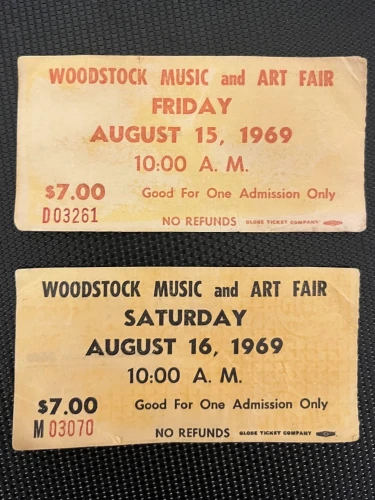
Weeks earlier, using our babysitting profits, we’d sent away for the $7 tickets (yep, still got ’em).
Arriving on Thursday, the day before the festival officially began (after the Peugeot up and died, we’d been among the thousands of other youth hitching our way to Bethel), we sat and watched the scaffolding going up on the stage. That night turned out to be gorgeous: stars so close we could almost touch them, and our sleeping bags arrayed around a bonfire some smart person had started earlier (Happily, Max must have stashed the cows somewhere since they never appeared during our days on the farm.)
But by mid-morning on Friday, the rain had begun—gently at first, but building in intensity by the afternoon. This is also when the kiosks that organizers had set up officially ran out of food. With a half-million wet and hungry kids, jars of peanut butter were passed around ceremoniously, a single spoon shared among strangers.
As the rain picked up Friday night, some kids from Philadelphia invited us into their two-man pup tent that night, which miraculously housed seven of us, slabbed sardine-style.
But wait. Before we grow too dewy-eyed over this sweet idyllic scene, I had to tell my nephew the truth: As much caring and sharing as our generation practiced (yes, to the shared bonfire; yes, yes to the communal peanut butter; and yes, yes, yes to the sardine-packed pup tent keeping out the rain), there was also a dark side to who we were then.
Tobi and I began to notice it for real while walking the paths around the farm on Friday night: a young woman behind a bush was rocking back and forth and crying inconsolably. We asked her if she was OK and needed help, but she didn’t seem to hear us, so deep was she inside her terror. Then our stroll took us past something even more frightening: the overdose tent, with spine-chilling screams coming from inside—one kid crying pitifully for his mother to save him.
Which may have been when the “stay away from the brown acid” warnings began coming from the stage. And, of course, wherever you wandered, there were couplings performed without much effort at privacy—scenes we walked by quickly, eyes averted from the amorous duos.
Sure, I could tell you the rest: the angry townsfolk of Bethel, furious at a 500,000 young invaders abducting their quiet little town, cursing the “dirty hippies” as we walked through the streets en route to the Greyhound bus station.
And to be fair, I could also report on the family who opened up their bathroom and kitchen wall phone (decades before the advent of the cell phone and when long-distance calls cost money). They were kind enough to offer mounds of peanut butter-and-jelly sandwiches and pitchers of lemonade set out on their picnic table, waving us in to eat, relieve ourselves (the porta-potties at the farm having long given up functioning) and call our worried parents, who were by now staring glumly at the nightly news and wondering what had become of their children.
But I’ll skip to what I told Daniel that day in my kitchen.
“Our generation, for all the good we embraced—our idealism, the depth of our caring and the sweetness of our sharing—I gotta tell you, we had one tragic flaw. We did not love or care for ourselves enough so the goodness couldn’t stick. We failed to value the God-given gift of our bodies, so we invited dangerous substances into them and gave them away sexually in ways both destructive and, at the end of the day, kind of sad.”
Meaning, free love wasn’t so free.
Then I asked him, “So, what about your generation?”
“We don’t have either one of those,” he shrugged. “We really don’t care, and we certainly don’t share.” And then, he added, “but we don’t self-destruct either.”
“Hmm,” I said after a few seconds had passed. “You know, when you really live as a Jew, you have one of them but not the other. You care, and you share—tzedakah is actually a mitzvah, a commandment, not just something you do if you feel like it. Even the poorest of us still has to give; it’s what Jews do. But you never disrespect your body; you know it’s a gift you’ve been given, and you take care of it, so you can serve the Boss and enjoy with abundant gratitude all the gifts you’ve been given in this lifetime.”
“Hmm,” he said after a few more seconds had passed. “That’s actually kind of interesting.”