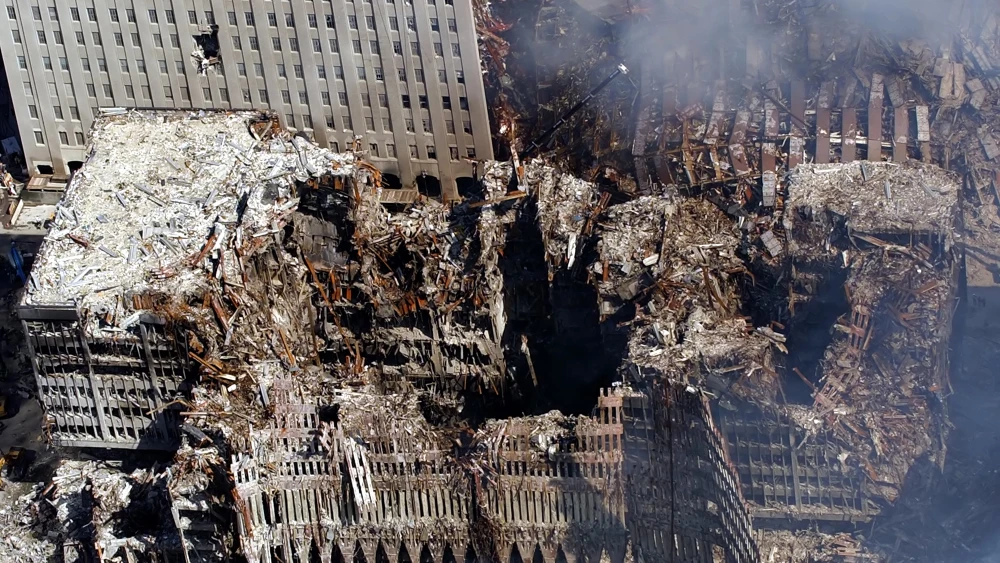

Twenty-five years ago, airliners hijacked by Muslim terrorists slammed into the World Trade Center and the Pentagon, while another crashed in a field in Western Pennsylvania, murdering a total of nearly 3,000 people. In the days that followed, “Never Forget” became a national oath.
Tragically, I believe we have forgotten.
We have not forgotten the dead, the firefighters, the passengers on Flight #93 or the horrifying images of that morning. What we have forgotten is what attacked us, why it attacked us and the ideology that animated the men who did it. America learned to recognize violent jihadism, but our determination not to blame all Muslims gradually became a reluctance to examine the religious and political ideology from which jihadism emerged. We learned to recognize the bomb while cloaking the ideology that built it.
Nearly two decades ago, in my book The Re-United States of America, I warned of Islamic fundamentalism while cautioning against painting all Muslims with a broad brush. A Muslim who embraces American constitutional democracy is no more responsible for Al-Qaeda or Hamas than a Christian is responsible for the Inquisition.
However, intellectual honesty demands that we address the other half of the argument. Islam is not synonymous with terrorism, but neither is terrorism entirely separable from the Islamist ideology that has produced so much violence and repression. Islamic scripture and tradition contain teachings concerning jihad, apostasy, intolerance of Jews and Christians, the subjugation of women and the supremacy of religious law that fundamentalists continue to invoke.
Judaism and Christianity also contain ancient passages profoundly at odds with modern liberal values. But in the West, those doctrines have largely been relegated to history or reinterpreted rather than advanced as political programs. Within much of contemporary Islam, by contrast, such doctrines remain culturally and politically consequential. Prejudice judges people by their identity; prudence judges people by their actions.
9/11 taught us to recognize fast jihad: spectacular violence intended to kill and terrorize. But there is another threat: slow jihad. This is the advancement of Islamist ideas through institutions, propaganda, intimidation, exploitation of Western liberalism and social pressure as opposed to terrorism.
The distinction matters. Muslim immigration is not slow jihad. Building a mosque is not slow jihad. But when religious leaders preach hatred of Jews, religious supremacy, hostility to Western society or the subordination of constitutional law to Islamic law—that is slow jihad.
Likewise, criticism of Israel is not necessarily antisemitism. But denying the world’s one Jewish state the right to exist in the Jewish people’s ancestral homeland is something different: It is “anti-Israelism,” antisemitism masquerading beneath a sanitized geopolitical veneer.
Gaza and Lebanon demonstrate what can happen when Islamist movements become entrenched. Hamas turned Gaza into an armed Islamist enclave committed to Israel’s destruction, while Iranian-backed Hezbollah effectively became a state within a state in Lebanon. Once entrenched, such groups can be extraordinarily difficult to dislodge. The West should heed that warning. It should welcome Muslims seeking freedom and opportunity while unapologetically rejecting those who embrace religious supremacy, political violence, antisemitism or values fundamentally hostile to liberal democracy.
Universities, legacy media and progressive politics have increasingly taught young Americans to see the world through the prism of oppressor and oppressed. The result is a remarkable alliance in which feminists, LGBTQ activists and other progressives provide political cover for movements whose beliefs about women, homosexuality and religious freedom conflict profoundly with their own. It is a kind of suicidal empathy: tolerance extended even to ideas that would not tolerate the people defending them.
We must say: religious freedom, absolutely; religious supremacy, never.
Oct. 7 exposed the contradiction. Legitimate concern for Palestinian civilians soon co-existed on American campuses with praise for “resistance,” justification or celebration of the massacre and atrocities by Hamas. The intimidation of Jewish students and rhetoric extended far beyond any criticism of Israel.
In Dearborn, Mich., participants at a large 2024 Al-Quds Day demonstration openly chanted “Death to America” and “Death to Israel.” Thankfully, some Muslim community leaders later condemned the chants.
The political examples are equally troubling.
Rep. Rashida Tlaib (D-Mich.) has defended the slogan “from the river to the sea.” Rep. Ilhan Omar (D-Minn.) declared shortly after she entered the U.S. House of Representatives that support for Israel was “all about the Benjamins” (hundred-dollar bills) and that Israel had “hypnotized the world.”
And New York City, of all places—the city attacked on 9/11 and home to the largest Jewish population outside of Israel—has elected Zohran Mamdani as its mayor. Mamdani supports BDS, resisted condemning the slogan “globalize the intifada” and declined to affirm Israel’s right to exist as a Jewish state.
Omar later apologized for her remarks, while Mamdani has condemned Hamas and antisemitism. Those apologies and condemnations can be acknowledged. But when they collide with a lengthy and consistent record pointing in the opposite direction, when does skepticism become common sense and political expediency the more plausible explanation?
Now, Michigan Democrats have nominated Abdul El-Sayed for the U.S. Senate. El-Sayed opposes American aid to Israel, even for the purely defensive Iron Dome. Following the attack on a Michigan synagogue in which an assailant drove into the synagogue while more than 100 children were inside, El-Sayed invoked the attacker’s loss of relatives in Lebanon and said, “Hurt people hurt people.” He later apologized. But here again, can an apology erase the original words or their relevance to a candidate’s worldview?
Moreover, El-Sayed’s father-in-law and major financial supporter has held leadership positions in CAIR-Michigan and ISNA, organizations historically identified by federal prosecutors as connected to a U.S. Muslim Brotherhood network. That does not make El-Sayed a member of the Brotherhood, but nor does it make the association irrelevant.
The point is not that these politicians are Muslims. It is that ideas, rhetoric and associations once relegated to the political fringe are increasingly normalized and even rewarded within one of America’s two major political parties and among young Americans shaped by our universities, media and progressive culture. Progressives have taught the next generation an astonishing lesson: not to abhor 9/11, but to search for America’s culpability and, in an act of self-reproach and atonement, tolerate the very ideology that produced the attacks.
Europe is America’s bellwether. Britain has acknowledged that fear of appearing racist has inhibited authorities from confronting radical Islam, while France now openly confronts Islamist “separatism.” The warning is clear: Tolerance without assimilation creates segregation, and segregation breeds extremism.
So, we must recalibrate. We must say: religious freedom, absolutely; religious supremacy, never.
The West should welcome immigrants prepared to embrace liberal democracy and its constitutional culture while barring those hostile to its fundamental values. Constitutional law must always supersede religious law. Our universities, media and political leaders must stop pretending that scrutiny of Islamist ideology is synonymous with prejudice against Muslims. Tolerance cannot mean surrender, and diversity cannot require moral blindness.
Twenty-five years ago, terrorists showed America what fast jihad looks like. We hardened cockpits, transformed intelligence gathering and made another 9/11 extraordinarily difficult. But while becoming very good at looking for bombs, we lost the courage to scrutinize the ideology that produced them.
On Sept. 11, 2001, we promised nearly 3,000 murdered Americans that we would never forget. Twenty-five years later, we have forgotten; not who we lost but too much of what we were supposed to learn. Honoring our old promise requires us to remember, to recapture clarity and resolve, and to renew our commitment to defend the freedoms and values the terrorists attacked.