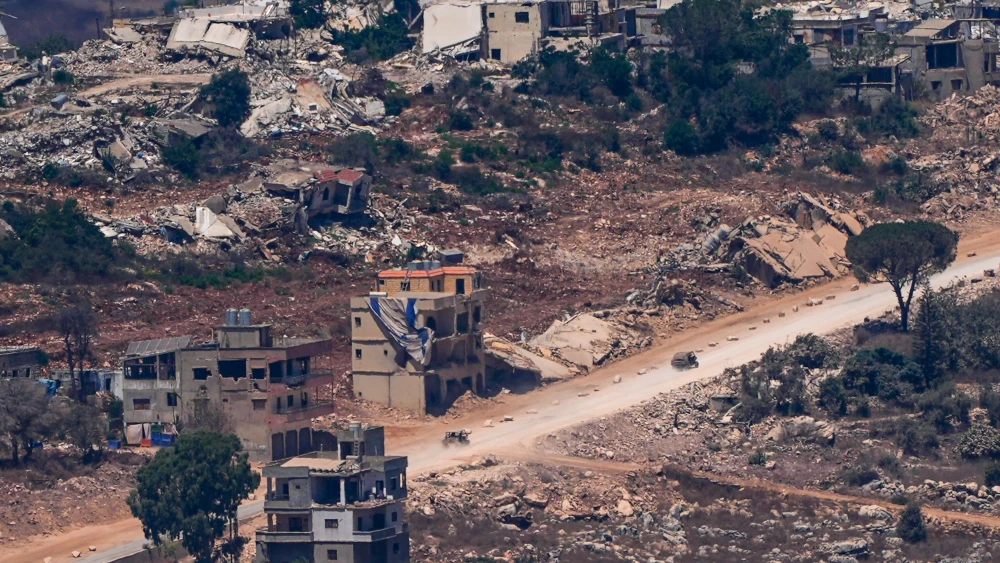
The Israel Defense Forces said on Sunday morning that it was striking in Southern Lebanon after the Iranian-backed Hezbollah terrorist organization launched two drones toward soldiers operating in the security zone.
Troops downed one of the drones, the IDF said. No injuries were reported in the attack.
The statement called the incident “a blatant violation” of the ceasefire agreement with Beirut.
Soldiers “will continue to operate in the security zone in order to remove any threat towards Israeli civilians and IDF soldiers,” the military said, adding that it would act “with determination against Hezbollah’s repeated attempts to harm IDF soldiers.”
Overnight Friday, the IDF also carried out strikes on Hezbollah terrorists and infrastructure in Southern Lebanon in response to a drone launched earlier in the day at soldiers operating in the security zone.
The drone attack constituted a “blatant violation” of the ceasefire agreement, the IDF said.
Israeli soldiers opened fire and downed the drone, the IDF continued, adding that no injuries were reported.
As part of the retaliatory strikes, the IDF struck weapon storage facilities intended to be used by Hezbollah operatives to plan and direct terrorist attacks on IDF soldiers in the security zone and Israeli civilians, the army said.
“The IDF is currently operating and will continue to act with determination against Hezbollah’s repeated attempts to harm IDF soldiers,” the IDF added.
The security zone in control of the Israeli military runs along the Israeli-Lebanese border from the Mediterranean Sea to the area north of Mount Hermon, extending roughly seven miles deep into Lebanon in its furthest points.
Earlier on Friday, Defense Minister Israel Katz reiterated Jerusalem’s position that Israel will not withdraw from Southern Lebanon until Hezbollah is disarmed throughout the country and the danger posed by attacks from the Land of the Cedars is neutralized.
“Prime Minister Netanyahu and I are leading a clear and uncompromising policy, implemented every day by the IDF: Israel will not withdraw from the security zone in Lebanon until Hezbollah is disarmed throughout Lebanon and the threats to the residents of the Galilee are removed,” Katz said.
He said that the IDF’s capture of the Ali al-Taher Ridge in southeastern Lebanon marked the completion of a phase in consolidating Israel’s hold on the security zone.
The decision to advance toward the ridge was made after intelligence indicated the presence of Hezbollah command-and-control tunnels there, according to the defense minister.
The tunnels served as a command center for attacks on IDF troops and the Galilee, while the ridge constituted Hezbollah’s last commanding position protecting the Nabatieh area, giving it strategic importance, Katz said.
Israel releases five Lebanese detainees
Also on Friday, Israel completed the release of five Lebanese civilians as U.S.-mediated negotiations with Beirut continued alongside efforts to locate and repatriate the remains of Lebanese Jewish community leaders abducted and murdered by terrorist organizations in the mid-1980s.
The International Committee of the Red Cross confirmed on Friday that it had facilitated the transfer to Lebanon of all five individuals at the request of the parties.
One detainee was transferred on Thursday and the remaining four on Friday “with full respect for the safety and dignity of the individuals involved,” the ICRC said. “The ICRC’s role in this operation was purely humanitarian, acting as a neutral intermediary between Israel and Lebanon,” it added.
At the request of the relevant parties, we facilitated the transfer of five individuals released from Israeli detention to Lebanon.
— ICRC (@ICRC) September 4, 2026
One individual was transferred on Thursday, and four others on Friday, with full respect for the safety and dignity of the individuals involved.… pic.twitter.com/FUNkRa5azO