


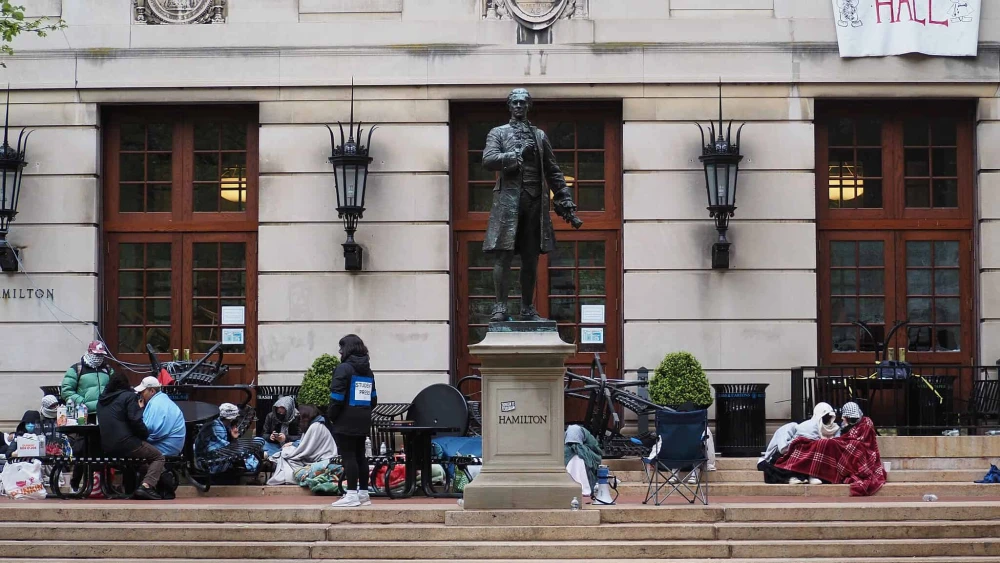
Courts risk creating an “anti-Zionist exception” that leaves Jews and allies with fewer civil rights protections than other groups, according to a forthcoming Cardozo Law Review essay.
Jon Michaels, a University of California, Los Angeles law professor, and Matthew Segal, a Tufts University professor affiliated with Yale Law School’s Brodie Center for Jewish and Israeli Law, penned the essay, which JNS viewed. Titled “Misdiagnosing Anti-Jewish Animus: How the judiciary’s approach to anti-Zionism risks distorting the First Amendment, excusing antisemitism and imperiling all civil rights,” it is slated to be published in 2027.
The authors use Torres v. Carlson, a lawsuit brought by Columbia University janitors Mariano Torres and Lester Wilson, neither of whom is Jewish, to explain the emerging exception. The janitors alleged that masked anti-Israel rioters, who were armed with hammers, knives, chains and other weapons, assaulted and detained them during an April 2024 anti-Israel takeover of Hamilton Hall at Columbia University.
According to the lawsuit, rioters called them “Jew-lover,” “Jew-worker” and “Zionists.”
A federal judge dismissed their claims, reasoning in part that anti-Zionism could not establish anti-Jewish discrimination, because Jews disagree about Zionism and because anti-Zionist rhetoric constitutes political speech. The case is being appealed to the U.S. Court of Appeals for the Second Circuit.
Michaels and Segal write that “under this approach, behaviors styled as ‘anti-Zionist’ have been deemed inherently not discriminatory, enabling anti-Zionism to function as a sort of get-out-of-legal-liability-free card.”
“Instead of relying on settled anti-discrimination case law, academic literature or the facts as alleged to assess whether anti-Zionist attitudes and speech might reflect anti-Jewish animus, the court seemed to presume that the defendants’ anti-Zionist rhetoric automatically disproves any allegation of anti-Jewish animus,” they write in the forthcoming article.
Michaels told JNS that the essay is a “reckoning with what Jewish plaintiffs, and plaintiffs who are coded as Jewish allies, are confronting.”
Existing civil rights laws are “more than sufficient to fully protect those plaintiffs,” he told JNS.
He added that denying Jews those protections is “legally unsupportable and bad as a matter of public policy.”



