


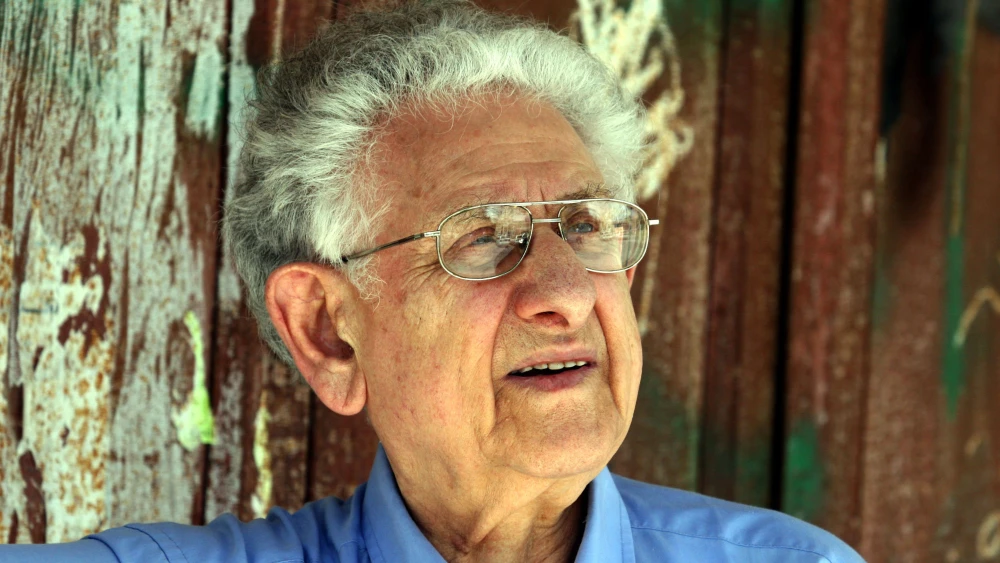

Immediately following Israel’s stunning triumph in the 1967 Six-Day War, several Israelis gathered to plan the return to Gush Etzion, just south of Jerusalem, which had been decimated during Israel’s struggle for independence 19 years earlier.
Among them was Elyakim Haetzni, who had arrived in Palestine from Germany as a 12-year-old in 1938 following the Kristallnacht pogroms. Severely wounded during the Independence War, he survived and became a successful Tel Aviv lawyer. Israel’s “miraculous victory” in 1967 inspired him to relocate to Hebron, the ancient capital city ruled by King David, whose millennia-old Jewish community had been destroyed in an Arab massacre in 1929.
In April 1968, several dozen Israelis, Haetzni and his family among them, celebrated Passover in Hebron. The Seder became “a once in a lifetime experience” for him. There, he realized, “I am at home, in the bosom of Abraham.” Jewish identity, he believed, “has to do with a historical link to people and places of the past” and Hebron is “part of our genetic code.” With his family, he moved to Kiryat Arba, a new community uphill from Hebron.
A highly respected lawyer, Haetzni represented both Jews and Arabs. But his commitment to Israeli settlers was unyielding, defending their right to disobey government orders commanding them to abandon their homes in Judea and Samaria.
“We are,” he insisted, “loyal to the covenant with God.” Responding to a Labor government’s inclination to relinquish portions of the biblical homeland to Arab rule, he asserted, “Even if 100% of the Jewish inhabitants of Israel should vote for its separation from the Land of Israel, that ‘hundred percent consensus’ would not have any more validity than the ‘hundred percent consensus’ that prevailed within the people of Israel when it danced around the golden calf.”
Haetzni was sharply critical of radical settlers who launched violent retaliatory attacks against Palestinians, condemning “the religious deviation” expressed by their attempts to hasten the arrival of the messiah with guns and dynamite. He insisted that, in the Land of Israel, Arabs may be gerim (strangers), just as Jews had been strangers in Egypt, but their lives must be protected. He lacerated rabbis who failed to admonish their followers with the biblical commandment, “Thou shalt not kill.”
From 1990-1992, Haetzni served in the Knesset as a member of the right-wing religious-nationalist Tehiya party.
While researching what became my history of the Hebron Jews, I had the pleasure of meeting Haetzni in his Kiryat Arba apartment. He welcomed me to the living room, where each wall contained shelves of books in several languages from ceiling to floor. In his soft-spoken way, he guided me through the return of the Jews to their ancient capital city following the Six-Day War, modestly avoiding his own pivotal role in this rebirth. After our illuminating conversation ended, he and his wife kindly drove me downhill to Beit Hadassah, a former medical clinic now inhabited by several Israeli families who, like Haetzni, were pioneers of the return to Hebron.
Elyakim Haetzni, identified as “a man who lived and breathed Zionism,” has been eulogized as “a founding father” of the settlement movement, a man of “leadership and kindness” who “stayed dedicated to the people of Israel and the State of Israel until his last day.” Although we spent little more than an hour together, he was a vital source for my understanding of the determination of Jews, few as they may have been, to restore life to Hebron and reclaim the city’s place in Jewish history. He was a passionate, if soft-spoken, leader; anything but the caricature of the “fanatic” that has invited attacks on settlers for the “crime” of returning to biblical Judea and Samaria. I will always cherish our time together.
Jerold S. Auerbach is the author of 12 books including Hebron Jews: Memory and Conflict in the Land of Israel (2009).


