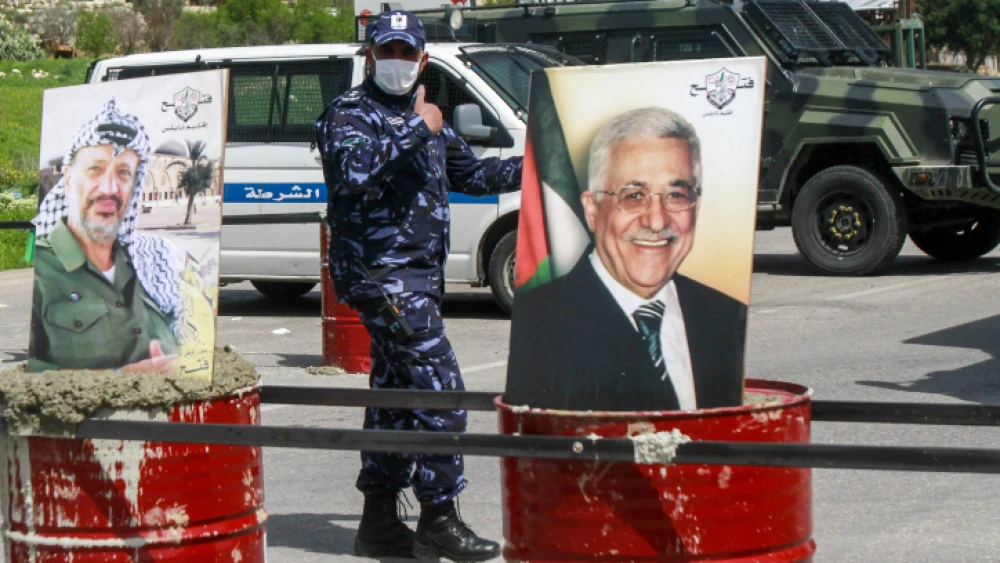

For which leaders is the payment of financial rewards to terrorists more important than paying teachers or supporting the needy? The answer is, of course, Palestinian Authority leaders—and during a pandemic, no less.
Anticipating a drop in income due to the current crisis, P.A. Prime Minister Mohammad Shtayyeh announced that the payment of March salaries will be staggered, with a different group of P.A. employees being paid every day. The order of payment is a clear indication of the P.A.’s priorities.
Preceded only by medical and supporting personnel and the P.A. Security Forces, third in line to receive their share of the limited P.A. budget are the terrorists incarcerated in Israeli prisons and the families of the dead terrorists, the so-called “martyrs.”
“Since the wheels of production, import and consumption have stopped, there will be a large drop of more than 50 percent in the P.A.’s revenues” said Shtayyeh according to the official P.A. WAFA news agency. “The international aid will decrease because the entire world is in crisis, and therefore we will work according to an emergency austerity budget by reducing the expenses as much as possible. However, we will pay the salaries for this month [March] in full and over the course of several days in order to prevent gatherings in front of the banks, and this [will be] in the following manner:
“On Sunday the salaries of the medical and supporting personnel will be paid; on Monday to the [P.A.] Security Forces members; on Tuesday to the prisoners and [the families of] the Martyrs; on Wednesday to welfare cases and the poor; on Thursday to the teachers; on Friday to the rest of the public employees. The last payment, on Saturday, will be to senior officials, to high level state employees, and to the ministers.”
As Palestinian Media Watch has shown, this is not the first time the P.A. has clearly demonstrated its warped priorities. In 2019, when the P.A. decided to plunge itself into a self-made financial crisis and was forced to cut salaries to its law-abiding employees, it nevertheless committed itself to paying, in full, the salaries of the terrorist prisoners and allowances of the families of the dead terrorists.
Similarly, the fact that the P.A. prioritizes the payment of terror rewards over the payment of benefits to the needy Palestinians comes as no surprise. As PMW demonstrated, the PA devotes six times more of its budget to the terrorist prisoners and the families of dead terrorists than it does to its needy.
To give the P.A. decision perspective, one must take into account that in 2019 the average monthly P.A. expenditure on the payment of the terror incentives and rewards was in excess of NIS 50 million ($13.9 million). That means that based on the U.S. Centers for Disease Control and Prevention’s price for coronavirus test kits, the P.A. just chose incentivizing and rewarding terror over purchasing 387,143 coronavirus test kits, or 465 low-cost MIT ventilators.
IDF Lt. Col. (res) Maurice Hirsch is director of Legal Strategies at Palestinian Media Watch.