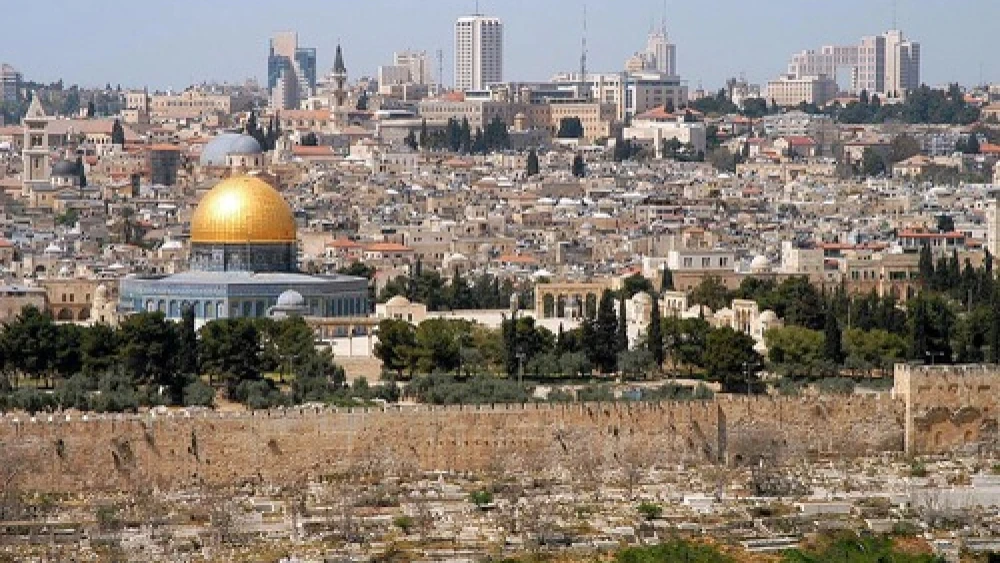
Who would have believed that 52 years have passed since that joyous day when we celebrated the unification of Jerusalem—that same city that for years served as a source of yearning and longing for Jews scattered across the Diaspora?
And today, we have the privilege of celebrating 71 years of the thriving State of Israel’s existence in Jerusalem.
For thousands of years, Jerusalem has served as a synonym for home: a historic home, a home both of dreams and reality, a home of prayer for every Jew.
For nearly 80 years, Jerusalem has been my home in every sense of the word.
As a Jerusalemite born and bred, I had the privilege of playing in its streets as a young boy, being filled with excitement at Beitar Jerusalem soccer matches, taking part in the 1967 Six-Day War and witnessing with my own eyes the unification of my city. I found the love of my life, Nehama, in Jerusalem, and grew as a person and an Israeli citizen within the framework of my roles in public service over the years.
As a people, Jerusalem is our capital, but at the same time, each and every one of us also has our own private Jerusalem. It seems that herein lies the magical secret of this city, which after thousands of years succeeds in being both historic and innovative, stately and personal, saturated with tensions, but also a symbol of cultural diversity and people and religions coming together.
For me, Jerusalem is a city that first and foremost respects the life that exists within it, from the east of the city to the west. It is the same city in which Jews, Muslims and Christians, people on the left and on the right, secular and haredi, rich and poor, live and work alongside one other.
Jerusalem is also a symbol of the commitment to equal treatment of all the city’s residents. This is our test of sovereignty. I am very pleased with the Israeli government’s efforts to reduce socio-economic differences and foster economic development in the east of the city. This sends an important message that sovereignty is a responsibility, and that if we succeed in Jerusalem—and we will succeed—we will succeed throughout Israel.
Because Jerusalem is a city of both the past and the future, what we are building in it belongs to all of us.
To all of us, Israelis and Jerusalemites alike, I wish for our capital to be the jewel in the crown of cooperation among sectors, generations and social statuses, and that culture and tolerance continue to thrive in the city alongside faith and hope.
And to you, my dear Jerusalem, I wish for your continued expansion and development, for the roots of your trees to deepen as they aspire to reach the heavens.
Next year in a rebuilt Jerusalem!
Reuven Rivlin is the president of Israel.
This column first appeared in Israel Hayom.