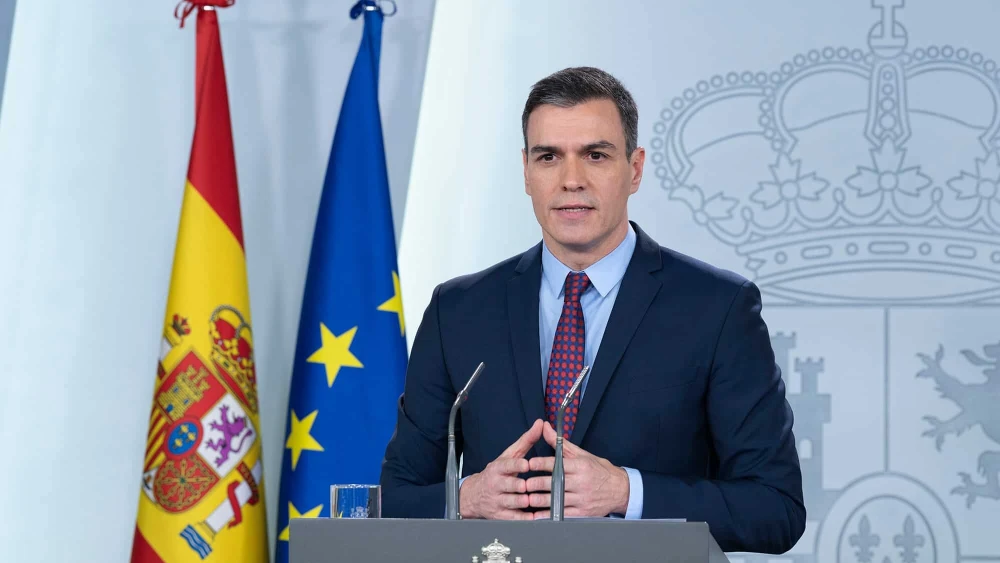

In diplomacy, legitimacy is a currency earned through consistency—and spent recklessly at peril. Pedro Sánchez is burning through Spain’s reserves at record speed.
This month, the prime minister’s government refused to allow U.S. forces to use jointly operated bases at Rota and Morón for operations against Iran, prompting U.S. President Donald Trump to brand Spain “terrible” and threaten a full trade cut-off: “We’re going to cut off all trade with Spain. We don’t want anything to do with Spain.”
When a leader selectively erodes sovereignty rules abroad—delegitimizing Israel while defying American security needs—he should not be shocked if the same standard turns inward.
The most vulnerable target? Spain’s colonized enclaves on Moroccan soil: Ceuta, Melilla and the smaller plazas de soberanía. A blunt trade war hurts both sides and risks a backlash from the European Union. A smarter U.S. play—reopening scrutiny of these colonial relics—costs Washington nothing, humiliates Sánchez and rewards a loyal ally in Morocco.
In the past two years, Sánchez has emerged as one of the West’s most aggressively anti-Israel leaders, treating Jewish sovereignty as uniquely negotiable. Rhetorical hostility after the Hamas-led terrorist attacks in southern Israel on Oct. 7, 2023, escalated into outright delegitimization, culminating in Spain’s unilateral recognition of a Palestinian state, absent the core conditions of statehood.
Recognition under international law is not symbolic. Per the Montevideo Convention, it requires effective territorial control, a monopoly on force and capacity for stable international relations. Gaza remains dominated by Hamas, ideologically committed to Israel’s destruction; the West Bank is fractured by militias, corruption and legitimacy crises. Spain’s move rewards aspiration over governance, undermining sovereignty’s meaning and inviting reciprocity: If rules can bend for a fictional state, why not for America’s oldest ally over Spanish colonies?
The hypocrisy deepens in Madrid’s refusal to join post-war efforts for viable institutions serving Palestinians. When the United States and partners formed the Board of Peace coalition for Gaza’s reconstruction, security reform and governance, Spain opted out—eager to grant symbolic rewards but unwilling to invest in the hard work of building functional statehood.
Domestically, this posture has fueled a surge in antisemitism. Spain’s Antisemitism Observatory reports incidents up 321% in 2024 over 2023, and 567% over 2022. Hostility is normalized under anti-Zionist cover in politics, academia and culture. Recent incidents include a desecrated Jewish cemetery in Barcelona, an attack on a kosher restaurant in Madrid, harassment of Israeli tourists (including a Holocaust survivor) at the Reina Sofía Museum for displaying a Star of David and Israeli flag and the removal of more than 50 kippah-clad teenagers from a Vueling airlines flight in Valencia for singing in Hebrew.
Sánchez, 54, is not merely tolerating antisemitism; by licensing anti-Israel delegitimization, he emboldens it—and Jews pay the price in an already tense European environment.
Geopolitically, Sánchez’s confrontational stance toward America compounds the damage. He questions U.S. military operations and positions Spain as a leading critic of Washington’s strategy amid Islamist consolidation in the Sahel and North Africa: ISIS and Al Qaeda affiliates expanding from Mali to Niger to southern Algeria, and Iranian influence deepening in fragile states. Weakening transatlantic ties here is no mere disagreement; it offers strategic openings to Iran’s Islamic Revolutionary Guard Corps and its proxies.
Contrast this with Morocco: One of the world’s oldest continuous polities, rooted in the Idrisid dynasty of the late eighth century. Successive dynasties—Almoravids, Almohads, Marinids, Saadians, Alaouites—forged enduring sovereignty, religious legitimacy and territorial continuity centuries before Europe’s modern state system.
Spain claims Ceuta (seized by Portugal in 1415, passed to Spain in the 17th century) and Melilla (late 15th century) predate post-colonial modern Morocco. This confuses colonial occupation with civilizational continuity; Morocco existed as a sovereign entity long before Iberian expansion. The irony sharpens through transatlantic history: Morocco was the first to recognize the United States in 1777, opening ports to the newly founded American Navy during the Revolutionary War. Spain’s relationship with the young republic, by contrast, was steeped in imperial rivalry and ended in the 1898 Spanish-American War—an American triumph over Spanish tyranny that dismantled its colonial empire in the Americas.
Today, Morocco bolsters that alliance via the Abraham Accords, normalizing relations with Israel and bridging Israel, the Arab world and Western democracies. Rabat invests in regional integration, counter-radicalization and intelligence-sharing. Its DGST (General Directorate for Territorial Surveillance) and BCIJ (Central Bureau of Judicial Investigations) have dismantled hundreds of terrorist cells since 2002 and provided tip-offs foiling plots across Europe, including locating Paris attacks mastermind Abdelhamid Abaaoud and aiding the recent Austrian disruption of an ISIS-linked plot targeting security services in January 2026. Morocco’s moderate Islam model stands as a bulwark against extremism.
Rabat also excels in migration control: preventing some 78,000 irregular crossing attempts in 2024 and contributing to a 42.6% drop in arrivals to Spain in 2025 (to 36,775 from 64,019), with Canary Islands flows down 62% to approximately 17,800 via enhanced patrols, intelligence, and anti-smuggling crackdowns. While Sánchez publicly aligns himself with terrorist breeding ideologies, Morocco delivers security results for Europe.
Moroccan authorities have also moved in recent years to block imported political symbolism, recently banning Palestinian keffiyehs and related gear from African Cup of Nations stadiums to insulate civic spaces. Awareness of foreign manipulation grew after Qatari-linked protests at Tangier Med aimed at blocking U.S. arms transport to Israel. Recently, young Moroccans have been flooding social media, affirming loyalty to Western alliances, openly supporting Washington and Jerusalem. “Long live the United States. Long Live Israel!” they affirm in hundreds of Instagram and TikTok videos.
Spain under Sánchez heads the opposite way.
The divergence hits hardest in North Africa’s territorial disputes. Ceuta, Melilla and plazas de soberanía (Chafarinas Islands, Peñón de Alhucemas, Peñón de Vélez de la Gomera) are seen across Africa as Europe’s last colonial vestiges. Frozen for decades by Spain’s NATO status, the status quo may now crack.
This month, Sens. Ted Cruz (R-Texas), Tom Cotton (R-Ark.) and Rick Scott (R-Fla.) introduced the Polisario Front Terrorist Designation Act. Cruz warned Tehran aims to make the Polisario the “Houthis of West Africa. ” This reflects Washington’s reassessment of North Africa amid Sahel jihadism and Iranian reach, in a region where Morocco stands out as a reliable partner. The 2020 U.S. recognition of Moroccan sovereignty over the Western Sahara chose to strengthen a proven ally rather than cling to ambiguity that empowers destabilizers. The same strategic logic now applies to Spain’s enclaves.
Trump’s trade threat is risky and potentially damaging, likely to provoke E.U. backlash and domestic blowback. Pressuring Ceuta, Melilla and the plazas de soberanía is far more surgical: zero cost to Washington, maximum political pain for Sánchez and a direct reward for Morocco’s unwavering loyalty—from Abraham Accords leadership to life-saving intelligence and migration control.
History shows that Washington favors reliable partners when sovereignty hangs in the balance. U.S. Secretary of State Colin Powell’s 2002 mediation in the Perejil crisis tilted toward preserving Moroccan claims. If Sánchez persists in undermining U.S. priorities, why should America indefinitely shield Spain’s last colonial relics?
Sovereignty is reciprocal. Defend your allies’ legitimacy, and yours is fortified; erode theirs, and your own invites erosion. By assaulting Israel’s sovereignty and defying America’s security needs, Sánchez is gambling Spain’s most vulnerable territorial claims. Morocco has aligned with the winning side as an Abrahamic security order consolidates in real time.
Spain, under Sánchez, is choosing obsolescence.