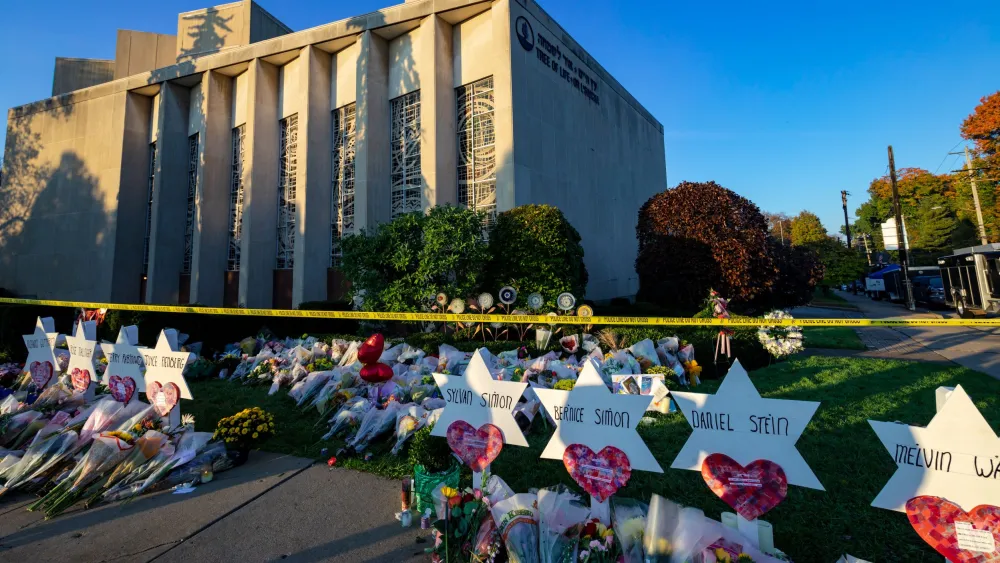

Eight years ago, 11 Jews went to the Tree of Life synagogue in the neighborhood where I grew up and never came home. They were killed in an antisemitic shooting spree. They weren’t soldiers. They weren’t political activists. They weren’t engaged in some great geopolitical struggle.
They were Jews attending Shabbat services in the Pittsburgh suburb of Squirrel Hill, one of America’s most welcoming, diverse and proudly Jewish neighborhoods.
On Oct. 27, 2018, that was enough to make them targets.
In the years since the Tree of Life massacre, I have often written about resilience. I’ve looked at the extraordinary ability of Jewish communities to mourn, rebuild and move forward. Eight years later, I find myself thinking about something different: We should not have to be this resilient.
There is something admirable about resilience, but there is also something dangerous about becoming too accustomed to celebrating it. Eventually, resilience can become society’s excuse for failing to confront what made resilience necessary in the first place.
Jews are attacked, and we strengthen security. A synagogue is threatened, and we hire another guard. Jewish students are intimidated, and we teach them how to respond. Israel is attacked, and Jews around the world discover that people they considered friends suddenly have difficulty condemning those who murdered Jews. Then we praise ourselves for persevering.
Oct. 27 and Oct. 7 do not feel like disconnected dates.
Perhaps the lesson of the Tree of Life shooting eight years later is that perseverance alone is no longer enough.
Oct. 7 changed that equation for me. The massacre in Israel and everything that followed stripped away many of the comforting assumptions American Jews carried with us. We learned how quickly sympathy can disappear. We watched hatred of Israel used to justify hatred of Jews. We saw Jewish students asked to explain themselves, Jewish businesses targeted, synagogues protected by police and people openly celebrating antisemitic violence.
Suddenly, Oct. 27 and Oct. 7 did not feel like disconnected dates. They became part of the same warning. Different perpetrators, different ideologies and different continents, but underneath them, the ancient idea continually reinvents itself: Jews are somehow responsible for the world’s grievances, and therefore violence against Jews can be explained, rationalized or excused.
That is why my hometown matters so much.
Squirrel Hill has never been simply a collection of Jewish institutions. It is a community where Jewish life is lived naturally and publicly. Synagogues, schools, bakeries, businesses and families exist alongside people of different religions, races and backgrounds. The answer to hatred was not retreat. It was life.
Squirrel Hill didn’t respond to Oct. 27 by becoming less Jewish. It remained unmistakably itself. That may be its greatest lesson.
That is also the story of Pittsburgh. The city could have collapsed when the steel industry did. Instead, it reinvented itself around medicine, universities, technology, entrepreneurship, innovation. The skyline remained, but the city underneath it evolved. There is something profoundly Jewish about that. We remember, but we rebuild. We mourn, but we create. We carry our history without allowing history to imprison us.
Perhaps that is where the conversation needs to go on this eighth anniversary. For years, much of the Jewish response to antisemitism has understandably focused on fighting antisemitism. We count incidents, issue statements, improve security, educate and protest. This is all necessary, but defeating antisemitism cannot become the organizing principle of Jewish life.
Our enemies do not get to decide what it means to be Jewish. Jewish children should know more about Judaism than they know about antisemitism. They should inherit Shabbat before security briefings, Israel before anti-Israel protesters, Jewish history before Holocaust history, and Jewish pride before Jewish fear.
The ultimate answer to those who hate us is not simply ensuring that Jews survive. It is ensuring that Jewish life flourishes: Construct another synagogue, send another child to Jewish camp, visit Israel, learn Hebrew, light Shabbat candles, support Jewish schools, wear the Star of David, and build Jewish institutions so ambitious and confident that they make clear we are planning not merely for the next anniversary, but for the next century.
The 11 people murdered on Oct. 27, 2018 deserve to be remembered. Their names should be spoken, and their lives should matter. What happened inside Tree of Life must never become another fading date on the calendar. But remembrance cannot only be about how they died. It must also be about how we live.
That is how we honor them, and that is how we win.