


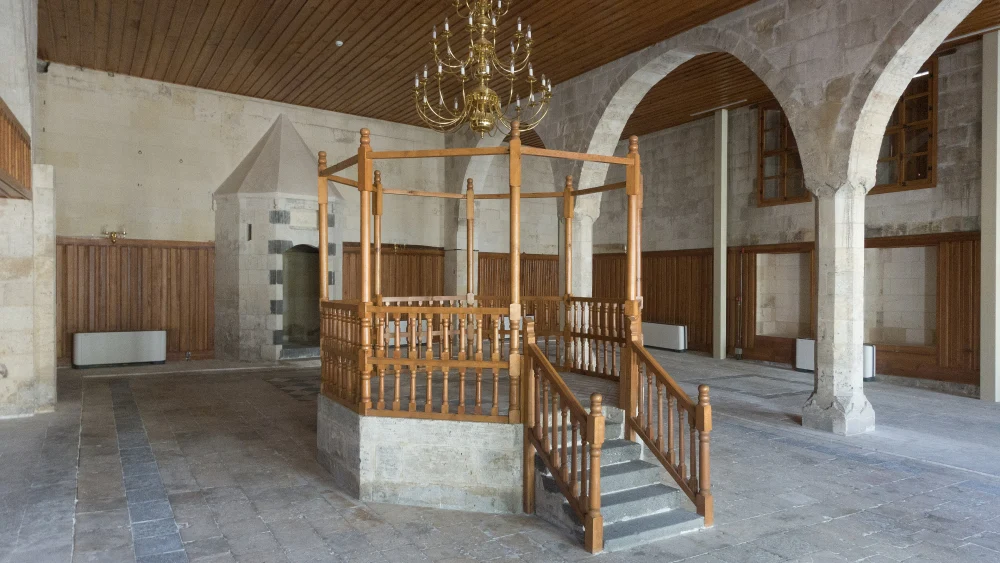

Rabbi Mendy Chitrik, the chairman of the Alliance of Rabbis in Islamic States, recently posted a photo on X of the Synagogue of Gaziantep.
Antep (officially called Gaziantep) is a city in southeast Turkey that once had a thriving Jewish community alongside Armenians, Assyrians, Greeks and Yazidis. Not anymore. All of these communities were murdered, expelled or forced to leave their ancestral homes.
Turkey has followed a persistent policy of state denial and historical revisionism, refusing to issue any formal recognition, apology, material restitution or reparations for atrocities committed against these communities by Turks.
The Gaziantep Synagogue was closed in 1979 after the local Jewish community was compelled to leave due to persecution and social hostility. This even though Jews had lived in Antep and the wider Anatolian region for thousands of years. According to research by author Yusuf Besalel, the Jewish presence in Antep dates back to the Babylonian exile in the sixth century BCE.
Because the city no longer has a Jewish population, the synagogue no longer functions as a place of worship. After its restoration in 2012, Gaziantep University took over its supervision for cultural events.
On Dec. 26, 2019, the synagogue hosted a Chanukah celebration. The event brought together more than 200 former residents and Jewish community members traveling from Istanbul and abroad, bringing life and worship back to the synagogue for the first time in 40 years.
During the event, Ishak Ibrahimzadeh, the leader of Turkey’s Jewish community, highlighted the reasons why Antep’s Jews were forced to leave the city in the late 1970s. He said that Jews faced harassment and threats from the locals, as well as abductions, forcing them to abandon the land they had lived on for 2,300 years.
Ozkul Arkadas’s grandfather was a rabbi in Antep and one of the last Jews to leave the city. Arkadas told the newspaper Salom:
“There were attacks [against Jews] in 1978-1979—homes and businesses were burned, and there was hostile rhetoric, armed assaults and so on. …
“The walls of the Jewish cemetery—located within the city cemetery—were rebuilt by Yakup Bilmen, and a lock was installed on the gate. I believe this will prevent further damage to the graves and headstones. Unfortunately, the centuries-old Jewish cemetery in the city no longer exists.”
Antep’s current population is roughly 2.2 million. The city’s residents are now mostly Turks and Kurds. It also hosts more than 310,000 Sunni Muslim Syrian migrants.
Notably, Antep has become such an alarming center of Islamic fundamentalism that many international media outlets, Western diplomats and security analysts called Antep and other Turkish cities on the Syrian border the “Jihadist Highway” during the height of the Syrian civil war.
According to news reports and intelligence agencies, Turkey’s southeastern provinces, including Antep, Urfa and Kilis, served as primary transit hubs and logistical gateways for foreign terrorists traveling from Turkey to join Islamic State in Syria between 2013 and 2015.
Today, the demographic profile of Antep is characterized by the total absence of non-Muslim communities, even though Antep was continuously inhabited by various peoples and religions since the fourth millennium BCE, sitting at the border and crossroads of Anatolia, Mesopotamia and the Levant.
Before Islamic invasions beginning in the seventh century C.E., the region where Antep is located was successively ruled, inhabited and shaped by the Hurrians, Hittites, Assyrians, Persians, Greeks, Armenians and Romans (including Byzantines), amongst others.
The Greek presence in Antep began during the fourth century C.E. following the conquests of Alexander the Great. In Hellenistic times, Antep was known as “Antiochia ad Taurum,” which translates to “Antioch in the Taurus Mountains.” Zeugma, an ancient Greek city and currently an archeological site in Antep, was founded during that period.
The Islamic presence in the city began with the early Islamic caliphates (Rashidun, Umayyad and Abbasid). Arab Muslim armies invaded the city and captured it from the Byzantines in 639 C.E., naming it Ayntab (meaning “good spring”). In 1098, the Crusaders captured the region and added it to the County of Edessa. Turkic tribes from Central Asia conquered it from the Crusaders around 1150. The city continued to be fought over by several regional powers until the Ottoman Turks invaded and annexed it in the sixteenth century.
Under Muslim rule, Christians and Jews became dhimmis, second-class subjects of an Islamic state who had to pay a very high tax known as jizya to remain alive and non-Muslim.
Following World War I, British and French forces were stationed in Antep under the 1918 Armistice of Mudros. Southern and southeastern Anatolia was then ceded to Turkey under the 1921 Franco-Turkish Agreement of Ankara.
Throughout its history, Antep was multicultural and had diverse ethnic, linguistic and religious communities. Today, it is almost completely Muslim. The only remaining religious minority there is the Alevis, a historically persecuted community whose faith and places of worship are not officially recognized by Turkey’s government. In July of this year, an Alevi shrine in Antep was attacked by “unidentified individuals.” The grave there was vandalized, artifacts were damaged, and an attempt was made to start a fire.
Before the 1895 Hamidian massacres and the 1913-23 Christian genocide, the city had a large, prosperous, and highly active Armenian community that played an essential role in the city’s commerce and culture.
Scholar and historian Umit Kurt, born and raised in Antep, investigated how Armenians were exterminated in the city in his 2021 book The Armenians of Aintab: The Economics of Genocide in an Ottoman Province.
Assyrians/Syriacs, Greeks and other Christians were also targeted, massacred or deported during the same genocide. The plundering of non-Muslim wealth was a nationwide policy. Kurt notes, “During the 1913 to 1918 period, the properties of two large Ottoman communities, Greeks and Armenians, were seized through special laws connected to a central policy that removed these people from their homes.”
The gradual decline and eventual erasure of non-Muslim populations constitutes a well-documented historical pattern across Islamic societies.
The city’s native Yazidi community, for example, has ceased to exist. Historically, Yazidis primarily lived in southeast Turkey, including Antep. They were for centuries persecuted by both the Ottoman Empire and republican Turkey.
According to researcher Amed Gokcen, until the 1970s, the Yazidi population in Turkey numbered around 80,000. Living under pressure within a predominantly Muslim population, the Yazidi people gradually migrated to other countries, primarily Germany, from the 1970s onwards. The current Yazidi population across Turkey is estimated to be around 300 to 400.
Similarly, contemporary Jewish heritage in Asia Minor (modern-day Turkey) has suffered near-total erasure. Only around 10,000 Jews are estimated to remain in Istanbul. Yet Jews have lived in Asia Minor since biblical times. As professor Franklin Hugh Adler wrote: “Jews had inhabited this land long before the birth of Mohammed and the Islamic conquests of the seventh and eighth centuries, or for that matter, the arrival and conquests of the Turks, beginning in the eleventh century. On the eve of the birth of Islam, most of world Jewry lived under Byzantine or Persian rule in the lands of the Mediterranean basin.”
Since its establishment in 1923, the Republic of Turkey has systematically pursued a policy of nation-building aimed at ethnically and religiously homogenizing the populace around a Turkish-Muslim identity.
The wealth and properties of non-Muslims, including Jews, who were murdered, deported or forced to leave were seized either by the government or private citizens. They are now Muslim properties. Yet the Turkish state has consistently declined to issue formal expressions of contrition, implement restorative justice or provide material reparations for its past and present atrocities.


