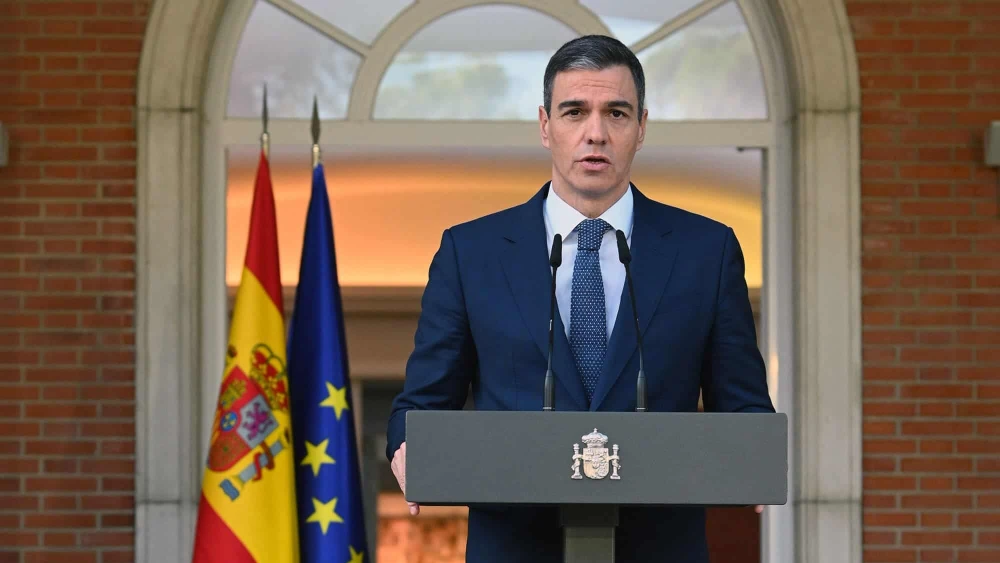

Spanish Prime Minister Pedro Sánchez is not Spain. Israeli Prime Minister Benjamin Netanyahu is not Israel.
This should be obvious. Increasingly, however, the distinction is disappearing from the language of Israel’s relations with Europe.
That matters because disagreements between governments are becoming confrontations between countries, criticism of policies is interpreted as hostility toward states and political leaders are made to stand for entire societies.
Sánchez provided a striking example in recent days. He accused networks linked to Russia and Israel of spreading and amplifying disinformation about the migration crisis in Ceuta—where more than 70,000 people crossed from Morocco in late July—citing research by the European External Action Service, the European Union’s foreign service.
The allegation is serious. If the Spanish government or the European External Action Service possesses evidence that Israeli-linked networks participated in an operation intended to destabilize Spain, it should make that evidence public. Israel is entitled to demand it.
But there is a broader problem: A claim concerning networks linked to particular actors can easily become a claim about Israel.
Countries are powerful political categories. Governments are temporary. Policies are complicated. Saying that another government opposes a particular policy invites an argument about that policy. Saying that another country is acting against yours creates something much larger: a national confrontation.
The Israeli government recently used the same rhetorical mechanism, although in very different circumstances.
The British government just enacted a ban on settlement products in response to settler violence in Judea and Samaria and Israel’s E1 settlement project. Regarding the latter, the government openly opposes a declared policy of the Israeli government, which it believes threatens the possibility of a two-state solution.
Israel can challenge the legal, political, and strategic case for British measures and respond to them. But the dispute concerns a specific Israeli government policy.
Israeli Foreign Minister Gideon Sa’ar described it differently. “If Britain acts against the State of Israel, the State of Israel will act against Britain,” he told Ynet, warning that Israel possesses unspecified “tools” with which to respond.
The cases are somewhat different. Sánchez has made a factual allegation about covert activity and therefore must produce evidence of it. The British government is making a political judgment about an acknowledged Israeli policy, whose merits and consequences can be contested without first establishing that the policy exists.
This is not an argument for false equivalence. Governments should be judged on what they say and do. Some accusations are more serious than others. Precision means preserving those differences, not erasing them in the name of balance.
What connects the episodes is the expansion of the identity of the actors: Governments become countries. Policies become national positions. Limited disputes become confrontations between states.
Whether this is deliberate or instinctive matters less than what the language does. It can mobilize solidarity, simplify complicated arguments and make retaliation easier to justify.
“Britain is acting against Israel” carries a force that “the British government is considering measures against one policy of the Israeli government” does not. What works politically in the short term can damage national interests in the long term.
The relationship between Israel and Europe is much bigger than their governments.
Israelis rightly object when European leaders speak as though Netanyahu represents every Israeli or the policies of his coalition reveal something fundamental about Israeli society. Millions of Israelis disagree with their government on settlements, the war in Gaza, the judiciary and almost every other contested issue.
The same distinction should be made regarding European societies.
Sánchez is not Spain. The British government is not British society. Even the institutions of the European Union cannot encompass the political diversity of more than 450 million Europeans.
Israel cannot demand that European leaders distinguish between Israel and its government while treating every hostile statement by a European leader as evidence that “Europe” has turned against Israel.
European governments and leaders have an equivalent responsibility. Opposition to Netanyahu cannot become opposition to Israel. Criticism of Israeli policies cannot become collective suspicion of Israelis, and certainly not of European Jews.
The relationship between Israel and Europe is also much bigger than the governments currently arguing over it.
The European Union remains Israel’s largest trading partner. Israeli and European scientists conduct research together. Companies invest across the Mediterranean. Israelis travel, study and live in Europe. Many Israelis hold European citizenship or are eligible for it. Jewish communities connect the two spaces through families, institutions, history and identity.
These relationships should not become collateral damage whenever political relations deteriorate.
This is where the interests of politicians and states can diverge. A leader may benefit from portraying a dispute as a national confrontation. The state that leader temporarily represents has an interest in ensuring that the confrontation remains limited. Israel will still need scientific cooperation, trade and political relationships with Europe after the present coalition is gone. Spain and Britain will still have economic, strategic and societal interests involving Israel after their current governments have left office.
That means insulating as much of the relationship as possible.
Scientific cooperation should not automatically suffer because of a dispute over settlements. Trade should not become a proxy battlefield for every disagreement over Gaza. Cultural and academic relations should not rise and fall with every diplomatic confrontation. European disagreements with an Israeli government should never be transferred onto Israelis or Jewish communities.
The same discipline is required from Israel. A sharply critical government in Madrid does not make Spain an enemy. A confrontation with London does not require a confrontation with British society. A disagreement in Brussels does not mean that Israel has “lost Europe.”
This is not diplomatic politeness. It is strategic insulation.
Governments change. Sánchez will not govern Spain forever. Netanyahu will not govern Israel forever. Foreign ministers will leave office, coalitions will collapse, and elections will produce governments whose policies cannot yet be predicted.
Geography will not change. Israel will remain on Europe’s Mediterranean doorstep. Europe will remain one of Israel’s most important economic and scientific partners. Both will continue confronting many of the same challenges.
The danger is not disagreement. Democracies disagree, sometimes profoundly. The danger begins when a dispute with a government becomes a confrontation with a country, and everything else is dragged into it.
Pedro Sánchez is not Spain. Benjamin Netanyahu is not Israel. Governments are temporary. Countries have to live with what their governments leave behind.