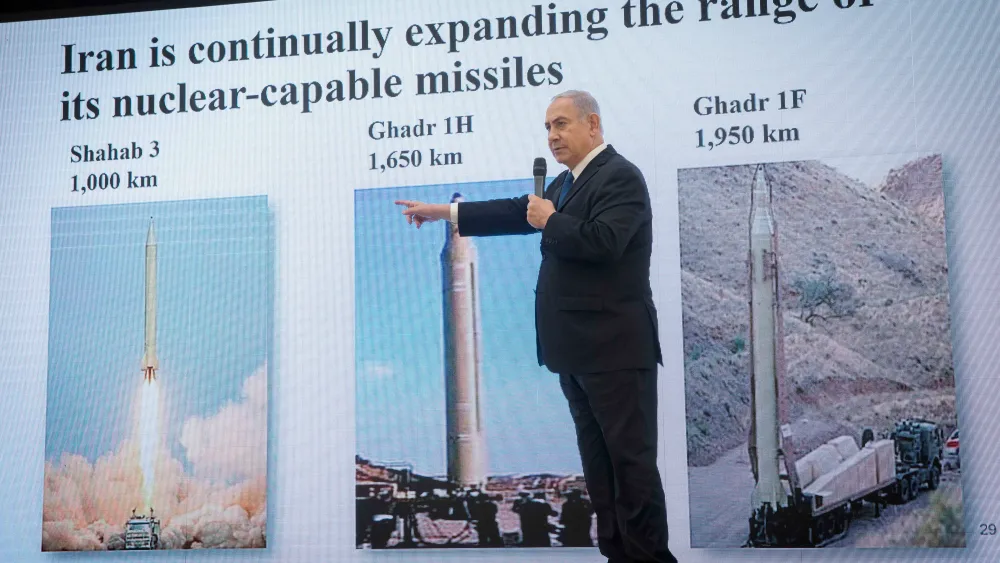
One can argue whether what Israeli Prime Minister Benjamin Netanyahu revealed from the Iranian nuclear archive constitutes a smoking gun and debate its significance as pertains to Iran’s compliance with the 2015 nuclear deal. One cannot, however, dismiss the intelligence agency’s accomplishment.
The Israeli intelligence community has once again proved that it has extraordinary capabilities. Reaching the secret archives, stored in an ordinary building in the heart of Iran so as not to attract the attention of foreign intelligence agencies, entering the facility and transferring the contents of those archives to Israel—these are all abilities that will remain important in future efforts to identify any Iranian attempt to deviate from the framework of the nuclear accord.
What should the Iranians internalize from the successful Israeli operation?
They should understand that they have been penetrated—that Israel has the ability to reach the most sensitive places in Tehran, and that they should think twice before they act. Even if it does not provide evidence of a current Iranian violation of the 2015 deal, this accomplishment by Israeli intelligence serves to delay to a certain extent any future violation by Iran.
The deal commits two grave sins that must be reckoned with: It allows the Iranians to continue to develop ballistic missiles, and more explicitly, it allows them to develop a new generation of centrifuges for the enrichment of uranium.
As a result, when the accord expires, the Iranians will find themselves much better off: possessing long-range missiles and centrifuges that are 10 or even 20 times faster than those they had before the deal. They could then return to the nuclear archive and easily pick up where they left off.
This begs the question: Why did they risk holding on to an archive that could incriminate them and show the world their bold-faced lies?
There may not be a smoking gun, but there is pride in the work of Israel’s intelligence agency and considerations that must not be ignored.