Newsletter
Newsletter Support JNS

Palestinian student movement raises funds to rebuild terrorist’s home

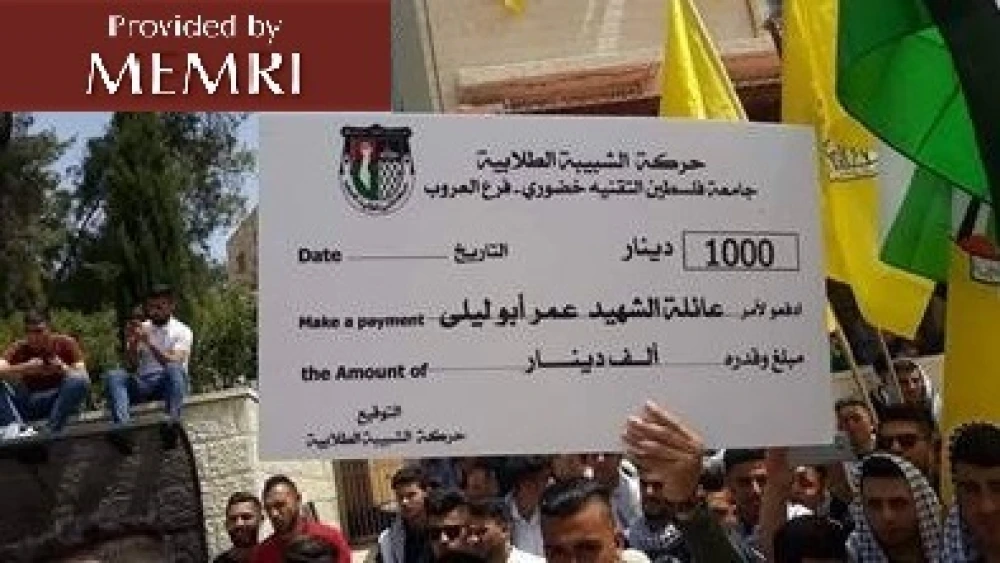
The Fatah-affiliated Shabiba student movement is collecting money for the reconstruction of the home of Omar Abu Laila, who murdered two Israelis in March.

Palestinian students display a check for 1,000 Jordanian dinars. The money was raised toward the rebuilding of the home of terrorist Omar Abu Laila, who murdered two Israelis in March. Credit: MEMRI.

Ahead of student union elections at Palestinian universities, Fatah’s Shabiba student movement at the Hebron branch of the Palestine Technical University-Kadoorie announced on Sunday that it had raised 1,000 Jordanian dinars (about $1,400) for the rebuilding of the home of Omar Abu Laila, a terrorist who killed two Israelis in March.

The home was demolished by Israel on April 24.

Shabiba declared that its aim in rebuilding the home was to set an example for all Palestinian young people and encourage them to support the families of the “martyrs.”

“I’ve read and seen a lot of what others have had to say in response, and I understand the hurt I caused and am truly sorry,” Rama Duwaji told an online arts magazine.
The legislation would empower the New York City Police Department to set limits on how close demonstrators can gather near schools, as critics warn of free speech infringement.
The move aims to boost long-haul capacity as other airlines scale back routes to and from Israel.
“School districts, like colleges and universities, must take prompt and effective action to address antisemitic harassment,” stated Harmeet Dhillon, assistant U.S. attorney general for civil rights.
Just one Democratic congressman voted against the measure to require U.S. forces to be withdrawn from the conflict with Iran.
“This tool makes it easier to confront and understand family histories connected to the Nazi era,” Die Zeit stated in its introduction of the database.