


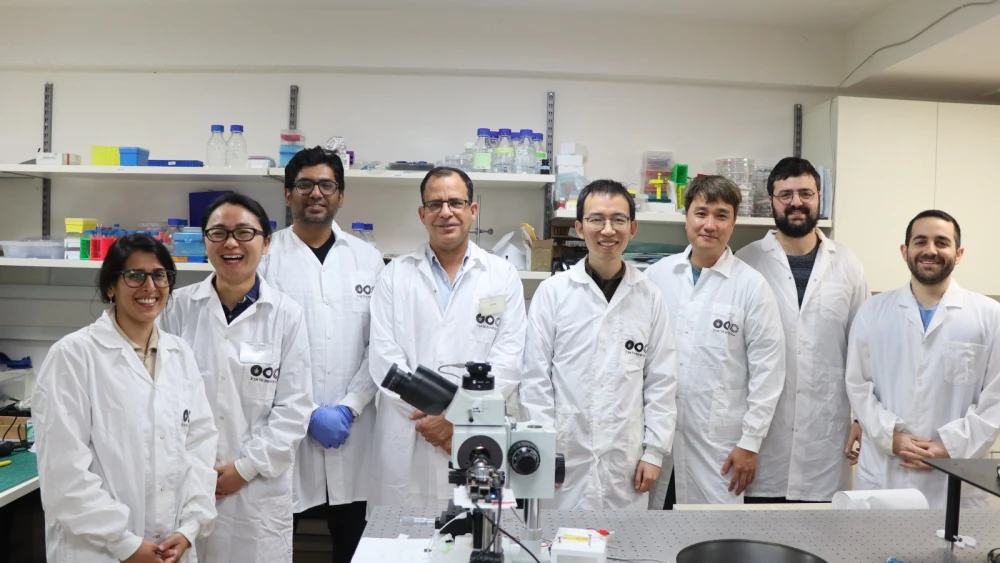
Researchers at Tel Aviv University have developed a “hybrid micro-robot” the size of a biological cell that is capable of capturing damaged cells, the institution announced on Sunday.
The tiny robot (10 microns, or 0.000393701 of an inch, across) can navigate between cells in a biological sample, carrying a targeted cell for study such as genetic analysis, the university said.
It can be controlled using two types of mechanisms: electric and magnetic.
The technology was developed by Professor Gilad Yossifon from the School of Mechanical Engineering and the Department of Biomedical Engineering and his research team.
“Developing the micro-robot’s ability to move autonomously was inspired by biological micro-swimmers such as bacteria and sperm cells. This is an innovative area of research that is developing rapidly, with a wide variety of uses in fields such as medicine and the environment, as well as a research tool,” said Yossifon.
Collaborators on the research included TAU post-doctoral researcher Yue Wu and student Sivan Yakov, along with Afu Fu, a post-doctoral researcher at the Technion-Israel Institute of Technology in Haifa.
The research was published in the journal Advanced Science.
“Among other things, the technology will support the following areas: medical diagnosis at the single cell level, introducing drugs or genes into cells, genetic editing, carrying drugs to their destination inside the body, cleaning the environment from polluting particles, drug development, and creating a ‘laboratory on a particle'—a microscopic laboratory designed to carry out diagnostics in places accessible only to micro-particles,” said Yossifon.


