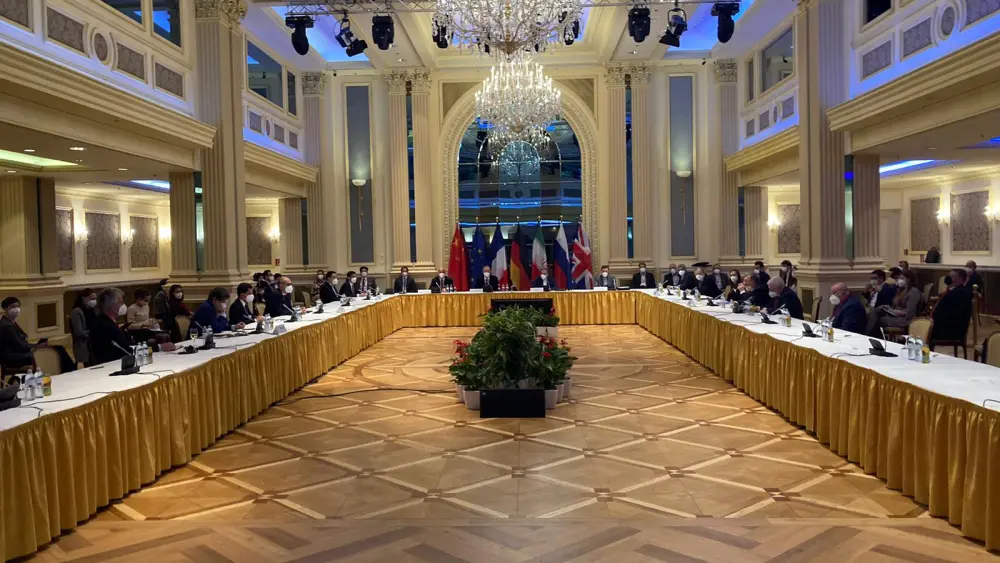
As the fifth round of talks on reviving the 2015 Joint Comprehensive Plan of Action nuclear agreement drew to a close in Vienna on Wednesday, the European Union’s chief negotiator said that the next round, set to begin next week, would likely be the last.
“I am sure that the next round will be the one in which we will finally get a deal,” said Enrique Mora, chief coordinator of the talks, according to Reuters.
However, senior diplomats from Britain, France and Germany—all countries that are signatories of the JCPOA—sounded a more cautious note.
“We have continued to make progress and important parts of a future deal have now been fleshed out, but the most difficult decisions lie ahead. We have, of course, worked based on the principle of nothing is agreed to [until] all is agreed,” Reuters quoted the diplomats as saying.
Iranian Deputy Foreign Minister Abbas Araqchi told reporters after Wednesday’s meeting of the JCPOA Joint Commission that while the next round could well be the last, “nothing is predictable in diplomatic negotiations,” according to Iran’s Tasnim News Agency.
After 10 days of “intensive talks” in Vienna, the parties had concluded that there was a need to return to their respective capitals for further consultations, he said.
“Many hoped that this would be the last round of negotiations. As I had said before, I guessed that we are still distant from the point for the conclusion of an agreement, but we are not very far from it,” he added, according to Tasnim.
Diplomats told Reuters that the talks are expected to resume on June 10, emphasizing that the date had not been finalized.
Iran is scheduled to hold a presidential election on June 18; some delegates said that it was unlikely that a deal would be concluded before then.
Speaking at a Cabinet session on Wednesday, Iranian President Hassan Rouhani described the upcoming election as a “major achievement” of the Islamic Revolution, according to Tasnim.
Rouhani said that “the negotiations in Vienna are going on well,” and that “the main problems with the U.S. have been settled,” though did not elaborate.