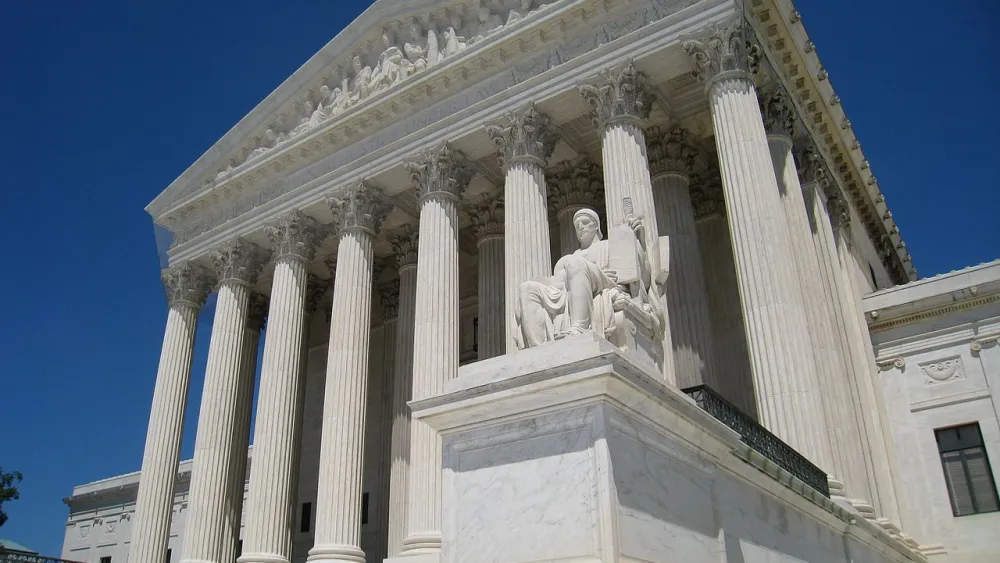
The U.S. Supreme Court agreed last week to hear a case that could have ramifications for the American Jewish community.
The highest court in the land agreed to hear arguments in Maryland-National Capital Park and Planning Commission v. American Humanist Association, regarding whether a 93-year-old cross-shaped memorial dedicated to local American troops who perished in World War I “located on a Maryland highway median violates the Constitution’s required separation of church and state, a case that could impact hundreds of similar monuments nationwide,” according to the Associated Press.
In October 2017, the Fourth Circuit Court of Appeals ruled that the monument is unconstitutional because it “excessively entangles” church and state.
The Jewish Coalition for Religious Liberty filed a brief in July in support of the plaintiffs, who argue that the memorial’s symbolism conveys a non-religious message of remembrance.
The amicus curiae includes a group of lawyers, rabbis and other Jewish-observant professionals who believe in religious liberty. The brief asks the Supreme Court to “repudiate both ‘offended observer’ standing and the ‘reasonable observer’ test for passive religious displays” in accordance with Freedom of Religion under the Bill of Rights.
The brief argues that the appeals court decision is a “misuse” of Lemon v. Kurtzmanover “passive displays.”
The Supreme Court ruled in the 1971 case that for a statute to be considered constitutional in accordance with the First Amendment’s Establishment Clause, the law must consist of a genuine secular function, not have the main effect of advancing or hindering religion, and it cannot enable “excessive entanglement” of church and state.
JCRL asked the court to overturn Lemon. Were that to happen, it could affect numerous issues relevant to the Jewish community.