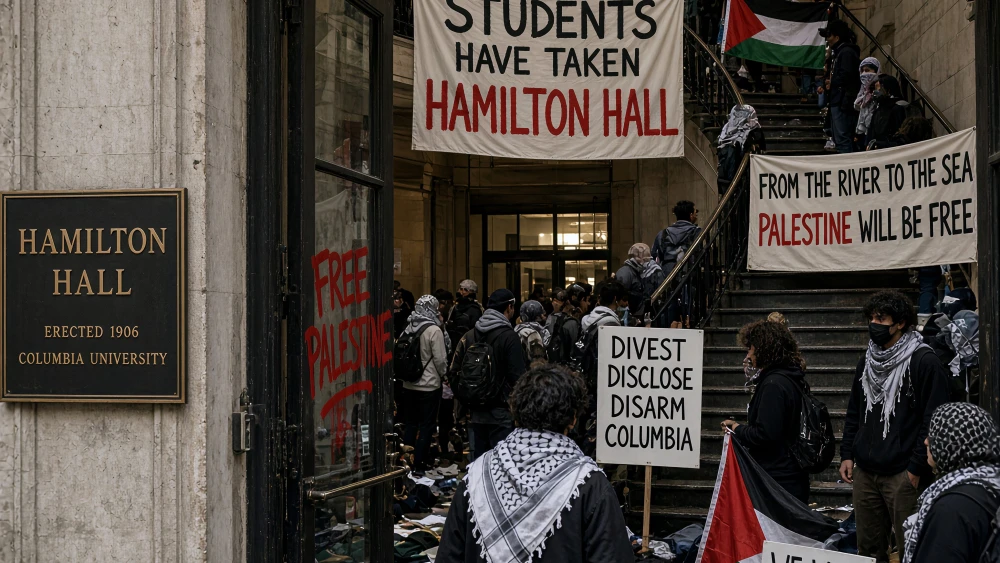
The Center for Jewish Legal Studies (CJLS) has filed an amicus brief in Torres v. Carlson, No. 26-1773, urging the U.S. Court of Appeals for the Second Circuit to reverse the dismissal of claims brought by two Columbia University janitors. The janitors allege they were barricaded, beaten and held captive by masked occupiers of Hamilton Hall in April 2024.
The plaintiffs, Mariano Torres and Lester Wilson, who are not Jewish, allege that the occupiers repeatedly called Torres a “Jew-lover” and told Wilson, “You work for the Jews” and “You’re a Zionist.” The district court dismissed the case, describing the occupiers’ calls for “Intifada” as “pure political speech” and discounting their use of “Zionist.”
The CJLS brief argues that the district court improperly resolved a disputed question of fact against the plaintiffs at the pleading stage. As the brief explains, speech can address political subjects and still demonstrate discriminatory intent and a speaker’s intent depends on context and history. The brief draws on historical examples, from Soviet and Polish “anti-Zionist” campaigns to the violence associated with the word “Intifada.” It explains why a factfinder could conclude that the occupiers used “Zionist” as a substitute for “Jew” and targeted the janitors because they were perceived as supporters of Jews. The brief also argues that the district court improperly ignored months of alleged conduct leading up to the takeover.
The brief emphasizes the importance of crediting the plaintiffs’ plausible account and allowing the case to proceed. “Courts cannot decide what words mean by looking at them in a vacuum,” said Rona Kaufman, cofounder of CJLS and author of the brief. “According to the complaint, people who knew nothing about these janitors’ politics called them ‘Zionists’ and ‘Jew-lovers’ in the same breath. History shows how this vocabulary has long been used against Jews and those who stand with them. What these words and this conduct meant, in context, is a question of fact for a factfinder, not one a court can resolve against the plaintiffs on a motion to dismiss.”
“Federal civil rights law was designed to protect people targeted for their association with a despised group and that includes those who are perceived as supporters of Jews,” said Andrea J. Martin, cofounder of CJLS. “Our mission is to give courts the historical and legal frameworks they need to recognize antisemitism in its contemporary forms, including when it is expressed in political language.”
CJLS previously addressed the history and meaning of anti-Zionism in an amicus brief filed July 22, supporting the petition for certiorari in StandWithUs v. MIT. The district court in Torres relied principally on the First Circuit’s decision in that case.