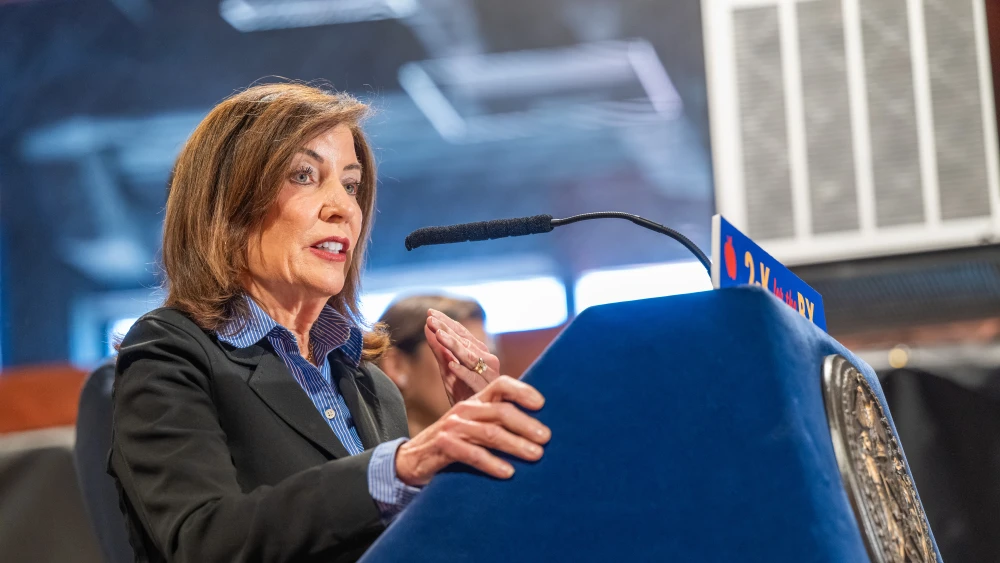
New York Gov. Kathy Hochul visited Bnos Malka Academy, an Orthodox Jewish girls’ school in Forest Hills, Queens, N.Y., on Oct. 15 to discuss school security, education funding and resources for nonpublic schools.
Bnos Malka Academy educates girls from pre-kindergarten through eighth grade, combining general studies with a Jewish education rooted in Orthodox traditions. The school emphasizes academic growth alongside religious values, preparing students to develop their knowledge while strengthening their Jewish identities.
Sam Berger, an Orthodox Jewish member of the New York State Assembly who attended the visit with fellow Assembly member Nily Rozic, said that the discussion covered security grants for nonpublic schools, access to science, technology, engineering and mathematics funding, and the needs of yeshivahs across Queens.
“I’m especially grateful that Gov. Hochul is opting into the federal scholarship tax credit program, which will help countless families shoulder the financial burden of education,” he said.
Hochul said participating in the federal program could generate additional scholarship funding for students at public and private schools. Beginning in 2027, eligible taxpayers will be able to claim a federal tax credit of up to $1,700 ($3,400 for couples filing jointly) for contributions to qualifying scholarship-granting organizations. The scholarships can help cover eligible educational expenses, including tuition and tutoring.
During her visit, the governor met with Bnos Malka principal Rabbi Michael Weichselbaum and with Rabbi Yeruchim Silber, director of N.Y. government relations at Agudath Israel America. She also met with Sydney Altfield, CEO of Teach Coalition, an Orthodox Union program.
Altfield said that Hochul saw firsthand how students benefited from New York’s free school meals program.
“Jewish education is thriving, demand is growing, and families are making enormous sacrifices to give their children that education,” Altfield said. “What stood out was the governor’s genuine interest in hearing directly from educators about the challenges they face and what more can be done.”