Newsletter
Newsletter Support JNS

Israel’s UN resolution on sustainable agricultural technology passes with landslide majority

According to the Permanent Mission of Israel to the United Nations, the resolution aims to provide developing countries, as well as countries facing famine and drought, with access to advanced sustainable agricultural technologies.

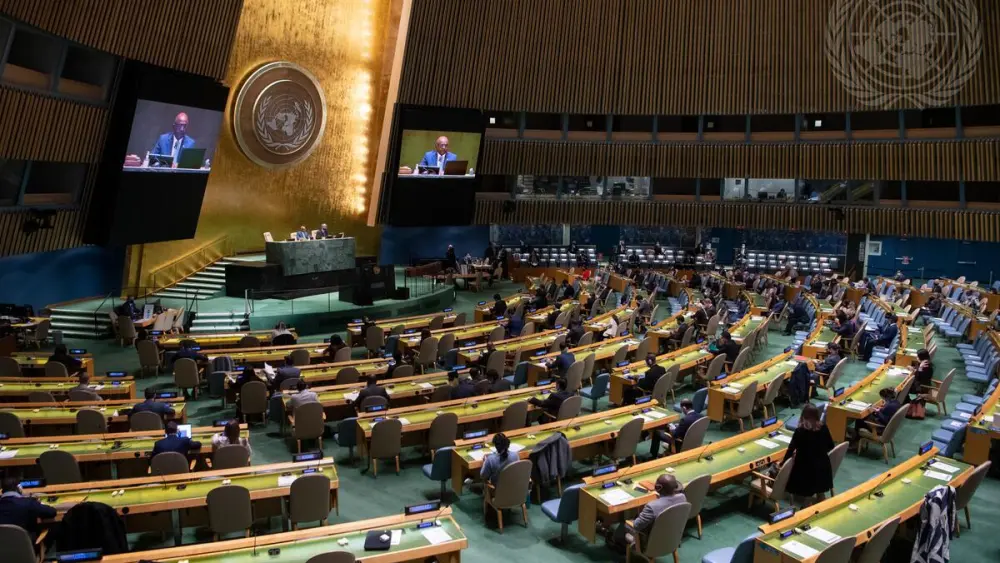
A wide view of the 30th plenary meeting of the U.N. General Assembly. Credit: U.N. Photo/Eskinder Debebe.

A United Nations resolution proposed by Israel on promoting agriculture technology for sustainable development passed on Tuesday 140-1.

According to the Permanent Mission of Israel to the United Nations, the resolution aims to provide developing countries, as well as countries facing famine and drought, with access to advanced sustainable agricultural technologies, a field in which Israel has made groundbreaking advancements. A record-breaking number of over 130 countries joined the resolution as co-sponsors.

Syria was the sole country that voted against the resolution, while Iran abstained. Israel’s Ambassador to the U.N. Gilad Erdan accused the two countries of anti-Semitism for opposing the resolution, and said they are choosing “hate and petty politics over the betterment of humankind.”

“Voting against a resolution, simply because it was proposed by Israel, was more important for them than voting for a brighter future for their citizens,” Erdan said in a speech to the Economic and Financial Committee. “But honestly, this is not surprising. Why would Syria, a Member State who uses chemical weapons on its people, care for the future of its population? Why would Iran vote in favor while it prefers to sponsor global terror over providing the farmers of Isfahan with water for their crops?”

The resolution will be voted on for a second time in the U.N. General Assembly in December.

The terrorists were conducting military drills and posed “a threat to IDF soldiers and to the State of Israel,” according to the Israeli military.
The route links Russian and Iranian ports and allows the countries to swap weapons, drones, ammunition, oil and foodstuffs.
Israel’s foreign minister and his Greek counterpart discussed the war, regional tensions and Israel’s military successes against Iran on Greek Independence Day.
Israeli Defense Minister Israel Katz and IDF Chief of Staff Lt. Gen. Eyal Zamir authorized new “quality strategic targets” in Iran and Lebanon.
“We don’t have time to waste,” said Minister Amichai Chikli of the threat of radical Islam in Europe,” as the Israeli government partners with right-wing parties with objectionable pasts.
A 14-year-old Israeli boy allegedly carried out paid tasks for suspected Iranian operatives, filming sensitive sites and spraying pro-regime graffiti.